Ian Hogg and Byron Adams peered out the windows of their helicopter as it glided over the rocky slopes of the Transantarctic Mountains, dry peaks that rise above vast ice sheets just 600 kilometers from the South Pole. Their eyes flitted across the ledges and cliffs below. It was a sunny day in January 2018, and they were searching for landmarks that matched those described in some brief notes left by a deceased entomologist who, back in 1964, had discovered an enigmatic creature in this desolate landscape. No one had seen it since.
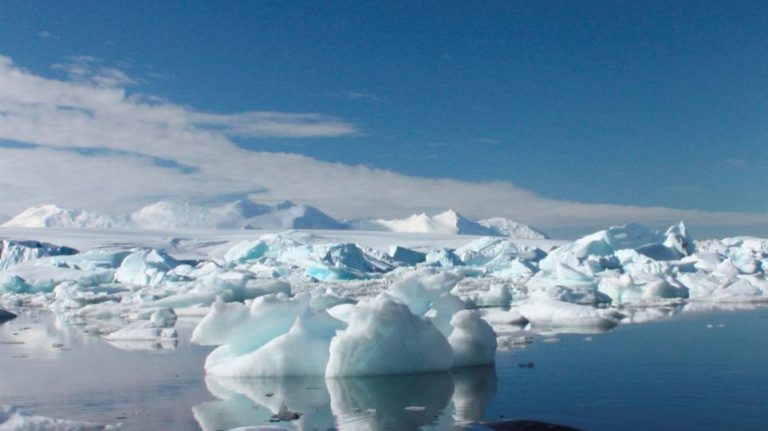
The Transantarctic Mountains stretch more than 3,000 kilometers across the continent, from the shoreline in the north toward the interior in the south, splitting the continent in two. The mountain chain, 100 to 200 kilometers wide, acts as a dam, holding back the vast East Antarctic ice sheet, a dome that rises 3,000 meters above sea level. Glaciers fed by that ice sheet ooze through gaps between the mountain peaks and slowly empty into lower-lying West Antarctica. Dry winds screaming off the eastern plateau keep the peaks themselves largely free of ice.
In winter, temperatures in the southern Transantarctics plunge below −40 degrees Celsius. Some of the hard, thin soils on these peaks haven’t tasted appreciable amounts of water for tens to hundreds of thousands of years, allowing them to accumulate caustic salts, much like the surface of Mars. Yet despite the harsh environment, a handful of tiny animals call these mountains home. Hogg and Adams had been collecting samples since 2006, trying to learn which species live where. The species that had been discovered in 1964, however—an insectlike animal called Tullbergia mediantarctica—had so far eluded them.
The location they were scanning, Mount Speed, was a low ridge in the southern Transantarctics, 700 kilometers inland from the sea. Here Shackleton Glacier pours from east to west through a gap in the mountains roughly 10 kilometers wide. Hogg, a biologist at Polar Knowledge Canada, spotted a cliff resembling one described in the entomologist’s notes. The pilot landed above it, and the passengers stepped out onto a barren rock slope strewn with chunks of yellowish granite. They began to methodically peek under one rock at a time. Within minutes they found their pale beasts—dozens of white, six-legged animals smaller than sesame seeds.
Atlético Madrid, Inter and Milan withdraw from European Super League
Skopjian media meltdown as ex-FM says “we are actually Bulgarians, not Macedonians”
The critters stepped slowly and purposefully among the sand grains, navigating with antennae that were soft and fleshy, like two outstretched fingers. The animals are extremely susceptible to dehydration, however, and within a minute of being exposed they began to shrivel and die in the dry air. Over the next few days Hogg and Adams found Tullbergia under rocks on four different slopes along the lower end of Shackleton Glacier. Sometimes the oasis they inhabited was smaller than a basketball court.
Tullbergia is one species in a larger group of springtails—primitive, wingless relatives of insects. Few people have heard of springtails, although the soil in your backyard probably harbors millions of them. These minuscule animals are found around the world—and a few species inhabit the sparse patches of ice-free ground that dot Antarctica’s interior, where there is little to eat but the occasional bacterium or microscopic fungus.
How Tullbergia and other springtails got to these remote mountains, and how they survived dozens of ice ages, is a mystery that scientists are eager to solve. Since the 2018 expedition Hogg and Adams, a biologist at Brigham Young University, have been performing genetic studies on the rediscovered Tullbergia, as well as on another species of springtail they found on the same expedition. The studies, which they discussed with me and which will be published later this year, will shed new and surprising light on the history of these species, which in turn may rewrite the story of how massive ice sheets waxed and waned across the continent as ice ages came and went across millions of years. Species such as Tullbergia are also stretching our ideas about the limits of biology, reinforcing the notion that even the cruelest environments on Earth can often sustain complex animal life.
Read more: Scientific American
Ask me anything
Explore related questions