“Overall, how satisfied are you with your life these days?” people across the European Union (EU) were asked. On a scale from 0 (“not satisfied at all”) to 10 (“fully satisfied”), nearly 80% of residents aged 16 and over in the EU rated their overall life satisfaction in 2013 at 6 and higher, with an average (mean) satisfaction of 7.1.
The survey found that life satisfaction is a multi-dimensional concept, which is very much shaped by various socio-demographic factors which lead to different living situations as well as to different expectations and preferences. While women and men are almost equally satisfied, health condition appears to be one main determining factor in life satisfaction, ahead of factors such as financial position, situation on the labour market or social relations. On the occasion of the International Day of Happiness3 on 20 March 2015, Eurostat, the statistical office of the European Union, publishes a selection of subjective indicators on well-being of people in Europe.
These data on subjective evaluations and perceptions in different domains have been collected for the first time in a comparable way in European official statistics. Highest life satisfaction was found in the Nordic Member States. In 2013, mean life satisfaction, measured on a scale of 0 to 10, varied significantly between EU Member States. With an overall average of 8.0, inhabitants in Denmark, Finland and Sweden were the most satisfied with their lives in the EU, followed by those in the Netherlands and Austria (both 7.8). At the opposite end of the scale, residents in Bulgaria (4.8) were by far the least satisfied, followed by those in Greece, Cyprus, Hungary and Portugal (all 6.2).
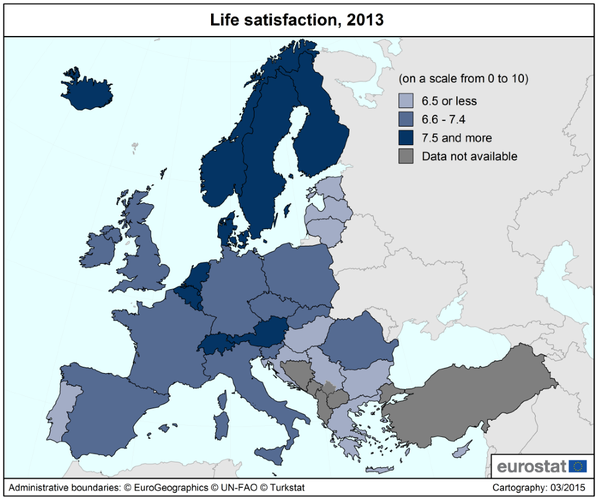
Young people tend to be more satisfied with life
When looking at age groups, life satisfaction in the EU was highest in 2013 among young people (an average of 7.6/10 among the EU population aged 16-24), and lowest for elderly people (an average of 6.8/10 among the EU population aged 75 and over). It should be noted that life satisfaction at EU level tends to decrease with rising age, with the exception of the age group 65-74, which is for most people the period right after retirement.
Income is not the most influential factor for life satisfaction
In 2013, the highest average rating of life satisfaction in the EU was to be found among the population reporting a very good health condition (7.9/10). Factors such as financial situation (an average of 7.5 among the population in the highest income tercile), and social relations (an average of 7.2 among the population having someone to rely on in case of need as well as among people living in households with dependent children) also appeared to be significant in influencing life satisfaction, albeit less so than health.
Men and women are equally satisfied with their lives
Another finding of the data collected by Eurostat on subjective well-being is that there is a very narrow gender gap in life satisfaction. Males (7.1/10) and females (7.0/10) living in the EU reported on average a nearly identical level of life satisfaction in 2013.
Ask me anything
Explore related questions