For decades, beer partisans have argued that fermented rather than baked grain led humans to begin sowing the fields, settling down, and abandoning their hunter-gatherer ways. I have found none of their arguments persuasive; there just wasn’t a smoking gun to support it one way or another. Food is a more basic need, and in the absence of evidence, bread seemed the more likely spark to a change as revolutionary as domesticating crops.
The debate is an old one. The archaeologist Robert Braidwood posed it in a now-famous symposium way back in 1953. Other researchers had already begun wondering whether beer might have come first, raising it as a legitimate area of inquiry. Braidwood put it this way:
“The question would thus appear to be: Could the discovery that a mash of fermented grain yielded a palatable and nutritious beverage have acted as a greater stimulant toward the experimental selection and breeding of the cereals than the discovery of flour and bread making?”
In late 2012, however, archaeologists made a rather startling discovery that had until recently escaped my notice–and it appears to tip the balance, with actual evidence, toward beer.
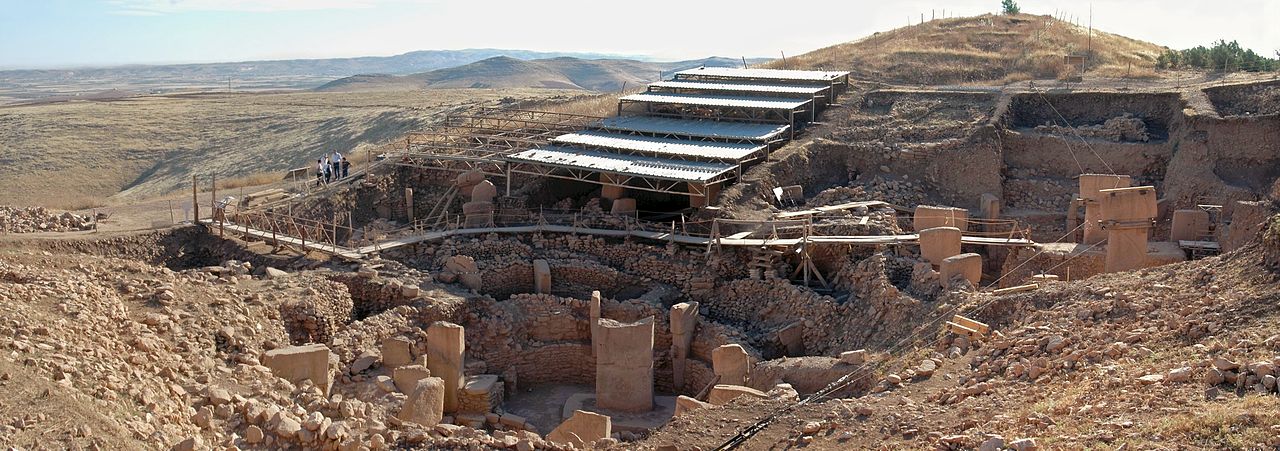
Recently, further chemical analyses were conducted by M. Zarnkow (Technical University of Munich, Weihenstephan) on six large limestone vessels from Göbekli Tepe. These (barrel/trough-shaped) vessels, with capacities of up to 160 litres, were found in-situ in PPNB contexts at the site. Already during excavations it was noted that some vessels carried grey-black adhesions. A first set of analyses made on these substances returned partly positive for calcium oxalate, which develops in the course of the soaking, mashing and fermenting of grain. Although these intriguing results are only preliminary, they provide initial indications for the brewing of beer at Göbekli Tepe.
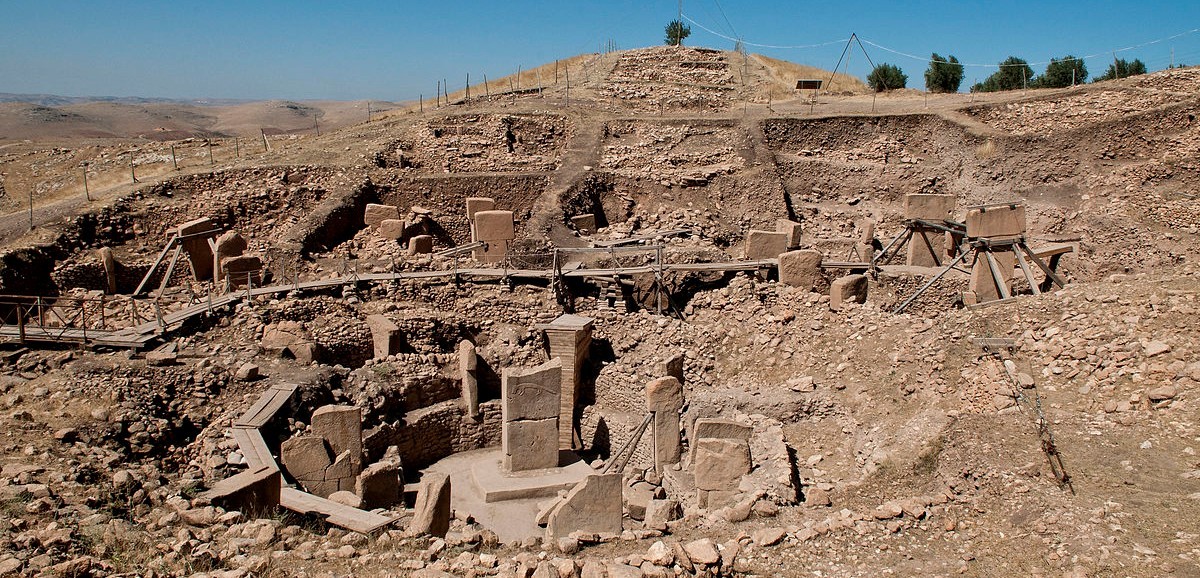
Göbekli Tepe is an archaeological site in Turkey that has challenged foundational ideas about that transition humans took from neolithic hunter-gatherers to becoming “civilized.” (There were a number of very uncivilized things that happened as a result of this transition, but let’s leave that aside for now.) Göbekli Tepe is a site in modern-day Turkey, and consists of a number of buildings. Generally when archaeologists unearth sites of human construction, they’re looking at the period of civilization; buildings equal settlements, so we thought. But Göbekli Tepe’s buildings are of a particular type. Marked by T-shaped pillars, up to 20 feet high, weighing 16 tons, archaeologists believe them to be worship sites, not dwellings. More ntriguingly, there are no permanent settlements nearby. These structures were erected 12,000 years ago, but not as a part of early human civilization, but rather a precursor to it…
This is extraordinary because it calls into question the accepted sequence of events: first there was agriculture, then settling down, and then the surplus allowed complex culture to arise. But:
Göbekli Tepe calls that conventional wisdom into question. Klaus Schmidt, a German archaeologist who led excavations at the site, argued before he died in 2014 that it might have worked the other way around: The vast labor force needed to build the enclosures pushed people to develop agriculture as a way of providing predictable food—and perhaps drink—for workers.
The site was not where people came to live, but to worship, feast, and drink.
It’s as though Göbekli Tepe were a cathedral and the others local churches; hunter-gatherers might have traveled long distances to meet, worship and help build new monumental structures, sponsoring feasts to display their wealth. “The feasting aspect is the easiest explanation for attracting a labor force to construct the enclosures,” [German archaeologist Jens] Notroff says.
That neolithic hunter-gatherers might devote their time to this enormous endeavor is fascinating on its own; that they would do so for ritual purposes rather than survival make it more so. The recent discovery that they may already have been making beer adds a further element of amazement, but it actually fits in perfectly with the context of the ritual and feasting activities. And here is where we find the first instance of a reason humans might have been drawn to beer-making before breadmaking. The argument goes like this:
Those feasts — and alcohol-induced friendliness — may have enabled hunter-gatherers to bond with larger groups of people in newly emerging villages, fueling the rise of civilization. At work parties, beer may have motivated people to put a little elbow grease into bigger-scale projects such as building ancient monuments.
“Production and consumption of alcoholic beverages is an important factor in feasts facilitating the cohesion of social groups, and in the case of Göbekli Tepe, in organizing collective work,” wrote Antiquity paper co-author Oliver Dietrich in an email. Dietrich is an archaeologist for the German Archaeological Institute.
I find this eminently plausible. It’s true that food is a more basic need, but that also argues against it as an organizing principle around which humans would do something as arduous as developing agriculture. Privation and want are anathema to the kind of social cohesion, leisure, and surplus energy needed to conduct giant public works projects. If we look later in the historical record, we see that the most energy was always put in service of these religious, transcendental statements (the Pyramids, cathedrals, etc). There are even other examples of neolithic structures–Stonehenge is a prime case. When humans have surplus, they invest it in more abstract desires than merely living another day.
Alcohol serves both ritual and social functions, and has a magical, transcendent (mind-altering) capacity. Unlike food, which appears naturally in the environment, alcohol must be manufactured. Humans didn’t need to settle down to produce food. If the the structures of Göbekli Tepe tell us anything, it’s that they had enough surplus time and energy that they could use it to build cathedrals. The motivation to produce beer–a substance they could not reliably produce without agriculture–would be a pretty obvious one for neolithic people looking to spend more time praying, celebrating, and feasting.
We still have no smoking gun, but now I’m persuaded there is smoke. For 64 years, Robert Braidwood’s question has had no answer–just the debate of partisans. Göbekli Tepe is challenging old theories, and it may finally give us something more than speculation about whether beer or bread came first.
Ask me anything
Explore related questions