Travel author Janeen Christoff presents the 7 most impressive points of interest in the world which were discovered by mistake
“The truth always has a way of bubbling up to the surface, and some of the world’s most treasured discoveries would never have been made were it not for a series of happy accidents”, she writes at Travel Pulse.
Lascaux Caves in France
These famous caves in southwestern France near Montignac were discovered in 1940 by four French teenage boys. One of the boys found the entrance to the series of complex caves and brought his three friends back with him to explore. The drawings on the walls of the cave are estimated to be 17,300 years old and are some of the best representations of Upper Paleolithic art and mostly depict large animals.
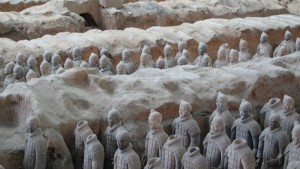
The Terra Cotta Army in Xian, China
In Xian, China, one of the must-see museums is The Museum of Qin Terra Cotta Warriors and Horses, where visitors can see a replica of emperor Qin Shi Huang’s army in terra cotta form — funerary art that was buried with the emperor. The army was discovered by mistake in 1974, when the farmers were digging a water well.
Derinkuyu in Cappadocia, Turkey
The Derinkuyu underground city in Cappadocia, Turkey, is said to have sheltered as many as 20,000 people with food and livestock at one time. It was built in the Byzantine era and was used as protection for many years. It was rediscovered in 1963 when a resident in the area accidentally came across a mysterious room behind a wall in his home.
Dead Sea Scrolls, Qumran Cave, Israel
Bedouin shepherds came across seven scrolls in a remote cave near the Dead Sea on the West Bank of the Jordan River. An American scholar who saw them determined that these were the Dead Sea Scrolls, the oldest copies of the Hebrew Bible ever found.
Today, visitors can tour the excavation site in Qumran and the Qumran caves and see see pottery, banquet halls, ancient cups, bowls and plates and get a glimpse into the lives of the Dead Sea Sect that inhabited the area.
Rosetta Stone
Soldiers came across this slab of rock that holds the key to ancient civilization while strengthening a fort in Egypt a few miles northeast of Rosetta.
Machu Picchu
It is now one of the world’s most popular tourist attractions, but the Western world wasn’t even aware of its existence until 1911 when a Yale University expedition led by historian Hiram Bingham came across the mysterious city while exploring Peru’s Sacred Valley.
Click here to read the full article.
Ask me anything
Explore related questions