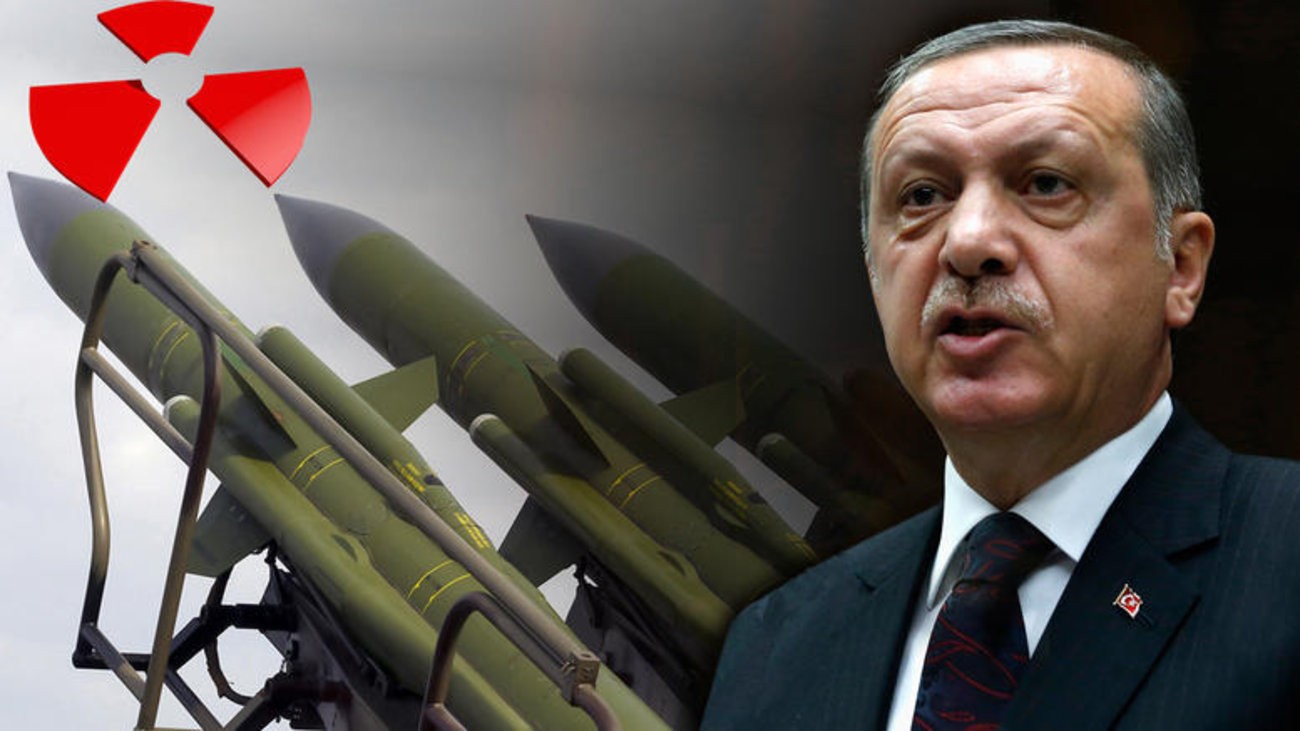
The rising tide of an aggressive blend of nationalism and Islamism might be prompting Ankara to pursue its own WMDs, and its preference appears to be long-range missiles. As Turkey feels more threatened by real or (mostly) imagined enemies, it increasingly views maximum possible military deterrence as essential to both survival (a defensive goal) and assertiveness (an offensive one). Precise long-range missiles are an unlikely acquisition, and nuclear warheads even more so. What matters is not whether Turkey can build up a dangerous arsenal but why it wants one.
In theory, Shiite Iran and Sunni Turkey (both Ottoman and modern) have been at peace for nearly 400 years, with their shared border unchanged since the signing of the Treaty of Zuhab in 1639. In reality, they have remained regional rivals, cold war adversaries, open enemies, and security and ideological threats to one other ever since. These days, they are not-so-discreet sectarian foes.
According to Kemal Okem, a prominent diplomat and Turkey’s first ambassador to Tel Aviv after Turkey and Israel “normalized” relations in 2016, Turkey shares Israeli concerns about Tehran’s regional ambitions and nuclear potential. “Iran’s nuclear file is a concern for everyone,” said Okem, formerly a chief advisor to Prime Minister Ahmet Davutoglu. “They [Iranians] see us as a strategic competitor … We saw the need for engaging and containing their ambitions.”
Concern about Tehran’s “nuclear file” is an open secret in Ankara. Officially, Turkey maintains that a nuclear Israel, not Iran, is a threat to the Middle East because of its undeclared arsenal. This position is backed up by occasional private threats by Ankara to work against Jerusalem at the International Atomic Energy Agency (IAEA).
In fact, Turkey feels threatened by both Israel’s and Iran’s nuclear capabilities, be they existing or emerging. The Turkish ambition to possess advanced offensive military capabilities reflects two desires: first, to become a regional power; and second, to erect a deterrent force against a rapidly changing, re-prioritized, and long list of enemies.
In line with that ambition, in late 2011, the state scientific research institute, TUBITAK, announced that its scientists would soon finish a missile of unknown flavor with a range of 1,500 km (932 miles) and in 2014 another with a range of 2,500 km (1,553 miles). A further missile with an 800-km range was ready for precision tests, according to the official narrative. The order for the missile program had come from then Prime Minister Recep Tayyip Erdoğan.
This missile program was curious, not only in terms of military technology but also in terms of the political deliberations that might have pushed Turkey into such a venture. Tehran is not the only potentially hostile capital Ankara could target within a 2,500-km range. The map shows many other possibilities: Algiers, Amman, Amsterdam, Athens, Barcelona, Beirut, Berlin, Brussels, Cairo, Copenhagen, Damascus, Geneva, Jeddah, Kiev, London, Milan, Moscow, Paris, Rome, Stockholm, Jerusalem, Tripoli, Vienna, Warsaw, and Zurich. But Ankara’s deliberations regarding the missile program apparently matured when the Turkish-Persian rivalry heated up in 2011, with Tehran claiming to possess Shahab-3 missiles with a range of 1,300 km.
In 2013, Turkey’s defense officials said that TUBITAK’s 800-km missiles, primarily targeting naval and aircraft shelter targets, had been successfully tested. They were fired from aerial platforms and hit targets over the Black Sea. The 1,500-km missile was to be launched in 2014, and the 2,500-km missile at an unspecified subsequent date. Since then there has not been a credible follow-up statement.
The announcement of these plans does not appear to have been a wise move. Forget the enormous problem of access to the ingredients needed to build up long-range missile capabilities (in the missile trade, participants face strict international proliferation controls – and Turkey is a signatory to the Missile Technology Control Regime). Turkey, with its unrealistic neo-Ottoman ambitions, wants to revive the mighty Ottoman army, this time with sophisticated gear to supplement its manpower. But are missiles the best choice of firepower?
Ballistic missiles are often imprecise, can be intercepted, and can carry only limited payloads (on average 500-1,000 kilograms). In comparison, a conventional F-16 fighter jet can carry a payload four or five times bigger and is an agile war asset. Rogue states often opt for missiles, calculating that these war toys can carry biological, chemical, and nuclear warheads. So why would Turkey, a NATO member state with a modern air force, go after a military capability that would better suit a rogue state with potentially sinister ambitions?
With which countries within a range of 2,500 km does Turkey think it might eventually have to battle? Which targets within that range might it hope to hit – targets that it cannot reach with a 1,000-km missile? Are biological, chemical, or nuclear weapons in Ankara’s contingency plans for future warfare?
Apparently, as Turkey feels more isolated and threatened by real or (mostly) imagined enemies both near and far, it feels it needs maximum possible military deterrence in order to survive (a defensive goal) and to be assertive (an offensive one). Erdoğan’s Turkey wants more than just missiles.
As Erdoğan’s silent war on the West has taken new and more aggressive turns of late, a Muslim cleric known to be Erdoğan’s religious mentor said what many Turks are thinking but are reluctant to express plainly: that Turkey needs its own weapons of mass destruction (WMDs). Hayrettin Karaman, a columnist at a fiercely pro-Erdoğan newspaper, wrote on March 16: “We need to consider producing these weapons [WMDs] rather than purchasing [them] without losing any time and with no regard to words [of caution] and hindrance from the West … Let’s invent [these WMDs], balance [the West] out, but let’s not use WMDs unless it is necessary; the way for not resorting [to WMDs] is to possess weapons that are equal to or more powerful than the ones the enemy has.” So: the West is the enemy. And WMDs are the means to fight that enemy.
The Ottoman siege of Vienna might have failed in 1683. But it looks as though the neo-Ottoman Turks are determined to get back to the gates (well, the skies this time) of Europe. Or at least that is their ambition.
Precise long-range missiles are a near impossibility for Turkey, given the technological and political barriers. Nuclear warheads are even more improbable. The problem for Turkey’s western “friends and allies” is not the risk of its achieving missile and nuclear capabilities. It is the Islamist ideology that encourages Ankara’s leaders to overtly or covertly harbor that ambition.
Ask me anything
Explore related questions