





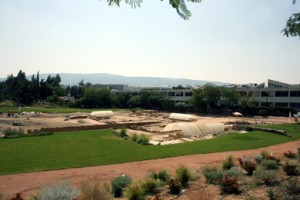
The archaeological site containing the remains of Aristotle’s Lyceum has officially opened its doors to the public today, ready to receive visitors from 8:00 in the morning until 20:00 at night.
This new and significant addition to the city, adds to 1.1 hectares of open land to the capital’s public space, and can be accessed either from the entrance on Rigillis Street or from the Byzantine and Archaeological Museum on Vassilisis Sofias Avenue.
The Lyceum was founded by the famous ancient Greek philosopher Aristotle in 334-5 B.C. when his former pupil Alexander the Great had embarked it on his wars of conquest in Asia. It was one of the three famous ancient schools of Athens, along with Plato’s Academy and the Cynosarges Gymnasium, where he taught his so-called Peripatetic Scholars just outside the city walls, between the rivers of Eridanos and Ilissos.
The area also had two temples, dedicated to Hercules and Apollo Lyceus, the latest, of which gave its name to Aristotle’s school.
The site was first opened to the public a month ago, for a tour forming part of the Greek Cultural Routes events organised by the culture and sports ministry. The remains on the site, covered by protective canopies, include a section of a Roman-era wrestling arena and gymnasium.
Ask me anything
Explore related questions




