





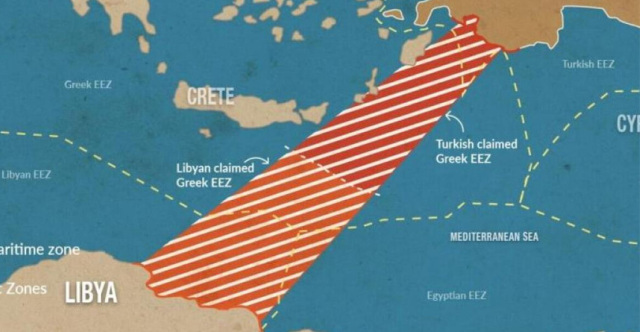
Diplomatic manoeuvring over Libya’s future and efforts to reach a political settlement in the divided country are intensifying, with Turkey and Egypt vying for influence in a reunited Libya and the Turkey–Libya memorandum among the central issues.
The United States, represented by White House envoy for Africa Massad Boulos, is actively involved in keeping the process of unifying Libya’s institutions on track and preventing the country from sliding back into civil conflict, which would turn it into a permanent ‘black hole’ in North Africa and the Arab world.
Despite the weight of the Turkey–Libya memorandum, Greece should be present in this process and seek an active role through both the EU and bilateral channels. Developments in Libya directly affect Greece because of the growing migration challenge and the problems arising from the unresolved delimitation of maritime zones between the two countries, but also because a new form of bilateral co-operation could offer significant opportunities extending beyond soft diplomacy in areas such as civil protection, health and culture, to legal assistance with reunifying institutions and drafting a new constitution, security co-operation, and energy and telecommunications links between North Africa and Europe.
A strong message
After being caught off guard by the ratification of the Turkey–Libya memorandum by the parliament in Benghazi, Athens mobilised diplomatically and secured renewed condemnation from the EU, Egypt, Israel, the United Arab Emirates and Bahrain, sending a strong message that these faits accomplis were unacceptable and that good neighbourly relations with Libya could not be built while it insisted on keeping the memorandum in place. Athens’ response to the ratification also sent a further message that any attempt by Libya to implement the memorandum at Greece’s expense would have serious consequences.
Prime Minister Kyriakos Mitsotakis’s address to the UN Security Council and the joint statement by the six parties, read out at the UN by Foreign Minister George Gerapetritis, have set a framework for the next steps. Yet developments in Libya are moving rapidly, leaving little room for any complacency that may have set in in Athens after its successful response to the ratification of the memorandum and the uneventful resumption of surveys for the Cyprus–Crete electricity interconnector. The memorandum remains in place despite its illegality and the threat of its implementation on the ground persists, with Turkish President Recep Tayyip Erdoğan’s scheduled visit to Libya set to be a critical moment in the coming weeks.
Egypt backed Greece, and Cairo’s condemnation of the memorandum was decisive, as Egypt, in addition to expressing solidarity with Greece, wants to protect its interests in maritime delimitation with Libya and, above all, prevent the country from becoming part of Turkey’s permanent sphere of influence.
Egypt’s diplomatic note to the UN, in which it formally reaffirmed its outright rejection of the Turkey–Libya memorandum, was another step in putting pressure on Libya. The Egyptian note also rejects in their entirety the two other memorandums signed by Tripoli and Ankara that formalise co-operation on hydrocarbon exploration and exploitation in the area Libya claims as its continental shelf under the Turkey–Libya memorandum. Like Greece in its own letters to the UN, Egypt calls on Libya to enter into dialogue to resolve the delimitation dispute. Athens should take note of that invitation.
The need to keep talks going
Despite the strained bilateral relations, Greece and Libya should seek to continue the delimitation talks already under way, in which Deputy Foreign Minister Alexandra Papadopoulou represents Greece. These talks should be linked to similar discussions expected to begin between Cairo and Tripoli, while the commitment made by the Greek foreign minister and his Egyptian counterpart, Badr Abdelatty, to open talks on completing the delimitation of the two countries’ continental shelves and exclusive economic zones should be followed through.
Map of the overlapping exclusive economic zones. The yellow line marks Egypt’s delimitation and the black line marks Libya’s. The resulting triangle shows where Libya’s exclusive economic zone overlaps Egypt’s.
The dispute between Egypt and Libya concerns the course of the lateral boundary at the eastern edge of Libya’s exclusive economic zone, which, taken together with the Turkey–Libya memorandum, overlaps the area Egypt has already unilaterally delimited. The Tripoli government’s commitment to addressing Egypt’s ‘concerns’ on the issue, to the extent that it can be regarded as credible, opens up an opportunity to undermine the Turkey–Libya memorandum indirectly, as abandoning Libya’s unilateral delimitation would also mean retreating from the boundaries the memorandum purports to grant it.
Cairo’s diplomatic note also shuts the door, at least for now, on the offers Turkey has been making, the latest of which came from the Turkish defence ministry and proposed an agreement between Turkey and Egypt to divide the continental shelf in the Eastern Mediterranean, disregarding the Greek islands entirely and encroaching on Greece’s continental shelf.
These moves, however, must be seen in the context of developments in Libya and the competition between Ankara and Cairo to consolidate their influence in the country as reunification moves forward, albeit with difficulty.
Erdoğan is expected to visit Tripoli on 8 and 9 December for the fourth Turkey–Africa summit, which Libya has undertaken to host despite major challenges, particularly over security. The Turkish president is expected to set out Turkey’s increasingly active policy towards Africa and express his support for Libya, seeking to cement Turkish influence in the country by invoking the Turkey–Libya memorandum. A central question is whether Erdoğan will use the occasion to announce steps to put the hydrocarbon exploration memorandums into effect, with the participation of Turkish oil company TPAO, a move that would trigger a new round of tensions in the region.
Turkey recently gave Saddam Haftar, the powerful figure in Benghazi, a high-profile welcome in Ankara. With Turkey’s longstanding hostility towards his father, Field Marshal Khalifa Haftar, now behind him, Saddam Haftar is seeking to broaden his support base in a bid to become the next president of a united Libya. Tripoli’s prime minister, Abdul Hamid Dbeibah, also visited Antalya, where he met Erdoğan and other government officials.
Saddam Haftar, however, was also quick to visit Cairo, seeking to reassure the Egyptian government and maintain a balance in his relations with both countries as Egypt shifts its position.
Cairo reaches out to both sides
Cairo has stepped up efforts to engage with both sides in Libya and restore relations with the authorities in Tripoli, which it had until recently declined to recognise. Major General Hassan Rashad, head of Egypt’s General Intelligence Service, has taken on a key role, travelling to Tripoli to meet Prime Minister Dbeibah while maintaining direct contact with Saddam Haftar.
Egypt’s diplomatic push culminated in Thursday’s visit to Cairo by Dbeibah and his meeting with President Abdel Fattah el-Sisi, formalising the shift in Egyptian policy. Abdelatty had previously travelled to Tripoli, where he reopened the Egyptian embassy after 12 years and met both Dbeibah and the head of the Presidential Council, Mohamed al-Menfi. In effect announcing the restoration of relations with western Libya, the Egyptian minister said the talks had covered, among other issues, the delimitation of the maritime boundary between the two countries and the importance of completing it in accordance with international law while taking Egypt’s concerns into account. He also offered Libya the prospect of energy co-operation, including the rehabilitation of oil refining infrastructure and the extension of a pipeline to carry Libyan natural gas to Egypt’s liquefaction plants in Idku and Damietta.
With Chevron planning to begin seismic surveys in the offshore blocks south of Crete and the EU and key countries in the region having publicly rejected the Turkey–Libya memorandum, Greece needs to remain engaged and, despite recent developments, step up its contacts with both western and eastern Libya. Ignoring an opponent’s existence does nothing to counter them, and Greece’s absence from Libya has cost it dearly in the past.
Ask me anything
Explore related questions




