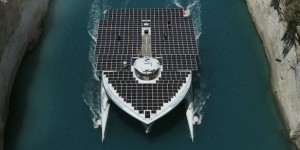
The Swiss-flagged Turanor PlanetSolar, the largest solar-powered boat in the world, is on its journey in the western Peloponnese in order to take part in an underwater archaeological project that focuses on making discoveries at the Franchthi cave in the Argolid southern Peloponnese.Franchthi Cave was continuously occupied for about 35,000 years from Peleolithic to Neolithic times.It was eventually abandoned around 3,000 B.C. and scientists assume that the people who lived here built a village nearby.
The project – TerraSubmersa – brings together Greek and Swiss archaeologists who will carry geophysical measurements to reconstruct the original above-water, topography of the area before it sank. They will be assisted by the Hellenic Centre for Marine Research (ELKEThE) – a collaborator on this project. Other partners on this project include the University of Geneva, the Swiss School of Archaeology in Greece and the Greek Ministry of Culture’s Ephorate of Underwater Antiquities.
The area of Argolid is famed as one of Greece’s richest archaelogical areas with its major palatial complexes of the Bronze Age that include Mycenae and Tiryns and later, classical-era city-states and sites like Argos as well as the impressive ancient theater of Epidaurus.
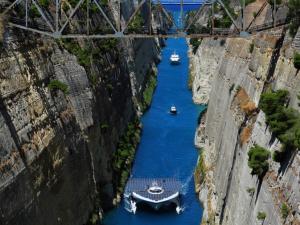
The 31-meter-long German-built catamaran that is powered by over 500 sq. meters of solar panels docked in Corinth on Thursday and left Corinth port yesterday. It will be in Greece for a month and is expected to begin underwater excavations on August 11. While in Greece it will also conduct geophysical research and assist underwater archaeologists in Aegean Sea surveys.
The boat will also stop at Eretria on Evia island, Athens and Nafplio with events to the public.
To follow the course of the Turanor PlanetSolar CLICK HERE.
Ask me anything
Explore related questions