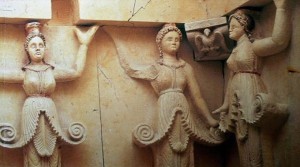
The Caryatids that emerged from the tomb on Kasta hill some days ago are believed to be of great archaeological importance.
The impressive element is that the combination of Sphinxes and Caryatids connects even more Aigai (Vergina) with Amphipolis: At the famous “Tomb of Eurydice” Sphinxes and Caryatids are present as miniature statues on the throne of this monument. Unfortunately, these were stolen in 2001 from the archaeological site of Vergina.
The marble Caryatids which support the ceiling with their heads is a pattern that was used extensively in ancient Greek monumental architecture, particularly after the highest artistic achievement of the Erechtheion constructed on the Acropolis of Athens. The appearance of the Caryatids in a tomb, such as the one at Amphipolis, clearly indicates the influence of the classical period to Macedonians. The architect who supervised the tomb of Amphipolis, as it continues to be revealed, chose to incorporate the best examples of sculpture tradition. This reinforces the argument that whoever was buried there was a prominent person.
The Caryatids of Amphipolis, although their status indicates that they have suffered any kind of hardship, implicitly justify those who want to believe that there is a possibility to find remaining of the body of Alexander the Great. And this because the Caryatids refer either to the Acropolis of Athens, or the Treasure of the Siphnians at Delphi. Alexander has always been an admirer of Athenian culture. The Erechtheion was completed in 406 BC and its greatest feature was the Caryatids. Before that, however, around 525 BC the Sifnians built a treasure and they offered it to Apollo. In the facade, between the pilasters, the peristyle was not based on columns, but on two “kores” (Karyatids), characteristic statues of Ionic art of the time, while on the top of the roof there was a sphinx. Alexander the Great must had the Caryatids in his mind when he sent to Athens 300 Persian shields after his triumph at the Battle of Granicus, or when he asked for atonement at Delphi for killing 6,000 Thebans in retaliation for an uprising in 335 BC.
It is also clear that any of the officials or the successor of Alexander who would want to imitate him or attempt to surpass him in posthumous glory could have ordered the Caryatids for his/her own tomb. Of course, one of the paradoxes is that the Caryatids remained for centuries identified with the Athenian glory.
According to one version, it was the elaborate dance that captivated the artists who designed the Acropolis, whereas another version argues that it was a deeper symbolism: As Vitruvius noted, a Roman architect and writer, residents of Karyon had allied with the Persians, but when other Greeks fought against them and won, the Athenians decided to punish the traitors. The fact that assigned to their daughters to bear the weight of the ceilings of their buildings refers to a form of eternal doom. But, it was also a message, that no one is left unpunished after a betrayal.
Ask me anything
Explore related questions