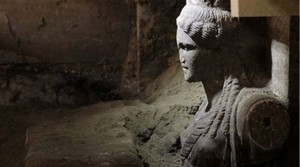
Andrew Chugg, author of “The Quest for the Tomb of Alexander the Great”, argues that the female sculptures discovered in the tomb on Kasta hill in Amphipolis ” represent Orphic revelers and priestesses of Dionysus,” as Discovery News mentions, drawing the conclusion that the tomb belongs to Olympias, the mother of Alexander the Great.
“These female sculptures may specifically be Klodones, priestesses of Dionysus with whom Olympias, Alexander the Great’s mother, consorted,” Chugg told Discovery News because “the baskets they wear on their heads are sacred to Dionysus.”
“In his ‘Life of Alexander,’ the Greek historian Plutarch wrote how Olympias used to participate in Dionysiac rites and orgies with these Klodones,” Chugg continues.
Plutarch mentions that these baskets were full of snakes, which “would rear their heads out of the baskets, terrifying the male participants in the Dionysiac rites and orgies”.
Chugg also added that he has “discovered there are Roman copies of a 4th-Century B.C. statue of Dionysus in both the Hermitage and Metropolitan museums with an accompanying figure of a priestess, who is dressed very similarly to the Amphipolis caryatids, including the ‘platform shoes,”.
So, assuming the tomb belongs to Olympia, “the explanation for the caryatids would be they represent those Klodones that shared in Dionysiac orgies with the queen whose tomb they guard,” Chugg said.
Ask me anything
Explore related questions