





Greece has the negative lead in Press freedom that has dramatically dropped over the last five years due to political interference and media monopolies. The data, published by Freedom House, a democracy think tank noted the greatest decline in press freedom for Greece among the 199 countries of the survey.
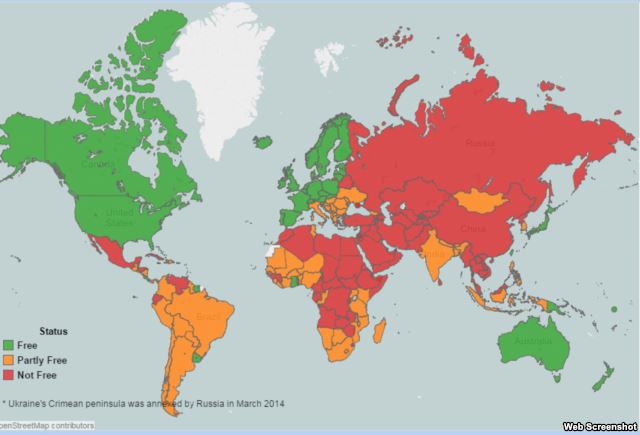
Conditions for the media deteriorated sharply in 2014 to reach their lowest point in more than 10 years, as journalists around the world encountered more restrictions from governments, militants, criminals, and media owners, according to the study.
“Journalists faced intensified pressure from all sides in 2014,” said Jennifer Dunham, project manager of the report. “Governments used security or antiterrorism laws as a pretext to silence critical voices, militant groups and criminal gangs used increasingly brazen tactics to intimidate journalists, and media owners attempted to manipulate news content to serve their political or business interests.”
The report found that the main factors driving the decline were the passage and use of restrictive laws against the media—often on national security grounds—and limits on the ability of local and foreign journalists to report freely within a given country, or even to reach it. In a time of seemingly unlimited access to information and new methods of content delivery, more and more areas of the world are becoming virtually inaccessible to journalists.
“One of the most troubling developments of the past year was the struggle by democratic states to cope with an onslaught of propaganda from authoritarian regimes and militant groups,” Dunham said. “There is a danger that instead of encouraging honest, objective journalism and freedom of information as the proper antidote, democracies will resort to censorship or propaganda of their own.”
Key Global Findings
- Global press freedom declined in 2014 to its lowest point in more than 10 years. The rate of decline also accelerated, with the global average score suffering its largest one-year drop in a decade.
- Of the 199 countries and territories assessed during 2014, a total of 63 (32 percent) were rated Free, 71 (36 percent) Partly Free, and 65 (32 percent) Not Free.
- Only one in seven — about 14 percent — of the world’s inhabitants live in countries with a Free press.
- All regions except sub-Saharan Africa, whose average score improved slightly, showed declines. Eurasia suffered the largest drop.
- Several countries with histories of more democratic practices have experienced serious deterioration over the past five years. Greece has fallen by 21 points on a 100-point scale since 2010, as existing structural problems were exacerbated by the economic crisis and related political pressures. Large five-year drops were also recorded in Thailand (13 points), Ecuador (12), Turkey (11), Hong Kong (9), Honduras (7), Hungary (7), and Serbia (7).
- The world’s 10 worst-rated countries and territories were Belarus, Crimea, Cuba, Equatorial Guinea, Eritrea, Iran, North Korea, Syria, Turkmenistan, and Uzbekistan. The Russian-occupied territory of Crimea was assessed separately for the first time in this edition.
Key Regional Findings
Europe
- This region enjoys the highest level of press freedom, although the regional average score has registered the world’s second-largest net decline over the past 10 years.
- Norway and Sweden were rated the world’s top-performing countries.
- Turkey’s media environment deteriorated further as the government moved more aggressively to close the space for dissent through new legal measures and intimidation.
- Notable declines also took place in Greece, Serbia, and Iceland.
- In Hungary, which remains Partly Free, the administration of Prime Minister Viktor Orbán continued to exert pressure on media owners to influence coverage.
Americas
- In Latin America, meaning the Spanish- and Portuguese-speaking parts of the region, only three (15 percent) of the countries were rated Free, and just 2 percent of the population lived in Free media environments.
- Honduras, Peru, and Venezuela experienced significant declines.
- Mexico, already suffering from endemic violence, received its lowest score in over a decade, after the passage of a controversial new telecommunications law.
- In Ecuador, hostile rhetoric from the government, combined with pervasive legal harassment of journalists and media outlets, led to a two-point decline.
- The United States’ score fell by one point due to detentions, harassment, and rough treatment of journalists by police during protests in Ferguson, Missouri.
Asia-Pacific
- Only 5 percent of the region’s population had access to Free media in 2014.
- China’s score was its worst since the 1990s, as authorities tightened control over liberal media outlets and alternative channels of news dissemination.
- Press freedom deteriorated sharply in Hong Kong due to a surge in violent attacks against journalists and pressure on companies to pull advertising from outlets that were critical of Beijing.
- Thailand’s press freedom score dropped significantly in the wake of the military coup and the imposition of martial law.
Eurasia
- The overwhelming majority of people in the region (82 percent) lived in Not Free media environments.
- Russia’s government tightened its grip on the media, suppressing independent reporting and deploying state-controlled outlets to attack domestic dissent and perceived foreign adversaries.
- Ukraine was upgraded to Partly Free as the fall of President Viktor Yanukovych’s government led to decreases in political pressure on state media and hostility toward independent voices.
- In Azerbaijan, the government unleashed a major crackdown on independent media, employing threats, raids, restrictive laws, and trumped-up criminal charges.
Middle East and North Africa
- Only 2 percent of the region’s people lived in Free media environments, while the vast majority, 93 percent, lived in Not Free countries or territories.
- Backsliding occurred in Algeria, which fell into the Not Free category, as well as in Egypt, Iraq, and Libya.
- Press freedom declined further in Syria, where the brutal civil war posed enormous dangers for journalists.
- Tunisia registered the best score of any Arab country in over a decade.
Sub-Saharan Africa
- The majority of people in the region (58 percent) lived in countries with Partly Free media.
- Guinea-Bissau and Madagascar improved to Partly Free.
- South Africa suffered a decline due to increased use of the apartheid-era National Key Points Act and other laws against the media, as well as an increase in violence against journalists.
- In Nigeria, little reporting was possible from areas controlled by Boko Haram, and the military increased efforts to punish critical coverage of its operations.
- Ethiopian authorities stepped up arrests of independent journalists, including the Zone 9 bloggers.
CLICK HERE to read the full report
Ask me anything
Explore related questions




