





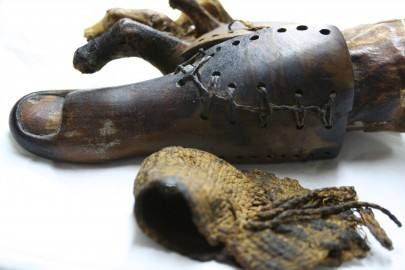
The fake toes from the Cairo museum in Egypt first discovered in the late 19th century and the second in 2000 in a tomb near the ancient city of Thebes, turned out to be practical walking devices, rather than cosmetic.
The wood and leather toe had been buried with a woman believed to have lived between 950BC and 710BC. The other fake toe, named the Greville Chester Great Toe after the collector who acquired it for the museum in 1881, is made of cartonnage, a sort of papier maché made using linen, glue and plaster. Based on the way the linen threads were spun, it dates from 1295 to 664 B.C.

(The original Cairo toe, made out of wood and leather, is housed at the Egyptian Museum in Cairo. The toe was found attached to a female mummy)
“Several experts have examined these objects and had suggested that they were the earliest prosthetic devices in existence. There are many instances of the ancient Egyptians creating false body parts for burial, but the wear plus their design both suggest they were used by people to help them to walk. To try to prove this has been a complex and challenging process involving experts in not only Egyptian burial practices but also in prosthetic design and in computerized gait assessment” said Dr. Jacky Finch, a lead researcher from the University of Manchester.
To determine what purpose the toes really served, researchers built replicas of the prosthetics. One a simple stub built of glue, plaster, and linen, the other a more detailed and aesthetically pleasing wood and leather number with a carved toenail.
Dr Finch recruited two volunteers who were both missing their right big toe. She carried out the tests in the Gait Laboratory at Salford University’s Centre for Rehabilitation and Human Performance Research. The replicas of the ancient toes were made to fit each volunteer along with replica leather ancient Egyptian style sandals.
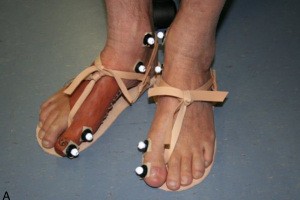
(A volunteer in the study wears a replica of an ancient Egyptian prosthetic toe with imitation Egyptian sandals)
Not only was walking in the sandals without a prosthetic particularly uncomfortable for test subjects, but the prosthetics actually performed better in tests where participants were wearing sandals, rather than walking barefoot. That specificity lends, even more, support to the fact that these toes represented the first successful attempt to craft artificial body parts for humans.
Assessing the volunteers’ experience, Dr Finch said: “It was very encouraging that both volunteers were able to walk wearing the replicas. Now that we have the gait analysis data and volunteer feedback alongside the obvious signs of wear we can provide a more convincing argument that the original artefacts had some intended prosthetic function.”
“The pressure data tells us that it would have been very difficult for an ancient Egyptian missing a big toe to walk normally wearing traditional sandals. They could, of course, remained bare foot or perhaps have worn some sort of sock or boot over the false toe, but our research suggests that wearing these false toes made walking in a sandal more comfortable.”
Until now, an artificial leg made of bronze and wood and found buried with a Roman aristocrat in southern Italy dating to 300 B.C. was thought to be the first prosthesis. Finch’s work suggests, however, that the Egyptians be credited with pioneering prosthetic medicine.
Ask me anything
Explore related questions




