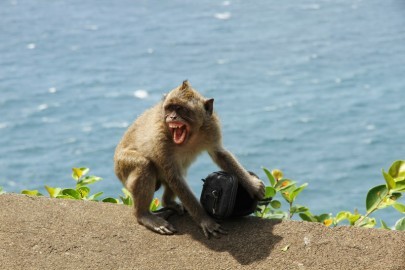
Long-tailed macaques living near an Indonesian temple have figured out how to run a ransom racket on visiting tourists.
The monkeys grab valuables, such as glasses, hats, cameras or, in one case, a wad of cash from the ticket booth, then wait for temple staff to offer them food before dropping their ill-gotten gains and dashing off with the tasty prize (see video below).
Although this behaviour has been reported anecdotally at Uluwatu Temple on the island of Bali for years, it had never been studied scientifically in the wild. So Fany Brotcorne, a primatologist at the University of Liège in Belgium, and her colleagues set out to discover how and why it has spread through the monkey population.
“It’s a unique behaviour. The Uluwatu Temple is the only place in Bali where it’s found,” she says, which suggests it is a learned behaviour rather than an innate ability.
Brotcorne wanted to determine whether it was indeed cultural, which could help us better understand the monkey’s cognitive abilities, and even human evolution.
Robbing and bartering
She spent four months observing four different groups of monkeys that live near the temple. The two groups that spent the most time around tourists had the highest rates of robbing and bartering, supporting the idea that they were learning the behaviour by watching each other. Groups with more young males, who are more prone to risky behaviour, also had higher rates than other groups.
Although this study is based on only a small sample, Brotcorne believes her team has found the first preliminary evidence that the behaviour is a cultural one, transmitted across generations by monkeys learning from each other.
In the years since these observations, she has gathered more evidence: the members of a fifth group of macaques that moved into the area around the temple have also started to learn that they can barter stolen goods for snacks.
Serge Wich, a primatologist at Liverpool John Moores University in the UK, says Brotcorne’s work provides “a novel and quite spectacular example of flexibility in primate behaviour in response to environmental changes”.
Criminal traditions
It is particularly interesting, he adds, because the same behaviour isn’t seen in other places where it could occur. “This indicates that it can indeed be a new behavioural tradition in primates and one that teaches us that new traditions can involve robbing and bartering with a different species,” he says.
Brotcorne says her work should help researchers learn more about the psychology of primates: how information is transmitted among groups, how much they understand their own actions and how they plan for the future.
It could even help answer questions about the evolution of our own cognitive abilities. “Bartering and trading skills are not well known in animals. They are usually defined as exclusive to humans,” she says.
But seeing it in macaques could help us learn how early the behaviour might have arisen in the evolution of the human lineage.
So did Brotcorne ever fall victim to her own thieving research subjects?
“Oh, so many times,” she says. “The monkeys were always trying to steal my hat, my pen, even my research data!”
Ask me anything
Explore related questions