

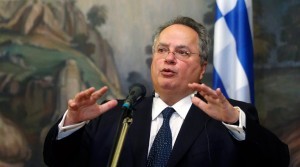
The Greek Foreign Minister Nikos Kotzias gave an interview on Alpha Radio, and he said some really interesting things:
M. NIKOLTSIOU: Minister, good morning and thank you for being with us.
N. KOTZIAS: Good morning from Kozani. I hope yours is a beautiful Saturday.
M. NIKOLTSIOU: A summer’s day, without rain. So, Minister, a lot has happened in recent days: we had Trump’s visit to Saudi Arabia, and immediately afterwards Qatar is isolated.
N. KOTZIAS: International politics is like the heart: it beats 24 hours a day and keeps us all correspondingly busy with our duties. To give you an indication, my last conversation with the Foreign Minister of a friendly country was at four in the morning – with a Minister of a Gulf country. In fact, I talked to everyone, but due to religious holidays, the talks take place after midnight and up until the morning hours.
M. NIKOLTSIOU: Can I ask if there is anything to report from this conversation?
N. KOTZIAS: Look, first of all, we are a country that has good relations with the Arab world, and at the same time we try to preserve the right and fair balance, underscoring that our country was never a colonial power, that our interest is in there being stability and security in the region. All of the countries involved in this crisis were in Rhodes a few weeks ago and contributed to the success of the International Rhodes Conference, in the direction of our creating a special security and stability organization for the Eastern Mediterranean. Consequently, we are acting on this foundation. Of course, there are countries with which we have exceptional relations, and this is shown by the fact that Egypt asked us to represent its diplomatic, political and consular interests in Qatar, because there are over 250,000 Egyptian workers there. I think the same will happen with one more country, but it’s too early for me to announce that with certainty.
M. NIKOLTSIOU: So we await a relevant announcement. Minister, what is your reading of these very rapid developments? Is the map of the region being redrawn?
N. KOTZIAS: I would say that these developments have a 15- to 20-year backstory. It is a discussion about the Arab world’s relations with Iran, about terrorism’s source and what the common stance of the Arab states can or cannot be. I remind you that there was a similar intervention in 2014 – not of the same intensity – when there was a change in the head of the royal family in Qatar and three successors were passed over in the line of succession, and in the end the next in line, the current Emir, became Qatar’s head of state. As you can see from the statements being made by the involved parties on the other side, they want a change in policy, not in leadership. That is, they want Qatar to align itself more closely with the common foreign policy of the other countries, which are basically the United Arab Emirates, Saudi Arabia and Egypt – but, as you have seen, many other countries have also taken a stance. The latest country to take a stance was Djibouti.
M. NIKOLTSIOU: What role might Turkey and Erdogan play? Because we are seeing an effort …
N. KOTZIAS: Erdogan and Turkey want to appear as mediators – a role that we in fact have – but they can’t, because the countries on the other side identify them with Qatar and the Muslim Brotherhood.
M. NIKOLTSIOU: Will a Kurdish state be created? Because we see the statements from the U.S. – not if, but when, the Americans are now saying.
N. KOTZIAS: The Kurdish issue has two components right now. One is Kurdistan in northern Iraq, where the European Union wants to see the country’s unity, but, as you know, the country’s unity has to be desired by the citizens themselves, and not by third parties. We’ll see. A referendum has been announced for September of this year in northern Kurdistan – that is, northern Iraq. This referendum, I remind you, was provided for from the outset by Iraq’s constitutional agreement, but the right was never exercised in practice. There is also the issue of the Kurdish zone in northern Syria, which is a major problem for Turkey itself. The western countries don’t want to break Syria’s unity, because right now we all favour the defeat of the reactionary Islamofascist forces and the defeat of authoritarianism within Syria. There is a draft constitution from certain Western powers, which has not been made public, and Russia has put forward a draft constitution that has been made public and that provides for Syria’s becoming a federal state with a Kurdish state as one of its components. In general I want to say – because Turkey is opposed to all of this, as is its right and its foreign policy choice – in all of these countries, the Kurds should have the rights that the Republic of Cyprus intends to grant to the Turkish Cypriot community. Because at some point we have to compare what they are pursuing in Cyprus and what they are prepared to give to their own much larger communities within their country.
M. NIKOLTSIOU: Before you leave us, Minister – and I thank you for your time – we would like a comment on the result of the elections in the UK.
N. KOTZIAS: Elections in recent years have played strange games with opinion polls. I remind you that the opinion polls gave a 20% lead to the Conservative party, but they were completely wrong. This should be borne in mind by those who believe that what the Greek opinion poll companies show as a big lead for the main opposition party is real and will be reflected in the next elections. They shouldn’t be in such a hurry. The elections will happen on schedule and both they and the polling companies that support them will be surprised by the result. The second and more important thing is that the British issue and the issue of Brexit will become more complex. Ms. May called elections seeking a stronger majority so that she could negotiate a ‘hard’ Brexit from a stronger position. As we saw, her position wasn’t strengthened. The British voters did not give her what she wanted, and I think she will have to shift towards a softer Brexit. But we’ll see. We need to see what coalition government is formed, because there is no absolute majority.
M. NIKOLTSIOU: It seems she will form a government with Northern Ireland’s Democratic Unionist Party.
N. KOTZIAS: They are negotiating, but the third thing has its significance: Britain’s electoral system is the most extreme majority voting system. With 30%, you can take 70% of the seats. This shows that at points in history when we have major shifts and changes on the political stage, the international political stage, not even the most extreme majority voting laws can give a party a majority.
M. NIKOLTSIOU: Might the result of the UK elections impact Greece in some way? I mean in terms of what we are pursuing with regard to the debt, the extent to which Britain’s role…
N. KOTZIAS: Britain’s role in the debt issue isn’t as strong as its economy is within the European Union, because it isn’t a member of the Euro Area. I believe that what’s important is that a softer Brexit will be pursued – or at least it would be more realistic to pursue a softer Brexit, because no one knows for sure. And the British should always keep in mind what I say to them: that our handling of matters of major interest to them will also depend to a great extent on their stance on the Cyprus issue.
M. NIKOLTSIOU: Since you gave me the opening, we have developments on this. Will we have new developments?
N. KOTZIAS: We will, but there is a great deal to discuss. Thank you very much.
M. NIKOLTSIOU: Thank you very much, Minister.
N. KOTZIAS: Have a good weekend.
M. NIKOLTSIOU: Take care, and thank you.
Ask me anything
Explore related questions