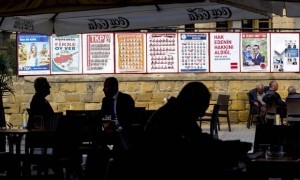
When Turkish-Cypriots go to the polls on Sunday, they will do so under the shadow of the giant Hala Sultan mosque.
Before its foundation stone was laid in a remote spot on the road to Famagusta barely four years ago, there was little else towering over the Mesoria plain that engulfs northern Nicosia. Now, its monumental domes and minarets are by far the biggest in the eastern Mediterranean.
For many, the building symbolizes Ankara’s tightening grip over the breakaway Turkish-occupied northern Cyprus.
“So much hangs on this election”, says Esra Aygin, a prominent Turkish-Cypriot moderate and member of the bi-communal lobby group, Unite Cyprus Now. “The mosque represents the change in lifestyle and culture that Turkey would like to impose on us. It is very important that the forces of reconciliation do well if [President Mustafa] Akinci’s hand is not to be weakened and further mistrust avoided”.
Turkish-Cypriots are seen as being among the most liberal Muslims in the western world. Most enjoy alcohol –attributing their penchant for whisky to colonial rule under the British. The majority also abhor the idea of women wearing headscarves and frequently joke they would only go to a mosque to attend a funeral. In such circumstances, Islamisation has been met with trepidation.
Like the outcome of the, so-called, parliamentary election at stake, secular Turkish-Cypriots worry that religion –and policies aimed at promoting a resurgence of Islam– could be the next big impediment to reconciling with Greek-Cypriots in a united Cyprus.
Increasingly, concerns have been voiced that Turkey –which launched an invasion in 1974, alledgedly, to protect the minority in response to an Athens-inspired coup to unite the island with Greece– is now bent on erasing a way of life that is not only cherished but central to their identity.
Friction recently boiled over when the Turkish-Cypriot daily, Afrika, ran a cartoon from an Athenian newspaper depicting a Greek statue urinating on the head of a grimacing image of the Turkish president, Recep Tayyip Erdogan. Turkish-Cypriot nationalists, including the state’s deputy prime minister, Recep Akdag, denounced its publication as an insult to the “entire Turkish nation”.
Sener Elcil, who heads the Turkish-Cypriot teachers’ union and is a vocal critic of Ankara’s growing influence over his homeland, has watched the Hala Sultan mosque being built with a mix of fury and anxiety.
“We don’t want Sunni Islam imposed on us but they are working systematically to radicalise the system and change the fate and culture of Turkish-Cypriots”, he told the Guardian. “All this is alien because culturally, we are very close to the Greek-Cypriots”.
Under Erdogan’s watch, Turkey has embarked on a mega mosque-building programme across five continents.
When the Hula Sultan mosque in Nicosia opens its doors this year, it will be able to accommodate 3.000 worshippers. Many faithful will be settlers –mainland Turks brought in initially in the 1970s as part of efforts to “Turkify” the north.
“It is not only that Turkish-Cypriots have become a minority in their own country, they are now trying to replace the secular education system with religious schools”, said Elcil. “Over 400 imams have been sent here as missionaries to target the children of settlers. Instead of English, lessons in Arabic and the Qur’an are being taught. Religion has never been a point of conflict in Cyprus, nationalism, yes, but not this”.
Mass rallies have taken place outside the Turkish-Cypriot “parliament”, attended mostly by young people deploring Ankara’s attempt to mold their culture into one more in tune with Islamic norms. Among points of grievance were the attempts by Turkey’s ruling neo-Islamist AKP party to impose single-sex swimming pools at universities.
“In the past, there were efforts to make us more Turkish because it was felt we weren’t Turkish enough”, lamented Aydin. “Now we’re not Muslim enough and the answer is more mosques, more religious classes, more Qu’ran courses. The only thing we want, and can’t be, is Cypriot”.
Religious leaders brush off the criticism as left-wing dissent. Cyprus’s vice grand mufti, Imam Shakir Alemdar, who is based in the island’s south, says inter-faith dialogue has been so successful it has helped lay the foundation for future hope.
“Hala Sultan mosque and all matters of religion in the north has some criticism from leftist groups but they criticise anything and everything when it comes to religion, especially Islam”, he said. “There is not only criticism but also a lot of support”.
Sunday’s election comes against a backdrop of mounting frustration with international isolation.
Since unilaterally declaring independence 35 years ago, only Turkey has recognized the impoverished territory, bankrolling it annually to stay afloat.
When Cyprus became the European Union’s most easterly member state in 2004, Turkish-Cypriots were left out in the cold after the island’s majority Greek population rejected a controversial reunification plan in a referendum.
Following the collapse of peace talks in Switzerland last July –widely seen as the “best ever” chance of reunification– thousands of Turkish-Cypriots have rushed to get EU citizenship by acquiring Republic of Cyprus passports. Others have simply voted with their feet, leaving the isolated republic for wealthier countries elsewhere in Europe.
“Unless there is a solution soon, there will be no Turkish-Cypriots to have a solution with”, said James Ker-Lindsay, a veteran Cyprus expert. “Northern Cyprus will simply become a Turkish province – a place of mosques and settlers. We are in a race against the clock”.
Source: theguardian.com
Ask me anything
Explore related questions