×
GreekEnglish

×
  • Politics
  • Diaspora
  • World
  • Lifestyle
  • Travel
  • Culture
  • Sports
  • Cooking
Friday
13
Feb 2026
weather symbol
Athens 14°C
  • Home
  • Politics
  • Economy
  • World
  • Diaspora
  • Lifestyle
  • Travel
  • Culture
  • Sports
  • Mediterranean Cooking
  • Weather
Contact follow Protothema:
Powered by Cloudevo
> World

Exoplanets could be habitable, scientist says

They are located in the Trappist-1 system

Newsroom January 24 08:35

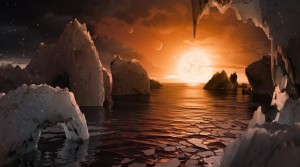
Two exoplanets in the TRAPPIST-1 system have been identified as most likely to be habitable, a paper by PSI Senior Scientist Amy Barr says.
The TRAPPIST-1 system has been of great interest to observers and planetary scientists because it seems to contain seven planets that are all roughly Earth-sized, Barr and co-authors Vera Dobos and Laszlo L. Kiss said in “Interior Structures and Tidal Heating in the TRAPPIST-1 Planets” that appears in Astronomy & Astrophysics.
“Because the TRAPPIST-1 star is very old and dim, the surfaces of the planets have relatively cool temperatures by planetary standards, ranging from 400 degrees Kelvin (260 degrees Fahrenheit), which is cooler than Venus, to 167 degrees Kelvin (-159 degrees Fahrenheit), which is colder than Earth’s poles,” Barr said. “The planets also orbit very close to the star, with orbital periods of a few days. Because their orbits are eccentric -not quite circular – these planets could experience tidal heating just like the moons of Jupiter and Saturn.”
“Assuming the planets are composed of water ice, rock, and iron, we determine how much of each might be present, and how thick the different layers would be. Because the masses and radii of the planets are not very well-constrained, we show the full range of possible interior structures and interior compositions.” Barr said. The team’s results show that improved estimates of the masses of each planet can help determine whether each of the planets has a significant amount of water.
The planets studied are referred to by letter, planets b through h, in order of their distance from the star. Analyses performed by co-author Vera Dobos show that planets d and e are the most likely to be habitable due to their moderate surface temperatures, modest amounts of tidal heating, and because their heat fluxes are low enough to avoid entering a runaway greenhouse state. A global water ocean likely covers planet d.
The team calculated the balance between tidal heating and heat transport by convection in the mantles of each planet. Results show that planets b and c likely have partially molten rock mantles. The paper also shows that planet c likely has a solid rock surface, and could have eruptions of silicate magmas on its surface driven by tidal heating, similar to Jupiter’s moon Io.

source: astrobiology

Ask me anything

Explore related questions

#earth#exoplanets#habitable#life#planets
> More World

Follow en.protothema.gr on Google News and be the first to know all the news

See all the latest News from Greece and the World, the moment they happen, at en.protothema.gr

> Latest Stories

Munich Conference formalizes the rift: Rubio cancels last-minute Ukraine meeting – “We must free ourselves from dependence on the US,” say Merz & Macron

February 13, 2026

The International Space Station returns to full crew, with four astronauts en route on a SpaceX mission

February 13, 2026

The moment when two US Navy ships collide near South America (video)

February 13, 2026

From Faliro to Voula: Who is building the Athenian Riviera

February 13, 2026

Hatzidakis: The twelve-month tourist season in our country is feasible

February 13, 2026

Care packages in the crossfire – How Ukraine’s drone deliveries bring hope to the front

February 13, 2026

Mitsotakis on the donation from the Pavlos and Alexandra Kanellopoulos Foundation: Major multi-million intervention at KAT with 16,000 surgeries per year

February 13, 2026

Bloomberg: US back-and-forth forces Europe to consider developing a unified nuclear deterrent

February 13, 2026
All News

> World

Munich Conference formalizes the rift: Rubio cancels last-minute Ukraine meeting – “We must free ourselves from dependence on the US,” say Merz & Macron

Both the German chancellor and the French president spoke of the need to seek new alliances, as Rubio turned his back on a critical meeting on Ukraine

February 13, 2026

The International Space Station returns to full crew, with four astronauts en route on a SpaceX mission

February 13, 2026

The moment when two US Navy ships collide near South America (video)

February 13, 2026

Care packages in the crossfire – How Ukraine’s drone deliveries bring hope to the front

February 13, 2026

Bloomberg: US back-and-forth forces Europe to consider developing a unified nuclear deterrent

February 13, 2026
Homepage
PERSONAL DATA PROTECTION POLICY COOKIES POLICY TERM OF USE
Powered by Cloudevo
Copyright © 2026 Πρώτο Θέμα