The Holocaust of Arkadi in Crete on November 9, 1866, is a significant date in the Cretan uprising against the Ottomans. It paved the way to the emancipation of Crete from the Ottomans in 1898, and in the subsequent enosis (union) with Greece in 1913.
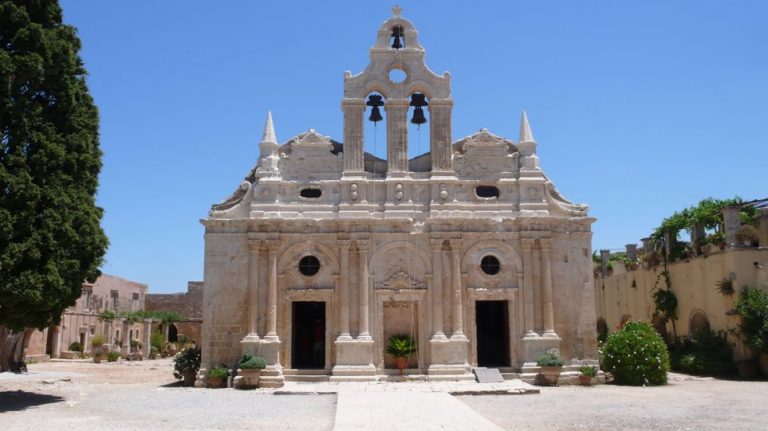
The Holy Monastery of Arkadi is one of Crete’s most acclaimed symbols of freedom. There, hundreds of people perished in the fight for freedom. The monastery dates back to the Byzantine era, and the fortress-like monastery is said to be named after Arkadios, a monk who founded the holy order.
The self-sacrifice of the besieged inside the monastery is considered one of the brightest and most inspiring moments in modern Greek history, as the people became symbols of heroism and courage. Their selfless act of bravery moved many across the world strengthening the Philhellenic movement in Europe and America.
The Cretans and the Turks had a long history of frequent and bloody uprisings. Cretans, long known for their bravery and survival skills, were determined to fight with every available tool-whether a rifle or farm implements. They wished to guard family and country, with the ultimate goal of gaining independence and union with Greece. Steadfast in this mission, by 1866, a 16-member revolutionary committee had formed, and with its strategic placement, made Arkadi Monastery its headquarters.
When the Turkish Pasha that ruled in Rethymnon became aware of the committee, he ordered Abbot Gabriel Marinakis to disarm the committee immediately and eject the rebels, or the monastery would be destroyed. Little did the Pasha know, Abbot himself was acting as chairman of the committee.
When Abbot Gabriel refused to comply with the orders, the rebels began to prepare, as they knew a Turkish attack was imminent.
In the early morning hours of November 8, 1866, the rebels woke up to the sight 15,000 Turkish soldiers surrounding the monastery. At least 30 menders of the defence were ready at the walls. To further complicate matters, the Greeks had 700 women and children inside the fortress who had sought refuge from the Turks.
After the besieged refused to surrender, the Turkish forces opened fire. The battle of Arkadi had begun. As that first day drew to a close, the area was filled with Turkish corpses.
According to accounts, two of the rebels snuck out at night dressed as Turkish soldiers to call for help in a nearby town. Unable to secure reinforcements, one of the rebels actually snuck back into the monastery, to continue the fight.
The following morning the Turkish troops used heavy artillery to smash down the main gate and the walls. Knowing death was near, the abbot summoned all the people to the chapel to administer the last sacrament. In an emotional speech, Abbot Gabriel urged the people to die fighting for their cause of freedom.
He then went out on an unguarded terrace and began shooting at the Turks. The Abbot was shot in the stomach and fell to his death, despite the Pasha ordering for his capture alive.
Though the rebels waged a fierce battle, resulting in hundreds of Turkish casualties, they knew they couldn’t win the battle, as they were running out of munitions and other supplies. At nighttime, the Turks launched a massive assault, storming the monastery and entering the inner courtyard.
During this time, Giaboudakis, one of the committee members, led the women and children into the gunpowder storage room. They prayed together and waited until the Turkish troops were pounding at the door. As the door began to break, Giaboudakis lit a gunpowder keg, resulting in a massive explosion. All the refugees were killed, as well as hundreds of Turkish soldiers. The final death toll was 864 Cretans, including men, women and children, plus 1500 Turkish troops. Of the 114 prisoners taken by the Turks, all were put to death. Somehow, three rebels escaped and lived to tell of the astonishing events that took place.
News of the holocaust rocked Europe and won much support for the Cretan freedom movement. In 1898, with the assistance of the newly founded Greek state, England, France, Italy and Russia, the Turks withdrew, ending their occupation of the island that dated back to 1669. At long last Crete had won its independence. By 1913, the ultimate goal was achieved-unity with Greece.
Ask me anything
Explore related questions