





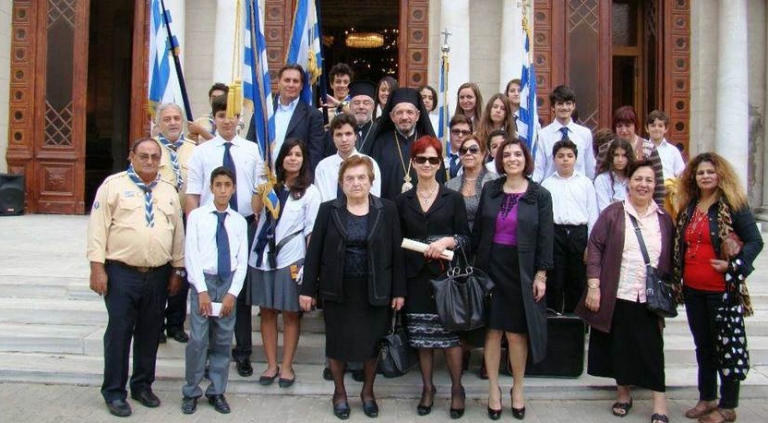
During the building of modern Egypt, Alexandria was a melting pot. People from the Levant and Europe came together there to form one of the most open cities in the Middle East and North Africa. Among them, the Greeks had carved out a prominent place for themselves, but they now stand at a crossroad, struggling to sustain their community and its legacy.
The establishment of Egypt’s modern Greek community dates to the first half of the 19th century, when Greek immigration escalated due to the economic opportunities available under the government of Mohammed Ali Pasha, especially in trade, a point of interest advanced by the proximity of Greece and Egypt. Although Greeks spread out across Egypt, Alexandria, the nation’s second largest city, was always the core of the community.
Andreas Vafiadis, a member of the board of directors of the Greek Community of Alexandria (EKA), told Al-Monitor, “[In Alexandria], the organizing of the Greek community took place in 1843, [when] some businessmen gathered at the Saint Sava Monastery decided that they had to do something for the Greeks, who had a lot of needs when they arrived to Egypt.” They decided to start with establishing a school and a hospital run by Greeks. A church and a cemetery soon followed.
This well-to-do community and the favorable climate toward it contributed to an increase in the number of Greeks living in the port city until the middle of the 20th century. The most generous estimates have them peaking at 150,000 residents in the early 20th century, making them at the time a large proportion of Alexandria’s total population of 400,000. Today there are fewer than 1,000 Greeks living in the city. The rise of Egyptian nationalism planted the seeds of their decline, inevitably transforming their role in Egyptian society.
Alexander Kitroeff, a professor of history at Haverford College and the author of “The Greeks and the Making of Modern Egypt,” spoke to Al-Monitor about Egypt’s early days of semi-independence under King Farouk. Kitroeff explained, “When Egyptian nationalism started to develop in the ’20s and ’30s, and Greeks realized that the privileges that foreigners once had would not always be in place, they developed this narrative of having a special relationship with the Egyptians and being key contributors to Egypt’s modernization.”
The turning point for the community arrived with the 1952 revolution that resulted in the nationalist and socialist regime led by Gamal Abdel Nasser. This changed the rules of the game for Alexandrian Greeks, many of whom saw their businesses nationalized or who lost their jobs, particularly in the public sector. This state of affairs coupled with Greece’s emergence from civil war led many Greeks to head for their homeland.
The sudden departure of Greeks from Alexandria, and a fondness for the cosmopolitan atmosphere that had characterized the city since the end of the 19th-century, resulted in many Greeks idealizing that epoch. For some, the nostalgia remains.
Kitroeff remarked, “Greeks felt much closer to the Egyptians [than other communities, for instance the British or French, did], and through the life and the economy that they developed, they genuinely believed they were contributing to Egypt, but they did it from a position of privilege.”
Read more HERE
Ask me anything
Explore related questions




