×
GreekEnglish

×
  • Politics
  • Diaspora
  • World
  • Lifestyle
  • Travel
  • Culture
  • Sports
  • Cooking
Tuesday
09
Dec 2025
weather symbol
Athens 12°C
  • Home
  • Politics
  • Economy
  • World
  • Diaspora
  • Lifestyle
  • Travel
  • Culture
  • Sports
  • Mediterranean Cooking
  • Weather
Contact follow Protothema:
Powered by Cloudevo
> World

NASA: Hubble photographed an entire galaxy – See what Seifert NGC 3254 looks like

NGC 3254 was first spotted in March 1785 by astronomer William Herschel, about 118 million light-years from Earth

Newsroom June 22 10:02

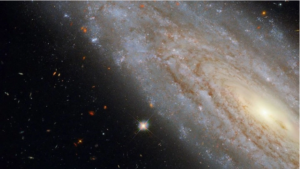
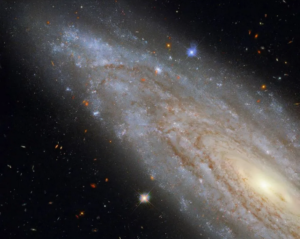
A stunning photograph of the galaxy named NGC 3254 was captured by NASA’s Hubble Space Telescope.

The Seifert Galaxies make up 10% of all galaxies and were named after the American astronomer Carl Seifert, who first studied them in the 1950s.

Seifert Galaxies are a type of galaxy, which includes an extremely bright small nucleus, which sometimes exceeds the brightness of the entire surrounding galaxy. According to NASA, these types of galaxies have “extremely active nuclei” and belong to the “active galaxies”.
>Related articles

Thousands of potential UFOs spotted in 1950s photos, before satellites even dotted the sky, according to studies

Europe responds to Elon Musk’s Starlink with a summit partnership in the satellite industry

Scientists detect…alcohol & vinegar in a neighboring Galaxy!

The photo of NGC 3254 is a composition of infrared and visible images. On the one hand it refers to a typical spiral galaxy. However, it is actually a Seifert Galaxy, which can be best seen in light outside the visible spectrum, according to NASA.

Galaxies have oversized black holes at their center, which accumulate material which, according to NASA, emits huge amounts of radiation. Oversized black holes are defined as those that have a mass 1 or 2 billion times the typical black hole.

See Also:

Alco poll: New Democracy leads with 12.9 points

These celestial objects release gases, dust, stars and planets, which they pull and eventually destroy. NGC 3254 was first spotted in March 1785 by astronomer William Herschel, about 118 million light-years from Earth.

Ask me anything

Explore related questions
#galaxy#Hubble Space Telescope#nasa#space
> More World

Follow en.protothema.gr on Google News and be the first to know all the news

See all the latest News from Greece and the World, the moment they happen, at en.protothema.gr

> Latest Stories

Trump’s son-in-law Jared Kushner joins Paramount’s $108 billion bid for Warner Bros

December 8, 2025

Benaki Museum: Christmas all-day program for all ages

December 8, 2025

Sisi – Haftar meeting in Cairo on Egypt-Libya EEZ delimitation: What it means for Greece

December 8, 2025

Greek government and farmers at a standstill: What measures are being discussed to end the blockades

December 8, 2025

Hatzidakis on Bloomberg TV: Energy agreements boost Greece’s geopolitical significance

December 8, 2025

Meeting between Minister Theodorikakos and Greek-American businessman John Catsimatidis

December 8, 2025

Stranger Things: Creators share TV settings for the best viewing experience

December 8, 2025

Trump announced an executive order for single AI application approval

December 8, 2025
All News

> Culture

Benaki Museum: Christmas all-day program for all ages

Guided tours, performances, and children’s activities open on December 13 at the Benaki Museum, Pireos 138

December 8, 2025

Restoration and enhancement works begin at the historic Church of Agios Nikolaos Rangavas in Plaka

December 8, 2025

George Osborne: “I remain optimistic about reaching an agreement with Greece on the Parthenon Sculptures”

December 7, 2025

History has treated her unfairly”: The 400-year mystery surrounding Shakespeare’s wife and son

December 6, 2025

Christmas with light installations, music, and cinema at the Stavros Niarchos Foundation Cultural Center

December 5, 2025
Homepage
PERSONAL DATA PROTECTION POLICY COOKIES POLICY TERM OF USE
Powered by Cloudevo
Copyright © 2025 Πρώτο Θέμα