

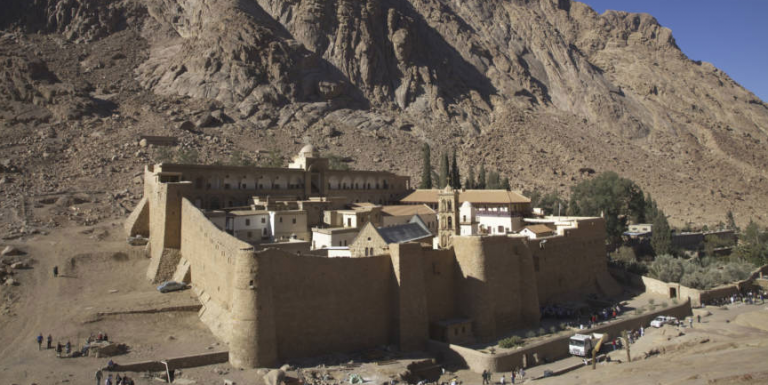
At the foot of Mount Sinai, the mountain atop which God is said to have given Moses the Ten Commandments, lies St. Catherine’s Monastery, one of the world’s oldest continuously running libraries. St. Catherine’s is home to some of the world’s oldest and most valuable books and manuscripts, and the monks that watch over them.
These texts are largely manuscripts and are filled with mostly Greek and Latin. However, recently scientists have uncovered new languages in the manuscripts — and some that haven’t been used since the Dark Ages.
The only catch — the languages can’t be seen with the naked eye.
When the texts were originally written, the monks only wrote in ancient languages. However, the parchment they were written on at the time was valuable, and often subject to reuse.
Texts deemed less important were scrubbed clean from the parchment, which was then reused for more important information, often written in other more universal or modern languages. These texts with multiple layers of writing are known as palimpsests.
Now, using new technology, a team of researchers has developed a way to uncover the ancient writings in the palimpsests at St. Catherine’s and have discovered languages thought to be long lost. One such language, Caucasian Albanian, hasn’t been used since the 8th century. Other languages include Christian Palestinian Aramaic, which is a mix of Syriac and Greek.
To uncover the hidden writings, the scientists photographed the manuscripts using different parts of the light spectrum and run the images through an electronic algorithm. This allowed them to see the first writing put down on the pages.
Space travel could create language unintelligible to people on Earth
Michael Phelps, a researcher at the Early Manuscripts Electronic Library in California, calls this development the beginning of a “new golden age of discovery.”
“The age of discovery is not over,” he said. “In the 20th century, new manuscripts were discovered in caves. In the 21st century, we will apply new techniques to manuscripts that have been under our noses. We will recover lost voices from our history”.
Phelps went on to praise the monastery for their record keeping and devotion to the preservation of history.
“I don’t know of any library in the world that parallels it,” he said. “The monastery is an institution from the Roman Empire that continues operating according to its original mission.”
However, he notes that though the monks deserve praise for recording history, they are also to blame for erasing the parchment that held it.
“At some point, the material the manuscript was on became more valuable than what was written on it,” Phelps said. “So it was deemed worthy of being recycled.”
Besides the discovery of the Caucasian Albanian language texts, the researchers also uncovered what is thought to be the first-known copy of the Bible written in Arabic, as well as the earliest examples of writings from the Greek philosopher Hippocrates.
Source: All That’s Interesting
Ask me anything
Explore related questions