





It was all smiles and thumbs-up on March 30, at 5:28 PM local time, when NASA astronaut Mark Vande Hei and Russian cosmonauts Anton Shkaplerov and Pyotr Dubrov thumped down in the steppes of Kazakhstan aboard a Russian Soyuz spacecraft—and with good reason. For one thing, Vande Hei had just completed a marathon 355 consecutive days aboard the International Space Station (ISS), setting a new U.S. space endurance record. For another—more important—thing, the joint U.S.-Russian return to Earth was one of the rare exercises in cooperation between the two nations during the white-hot tension between Washington and Moscow over the war in Ukraine.
From its inception more than a generation ago, the ISS—which was built and is maintained by 15 nations, led by the U.S. and Russia—was always intended to be an exercise in peaceable relations between two nations that fought a decades-long Cold War. “Up in space, we can have a cooperation with our Russian friends, our colleagues,” NASA Administrator Bill Nelson said in a press statement after Russia’s expanded invasion of Ukraine began and before the crew’s return. “The professional relationship between astronauts and cosmonauts, it hasn’t missed a beat. This is the cooperation we have going on in the civilian space program.”
But what war can not break, time and age can. The $150 billion ISS—as big as a football field and made of 16 pressurized modules and a pair of massive solar wings—is getting old. Its first component, the Russian Zarya (Dawn) module, was launched nearly 24 years ago, and orbital hardware can last only so long before equipment breaks down, small air leaks appear, and the constant punishment both by micrometeorites and the continual thermal cycling the station goes through on every 90-minute orbit—from 121 degrees C (250 degrees F) on the sunlit side of the Earth and -157 degrees C (-250 degrees F) on the nighttime side—take their own toll. NASA and the ISS partners had originally intended to keep the station in service only until 2025, when it would be sent on an incineration plunge through the atmosphere and into the ocean. In December, the Biden Administration extended its life to 2030—provided the hardware can last that long. But whatever its exact end date is, the station is on the clock.
New EU law could become Apple’s worst nightmare
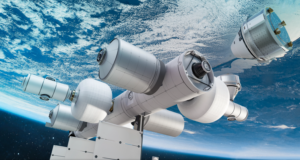
On Dec. 2, 2021, NASA made it clear that when that clock does toll, the U.S. will be getting out of the space station game, likely for good. Instead, the space agency signed a $415.6 million seed money deal with three companies—Blue Origin, Nanoracks, and Northrop Grumman—to develop their own private space stations, on which NASA and other customers could lease space for professional crews and tourists. The arrangement is similar to the one NASA struck in 2014 with SpaceX and Boeing after the space shuttles retired, contracting with both companies to develop crew vehicles to carry astronauts to low-Earth orbit. SpaceX’s Crew Dragon vehicle has already gone into service ferrying crews to the ISS, and while Boeing is still struggling with technical issues and has yet to fly a crew, it is scheduled to make an uncrewed test flight to the ISS in May.
Read more: TIME
Ask me anything
Explore related questions




