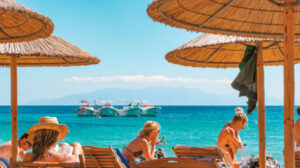
When Heading to the Beach, Be Prepared to Spend
It may sound strange, but the usual terms of nightlife have been transferred to the beaches. The “front row table” has become the “front row sunbed,” as sitting by the water’s edge has become a privilege. Additionally, there are “reserved” areas, often with “minimum consumption” requirements and specific arrival times to avoid cancellation of the reservation. Demand, especially on weekends, is high.
The market law of high demand applies here too, as sunbeds on the beaches are selling out quickly. Business owners have taken note of this, which explains the fierce competition for beach concession contracts this year, with the state collecting amounts that are sometimes ten times higher than in previous years.
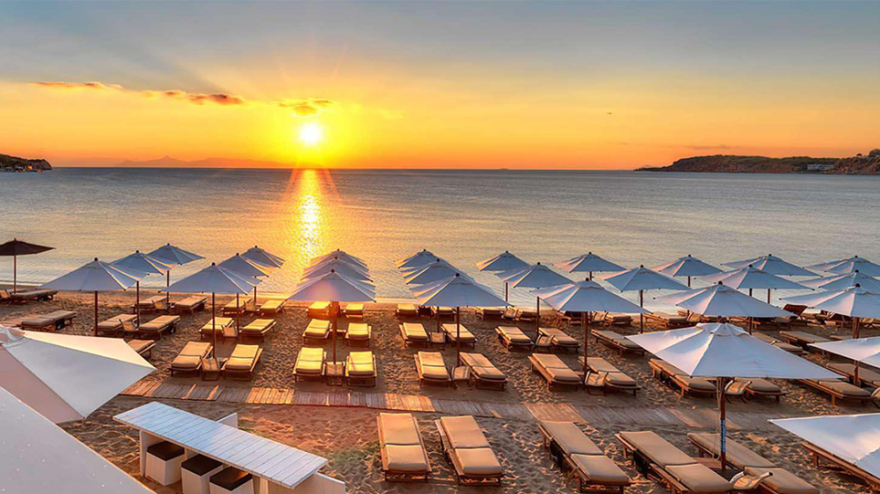
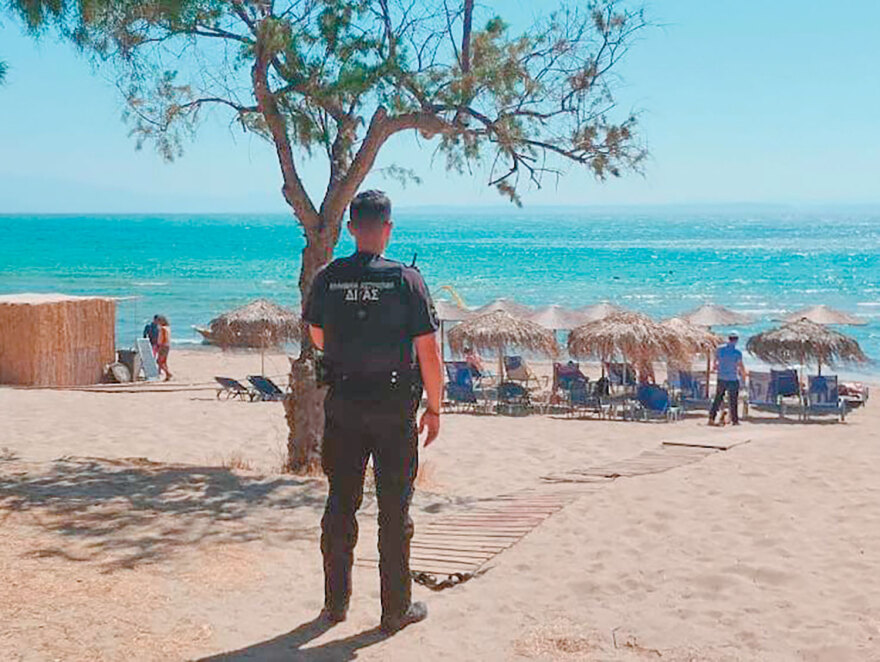
However, not everything is as it seems. In many cases, as has been proven in practice, business owners illegally occupy the beach with sunbeds or spread them across the entire beach (instead of just the portion they have rented), obstructing public access to the sea. For this reason, authorities use not only complaints from the MyCoast app but also satellite photos and drone inspections to restore legality where necessary.
Price List
For older generations, the idea of having to reserve and prepay for a sunbed and plan the next day’s swim might seem bizarre or even outrageous. Until the mid-2000s, choosing a spot on the sand to serve as the base for swimming felt like a practice of explorers. Just as explorers would plant their flag in the ground of the place they had just reached, families would plant their umbrella in the sand, where they would spread their towels.
Today, however, things have changed. On organized beaches, especially on weekends and holidays, there is a “war for sunbeds.” Finding a free sunbed with an umbrella is nearly impossible, which is why the practice of reserving sunbeds has become prevalent. There is even an app that allows people to book sunbeds or umbrellas online from their mobile phones. The sunbeds are prepaid, and swimmers receive a unique code via email, which they show upon arrival at the beach to be guided to their reserved spots. These spots come with various amenities, from free parking to free consumption up to a certain amount or complimentary cocktails (or sometimes nothing at all).
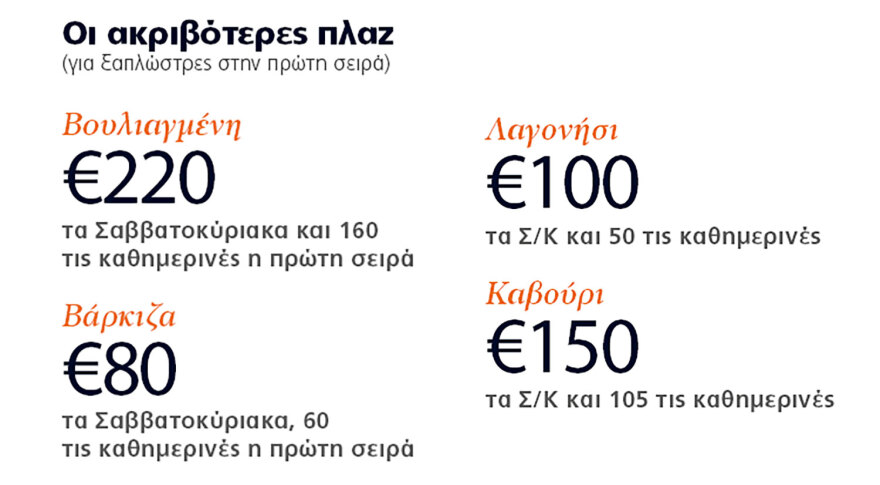
Everything has its price. And a beach chair in front of the wave has its own. If someone wants to reserve a sunbed from the first row at Vouliagmeni beach, they will have to pay 220 euros on weekends and 160 on weekdays, with prices for the second and fourth rows being 210 and 150 euros for weekends and weekdays respectively, and the third row at 200 and 150 euros for weekends and weekdays.
In Varkiza the booking prices for a set (two) of sunbeds in the first row on weekends are 80 euros and 60 euros on weekdays, while there is also the bell option, which is a wooden shelter with two sunbeds, a table and a pouf that costs 275 euros on weekends and 200 euros on weekdays. The cabana, however, can accommodate up to 10 people.
At Lagonisi, reservations for sunbeds with umbrellas in the first row cost 100 euros on weekends and 50 on weekdays, with the corresponding prices for the second row being 90 and 40 euros. In Kavouri (where there is no row-based classification), the price for online booking for two sunbeds and umbrella at the weekend is 150 euros, while on weekdays it is 105 euros, with the bells with poufs costing 220 euros and 160 euros respectively. For the bells, each extra pouf is charged 65 euros on weekends and 50 euros on weekdays.
The cost of the ticket is 50 euro per hour and 50 euro per day.
Here it is good to make a comparison of booking prices with the … risk of going and relying on luck that you will find a sunbed available. At the same beach in Kavouri a set (2 sunbeds and an umbrella) at the weekend costs 100 euros and on weekdays 70 euros. On weekends and holidays, if some people are lucky enough to find a bell available, they will have to pay 160 euros for one with 2 poufs or 220 euros for a bell with a double sunbed, with the corresponding prices for weekdays being 120 and 160 euros.
On an organised beach in Sun, umbrellas with front-row sunbeds with a reservation cost 80 euros at the weekend and 50 euros on weekdays, while the other rows cost 70 and 40 euros respectively.
In Voula, booking a sunbed with an umbrella on weekends costs 90 euros and 60 euros on weekdays, with the big bell (up to 6 people) costing 220 euros on weekends and 180 euros on weekdays.
There are, however, and the more affordable beaches to book. In Schinias, for example, one can find sunbeds from 15 to 45 euros (depending on the order and location) on weekends and from 10 to 28 euros on weekdays. On a neighbouring beach, booking a sunbed costs 50 euros and a table (up to 6 people) 170 euros.
If you’re lucky…
At the most popular beaches, which are also closer to the urban fabric of Athens, although the turnout is higher, reservations are not necessary. Luck is necessary to find a sunbed, but above all the necessary amount of money to be able to “occupy” a sunbed with an umbrella near the wave.
In Alimos, at beach bars, on weekends the entrance costs 10 euros per person, which should be added to the 5 euros per sunbed, while on weekdays the corresponding prices are 8 and 3 euros. At the Voula beach the entrance fee is 8.5 euros per person, while the sunbeds – depending on the location – cost 30-40 euros per set at the weekend. From Monday to Friday the entrance fee is 7 euros per person and the sunbeds cost 20-30 euros per set.
At a neighboring beach bar in Voula, the entrance fee is 8.5 euros per person, with sunbeds costing 70 euros per set on weekends, while on weekdays prices are 7 and 60 euros, respectively. In Kavouri, a set of sunbeds costs 42 euros on weekends and 35 euros on weekdays, while in Anavyssos, sunbeds cost 20 euros per set on weekends and 10 euros on weekdays.
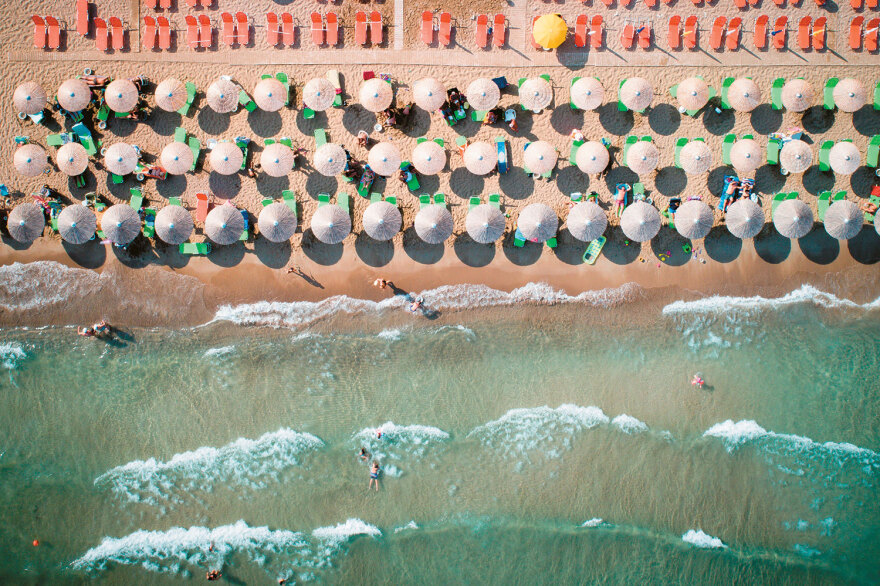
To oversee the legality of shoreline activities and ensure citizens’ right to access beaches, the MyCoast app has enlisted the help of citizens. They can easily and quickly report illegal activities from their mobile phones via this dedicated app. In addition, drones patrol suspicious beaches, capturing videos and photos that are compared with leasing agreements and aerial photographs from previous years. The surveillance drones have already started their patrols, especially in areas with numerous complaints, including Attica, the Cyclades, the Dodecanese, and Halkidiki. The final decision rests with the Public Property Management Agency inspectors, who receive the drone photos and determine the fines based on the extent of the violation.
In other instances, on-site inspections are conducted by mixed teams from the Ministry of National Economy and Finance, the Public Property Management Agency, the municipality, the Independent Authority for Public Revenue (AADE), the Financial Police, the Hellenic Police (EL.AS.), and prosecutorial authorities. After the inspection, an on-the-spot report with accompanying photographic evidence is prepared and delivered or posted immediately.
The MyCoast app has proven extremely popular since its launch. According to the General Secretariat of Information Systems and Digital Governance of the Ministry of Digital Governance, over 52,000 citizens have downloaded it. On the first day, the platform received 1,900 reports, and today, the number exceeds 9,000. Some of these reports have already led to business closures and fines totaling over 300,000 euros.
However, some reports were excessive or false (such as a “beach” in Syntagma Square or businesses reporting neighboring competitors). Despite this, among the 1,000 reports investigated within five days, significant violations were found, prompting authorities to focus their inspections on these areas due to the large number of justified complaints.
Ask me anything
Explore related questions