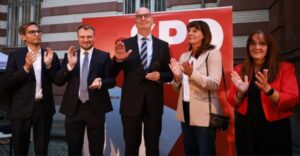
The Social Democrats (SPD) party of Germany’s Chancellor Olaf Scholz narrowly won the election in the eastern state of Brandenburg on Sunday.
Three weeks after the far-right party Alternative for Germany (AfD) made gains in two other East German states, the SPD came out on top. The election, on the outskirts of Berlin, was closely watched after the AfD became the first far-right party to win a state election in Germany since World War II, in the eastern state of Thuringia on September 1. The party also came a close second in Saxony on the same day. An AfD victory in Sunday’s election would deal a major blow to Scholz’s hopes of a second term in Germany’s federal elections next year.
According to final results released Sunday night by the state’s election administration, the SPD won 30.9 percent of the vote, while the AfD came in second with 29.2 percent. The Sahra Wackenknecht Alliance (BSW), a new left-wing movement, came third with 13.5 percent, while the centre-right Christian Democrats took 12.1 percent. These four parties secured their entry into the local parliament.
The Greens, who are likely to remain out of parliament, scored 4.2% (-6.6), while the left-wing party got 3% (-7.7), which, following the departure of Zara Wackenknecht, is seeing its numbers shrink, even in its once privileged eastern states. The Liberals (FDP) are also out of parliament, and are even counted among the “other parties.”
Of the 88 seats in the local parliament, 32 are occupied by the SPD, 30 by the AfD, 14 by the BSW and 12 by the CDU. Since all parties refuse to cooperate with the far right, the only options are a coalition of the SPD with either the CDU or the BSW. Prime Minister Dittmar Wojtke (SPD) has already stated, however, that he would prefer to work with the CDU.
In the individual results, Ditmar Wojtke, although extremely popular, failed to win his constituency and lost to AfD candidate Kubitsky by a margin of seven votes. In contrast, the AfD leader in the state (and “verified far-right” by the Office for the Protection of the Constitution) Hans-Christophe Byrd won his constituency over SPD candidate Nadine Grassmell.
The SPD victory brought a breather for Scholz, whose three-party governing coalition has performed poorly in elections so far this year.
The Social Democrats have ruled Brandenburg since 1990, and a defeat there would be a major blow to Scholz, who has his constituency in the state capital Potsdam.
Schultz has expressed his desire to be his party’s candidate for chancellor in next year’s federal election, and this weekend’s vote is also being watched for what it may signal for his political future.
“It’s super that we won”
Commenting on the results, Chancellor Olaf Scholz, from New York, where he is attending the United Nations General Assembly, expressed satisfaction with the election result. Responding to a question from reporters about the mood on the chancellor’s phone call with the SPD leadership, he said “good, of course!” he added: “It’s super that we won. I had a feeling it was going to happen.”
The winner of the evening, Ditmar Voidke, said that “a lot of hard work” was behind his party’s success and expressed his satisfaction that, he said, “social democracy has once again closed the way to the far right.”
CDU general secretary Carsten Linnemann called it a “bitter victory”, which he attributed to the “polarization between Dietmar Wojtke and the AfD”. He even congratulated Mr. Wojtke, who “played it all for everything and won,” referring to the Social Democrat prime minister’s statement that if he lost, he would leave.
“The sunrise is blue,” said AfD parliamentary group leader Alice Weidel and argued that the primary was lost for her party only because the SPD’s strategy attracted voters from other parties. The other parliamentary group leader Tino Hroopala said he was satisfied with the result, but also referred to “an opportunity lost to send Dietmar Wojtke into retirement.”
Green Party leader Rikarda Lang spoke of a “negative trend” in the east for her party and said the Greens would have to find a way out of this situation. Liberal (FDP) secretary general Biyan Jir-Saray, with his party’s figures only included in “other parties”, reiterated that we are facing an “autumn of decisions”, but refrained from answering questions about the future and the cohesion of the federal government.
FDP Vice President Wolfgang Kubicki reiterated his view that his party should consider leaving the governing coalition. “The ‘traffic light’ is toxic,” he commented via X, only to tell the Welt television service shortly afterward, “Either we will manage to find a reasonable common denominator within the next 14 days, three weeks, or it no longer makes sense for the Free Democrats to continue to participate in this coalition.”
The chancellor’s party won, and the chancellor lost
German media are already analyzing the results of the Brandenburg election and its impact on the central political scene, a year before the federal elections.
The majority of the German media consider the victory of the Social Democratic Party (SPD) to be credited to the state’s prime minister Dietmar Wojtke, but it causes at least temporary relief for Olaf Scholz.
“The chancellor’s party won, the chancellor lost,” writes the magazine Der Spiegel, referring to the fact that the state’s Social Democratic (SPD) prime minister, Dietmar Wojtke, took the election campaign upon himself and, by threatening to resign if the SPD did not finish first, caused a polarization that ultimately favored him. At the same time, he had declared Chancellor Olaf Scholz “undesirable” in his campaign – even though the chancellor lives in the region.
The Handelsblatt writes “With his victory, Dietmar Wojtke stabilizes the chancellor”, noting that the election result in Brandenburg gives Olaf Scholz a breathing space. Mr. Voidke has already said that Mr. Scholz should be his party’s candidate for the chancellorship again. “His campaign strategy of taking full risks and threatening to resign if he stayed behind the AfD has finally been a complete success. Therefore, the victory is above all an electoral victory for Wojtke,” the Financial Daily writes.
The Tagesspiegel points out that “the SPD wins by a wide margin over the chancellor. “Wojtke has everything Olaf Scholz lacks,” it said in a commentary, looking at the Brandenburg prime minister’s high popularity.
“The election reveals how contradictory the worlds in Brandenburg are,” the Süddeutsche Zeitung writes in a commentary, referring to the economic and social boom experienced by the regions of the state close to Berlin, in contrast to other regions, which are more affected by immigration.
Welt comments on the election result, noting that “the SPD is far from being rescued, despite the victory”, while referring to the Greens it calls it “a high price to pay for their ignorance on the issue of immigration”. Specifically for the CDU, the paper speaks of a “historic victory instead of the ‘Merz effect'” and predicts that the federal elections will not be a sure success for the CDU under Friedrich Merz.
Headlined “The many messages to Berlin” and subtitled, “Small election, big effect”, the Frankfurter Allgemeine Zeitung writes that “thanks to strong Prime Minister Wojtke, the chancellor is probably able to avoid an unpleasant debate, but the autumn of decisions is just beginning” for Berlin.
The Bild calls it “a triumph for the SPD, but not a success for Olaf Scholz” and refers to the chancellor’s abstention from the election campaign of Dietmar Wojtke, who did not want to be identified with the federal government and suffered its attrition.
Ask me anything
Explore related questions