Mount Tambora changed the world. In 1815, the Indonesian volcano erupted in the most powerful explosion ever recorded in history, sending a massive cloud of tiny particles that obscured the sun, cooling the planet and drastically altering the rhythms of Earth’s “clock.”
What followed became known as the “year without a summer”: global temperatures dropped, crops failed, people starved, a cholera pandemic spread, and tens of thousands of people died. The eruption was 52,000 times more powerful than the atomic bomb in Hiroshima.
Many volcanoes have erupted since, but Tambora remains the most devastating eruption on the planet. More than 200 years later, scientists warn that the world may face another one.
The question is not if but when, said Markus Stoffel, a climate professor at the University of Geneva. Geological evidence suggests a 1 in 6 chance of a massive eruption this century, he told CNN.
This time, however, it will occur in a world that has changed significantly—a world not only more densely populated but also warmed by the climate crisis.
The next massive eruption will “cause climate chaos,” Stoffel said. “Humanity has no plan.”
Sulfur Dioxide
Volcanoes have long shaped our world, contributing to the formation of continents, creating the atmosphere, and altering the climate.
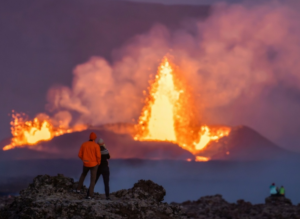
When they erupt, they release a mix of lava, ash, and gases, including planet-warming carbon dioxide, though in amounts dwarfed by what humans produce by burning fossil fuels.
When it comes to climate impacts, scientists are most interested in another gas: sulfur dioxide.
A massive volcanic eruption can propel sulfur dioxide through the troposphere—the part of the atmosphere where weather occurs—and into the stratosphere, the layer about 11 kilometers above Earth’s surface where airplanes fly.
There, it forms tiny aerosol particles that scatter sunlight, reflecting it back into space and cooling the planet below. These particles “will be transported around the globe and last for a few years,” said Alan Robock, a climate professor at Rutgers University who has spent decades studying volcanoes.
Poor Data from Volcanoes
For modern volcanoes, satellite data shows how much sulfur dioxide is released. When Mount Pinatubo in the Philippines erupted in 1991, it sent about 15 million tons into the stratosphere. This was not a massive eruption like Tambora, but it still cooled the world by about 0.5 degrees Celsius for several years.
For older volcanoes, however, “we have very poor data,” Stoffel said. Scientists try to reconstruct these past eruptions using information from ice cores and tree rings, which act like time capsules, storing secrets of the past atmosphere. From these, they know that massive eruptions over the past several thousand years temporarily cooled the planet by about 1 to 1.5 degrees Celsius.
Tambora, for instance, lowered the average global temperature by at least 1 degree Celsius. There is evidence that the massive Samalas eruption in Indonesia in 1257 may have contributed to the onset of the “Little Ice Age,” a chilly period that lasted for hundreds of years.
There is also evidence that massive eruptions can affect rainfall, drying out monsoon systems, including those in Africa and Asia. “Summer monsoons occur because land heats up faster than the ocean,” said Alan Robock. A massive volcanic eruption can disrupt the temperature difference between the two.
A More Unstable World
Understanding the impacts of previous massive eruptions is critical, but the next ones will occur in a world much warmer than before humans began burning large amounts of oil, coal, and gas.
“It is a more unstable world now,” said Michael Rampino, a professor at New York University researching the links between volcanic eruptions and climate change. “The impacts could be even worse than what we saw in 1815.”
In what may seem counterintuitive, a warmer world could mean that massive volcanic eruptions have an even greater cooling effect. This is because how aerosol particles form and spread “depends on the climate,” said Thomas Aubry, a physical volcanologist at the University of Exeter.
As the world warms, the speed at which air circulates in the atmosphere increases, meaning aerosol particles disperse faster and have less time to grow, Aubry added. Smaller aerosols can scatter sunlight more efficiently than larger ones, meaning the cooling impact will be greater.
Oceans may also play a role. As the ocean surface warms, a layer of lighter, warmer water sits on top and acts as a barrier to mixing between shallow and deeper layers. This may mean eruptions disproportionately cool the upper layer of the ocean and the atmosphere above it, Stoffel noted.
Climate change may also affect volcanic systems themselves. Melting ice can lead to increased eruptions, as its disappearance reduces pressure, allowing magma to rise more quickly. Scientists have also found that more extreme rainfall—due to climate change—can penetrate deep into the ground, where it can react with magma and trigger an explosion, Aubry said.
Impossible to Predict
As the world grapples with global warming, a period of cooling might sound like a positive. Scientists say the opposite is true.
First, there is the immediate impact. It is estimated that 800 million people live within about 60 miles of an active volcano—a massive eruption could wipe out an entire city. Campi Flegrei, for example, has shown signs of stirring and is located just west of the Italian city of Naples, home to about 1 million people.
Long-term impacts could be catastrophic. A temperature drop of 1 degree Celsius might sound small, but it’s an average. “If we look at certain regions, the impact will be much larger,” said Mei Chin, a geoscientist at the University of Cambridge.
Colder weather, reduced sunlight, and altered rainfall could affect many countries, including the U.S., China, and Russia, harming global food security and potentially leading to political tensions, even war, according to a recent analysis by insurance company Lloyd’s.
The human and economic toll would be enormous. In an extreme scenario similar to Tambora, economic losses could exceed $3.6 trillion in the first year alone, Lloyd’s estimates.
Moreover, cooling would offer no relief from climate change—within a few years, the planet would revert to its previous state.
Regions Scientists Are Watching
The next eruption could happen anywhere. Areas scientists are monitoring include Indonesia, one of the most volcanically active regions on the planet, and Yellowstone in the western U.S., which has not experienced a massive eruption for hundreds of thousands of years.
“But which will be next and when—that is still impossible to predict,” Stoffel said.
Massive volcanic eruptions cannot be prevented, but there are ways to prepare, Stoffel added. He urged experts to assess worst-case scenarios, conduct stress tests, and develop plans—from evacuations to relief efforts and securing food supplies.
While some may argue that the likelihood of a massive eruption is still small, “it’s not nothing,” said the climate professor from the University of Geneva, and currently, the world is unprepared for the consequences it would unleash. “We are only just beginning to get an idea of what could happen,” he concluded.
Ask me anything
Explore related questions