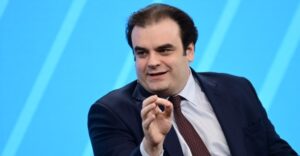
The Education Minister Kyriakos Pierrakakis spoke about the Universal Public Schools and elaborated on the education reform strategy during his television appearance on Wednesday morning, January 8, on SKAI. He then placed particular emphasis on the map for the internationalization of higher education, distinguishing between proposals for postgraduate partnerships between foreign and Greek public universities and the establishment of non-state universities from September 2025. Finally, he made reference to the Higher School of Performing Arts.
On the creation of the Onassis Public Schools Network
The importance of the Onassis Foundation’s donation was then highlighted by the Minister of Education, Kyriakos Pierrakakis, recalling that there has been successful cooperation between them in the campaign against school bullying.
Regarding the creation of Onassis Schools, the minister explained that they will be developed in areas facing social and economic challenges and will utilize existing school infrastructure, which will be modernized by drawing on resources from the Foundation’s donation. Importantly, the Foundation, as part of its offer, will also invest in infrastructure, allocating up to 1 million euros to each school unit – while the Marietta Giannakou program, through which 250 million euros will be allocated to schools in the country, is also running.
The prospect is to spread the Onassis Schools throughout Greece. More specifically, starting in September this year, it is planned to establish 22 Onassis Schools – 11 high schools and 11 middle schools. What these 11 areas will be, is also emphasized by the Prime Minister himself, according to Mr. Pierrakakis, who limited himself to mentioning that there will be a nationwide geographical dispersion and pledged that the specific areas where these schools will operate will be announced soon.
Onassis Schools will resemble Model and Experimental Schools but will be a new type of school. “The idea is to invest in that diversity. That is, to be able to have a pluralism in the system,” he explained. As for the students already attending these schools, they will remain but the way they are admitted will change along the way – as is the case respectively in Standard and Experimental Schools.
They will operate on the philosophy of the Standard and Experimental, which is based on educational innovations so once implemented, they are diffused more generally throughout the education system. In Onassis, “this logic will be served by other innovations, for example, in the development of teachers and their overall path in the education system, they will have to do with clubs and programs that go beyond the timetable.”
About the education strategy
The establishment of the Onassis Public Schools is but one piece of a puzzle, only one piece of a larger strategy, which includes many things, such as the introduction of the International Baccalaureate in Standard and Experimental Schools or the creation of Sports Schools.
“The education reform strategy includes too many points for it to catch on,” he said, adding: “We also see the results of reports, the PISA results, which are for the whole of Western Europe – they are not positive. It was thought that there was an overall drop because of the quid but that is not an excuse for stagnation. We know that we have to do too much and too quickly. And we will invest in infrastructure, and the books will change from September 26, the curricula.”
The minister acknowledged the intensity of competition in education systems internationally for access to higher education. “Our aim is to reduce rote learning and stress in the system. The curricula and all the changes we have initiated are in this direction are in this direction,” he said, noting that it is a difficult task as it is about balancing between time-honoured acquisitions such as the system of national examinations and at the same time, correcting problematic aspects of these.
“We have to simultaneously keep the good things about the system while reforming the more problematic aspects of it. The new curricula with new textbooks, which we will see from September 26, will be in this direction,” he said.
About internationalisation
The Minister of Education then referred to the internationalisation of tertiary education as a whole. He spoke about the successful creation of small and medium regional educational centers in our wider ‘neighbourhood’, such as Italy and in particular Florence, where 41 branches of foreign universities operate, and Cyprus, where, although until a few decades ago there were not even one foreign student now the situation has changed radically. “Greece has failed in this,” the minister admitted and continued: “It’s time to get it right now because we have excellent human resources in Greek public universities and excellent academic diaspora. We have professors, researchers all over the world. Internationalisation in Greece is to move along two parallel paths, starting simultaneously: one path has to do with the partnerships of Greek public universities with leading foreign universities, such as Yale or the University of California, on postgraduate programs. More than 100 tremendously interesting proposals have been submitte,” Pierrakakis said, pledging to announce these partnerships very soon.
The second path of internationalisation, involves the establishment of branches of non-state universities in Greece, which will operate as autonomous university departments with their own infrastructure. “For the branches, the application process has started, the evaluation of which will be completed at the end of spring. Then we will know about the non-state universities.”
Pierrakakis made reference to the future benefits, both social and economic, as well as purely educational. In addition, he spoke about the importance of creating a network of ‘ambassadors’ for our country: “It is very important to create ambassadors for our country, because when one studies in a foreign country, one learns to love and respect it, to visit it… how many ambassadors will be created for our country?”
Regarding the evaluation of applications, the minister stressed that “they will be evaluated by the Independent Authority for Higher Education – not by the Minister of Education…. We will see who reaches the quality criterion that we have set. I recall that the law has set the toughest qualitative criteria for a branch of a foreign university to be able to establish itself in our country,” he concluded.
About the Higher School of Performing Arts
The Minister of Education then turned to the discussion on the establishment of the Higher School of Performing Arts, explaining that – among other things – it comes to meet the need for the satisfaction of professional rights.
The ASPT will be created by absorbing five existing schools, following the model of the School of Fine Arts: “By merging schools that already exist and also building on it, like the National School, we will come to create the Higher School of Performing Arts on the model of Fine Arts. It will be within existing schools, which will be absorbed – the School of the National, the school that is the most prominent example. And we will come to do this, which has been done in other countries in Western Europe for many, many years and had not been done in our country. I am working closely with Lina Mendoni, the Ministry of Culture, to formulate aspects of this law. Very soon the bill will be in public consultation,” Pierrakakis assured.
Ask me anything
Explore related questions