





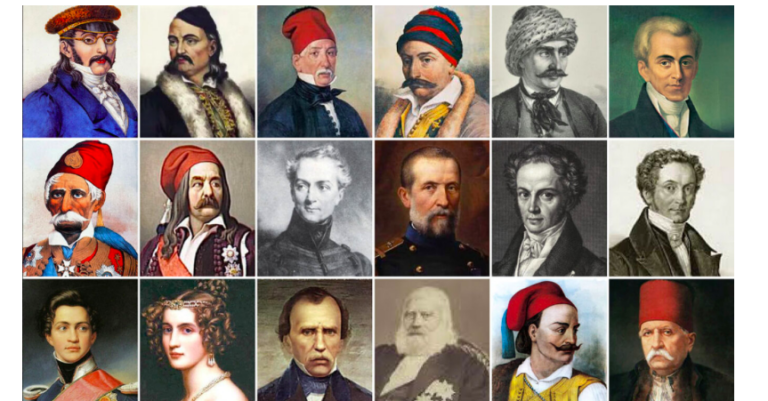
The death of Kostas Simitis on Sunday, January 4, 2025, was the reason we decided to write an article that we had been planning for a long time. This article will cover all the Prime Ministers of modern Greece, from 1822 to today. It will also provide some brief biographical details about them, primarily focusing on their studies, professions, and significant events during their premierships. Of course, there will be some omissions, but this information is not available on the internet, at least not in such an extensive form. And of course, only protothema.gr could present such an ambitious and innovative article. We begin today with the first part, covering the years from the Revolution to the expulsion of Otto.
From the Provisional Government of Greece (1822-1827) to the Constitutional Monarchy (1843-1862)
The distinguished academic Antonis Makrydimitris, in his monumental work “THE PRIME MINISTERS OF GREECE 1828-1997,” published by I. SIDERIS Editions in 1997, which has been out of print for some time, starts the account of Greek Prime Ministers from the period of the “HELLENIC STATE (1828-1831).” We will go a few years earlier, to the Provisional Government of Greece (1822-1827).
The first President of the Executive Body (15/1/1822 – 25/4/1823) was Alexandros Mavrokordatos (1791-1865). Born into an aristocratic family from Constantinople, he was a diplomat who studied fortification in Geneva and Medicine in Pisa. He is largely responsible for the defeat at Peta (July 1822). A controversial figure with behind-the-scenes actions, he was one of the main opponents of Ioannis Kapodistrias.
From April 26, 1823, to January 5, 1824, the President of the Executive was Petrombeis Mavromichalis (1773-1848). A Bey of Mani from 1815 and a key figure in the Revolution, he distinguished himself during Ibrahim’s invasions of Mani, where the latter suffered repeated defeats. His family’s opposition to Ioannis Kapodistrias and the assassination of the Governor by his brother Konstantinos and his son Georgios led to his imprisonment on charges of treason. He was released by Augustinos Kapodistrias.
From January 5, 1824, to April 17, 1826, the President of the Executive was Georgios Koundouriotis (1782-1858). A notable shipowner and a prominent figure of Hydra, he was opposed to Th. Kolokotronis during the civil war and anti-Kapodistrian. He organized the Hydra rebellion during the years of the Governor. Due to illness, he was temporarily replaced by Anagnostis Oikonomou (from December 23, 1824, to February 5, 1825), a prominent figure from Hydra during the Turkish occupation.
The last President of the Executive was Andreas Zaimis (1791-1840), serving from April 26, 1826, to April 14, 1827. A leader of the Kalavryta region, he was involved in the revolution and the fight against Ibrahim. His actions continued after the revolution, contributing to the efforts to develop the newly founded Greek State.
Hellenic State (1827-1833)
The Provisional Government of Greece was followed by the Hellenic State (1827-1833). From April 14, 1827, to January 18, 1828, power was exercised by a temporary government committee known as the Anti-Government Committee, consisting of Georgios Mavromichalis, Ioannis Markis – Milaitis, and Giannoulis Nakos.
From January 26, 1828, to September 27, 1831, the Governor, i.e., both the head of state and the president of the council of ministers, was Ioannis Kapodistrias (1776-1831), considered by many as the most prominent modern Greek politician.
He was born on the island of Corfu and studied medicine in Italy. He held important positions in the administration of the Ionian State (1802-1807). In 1809, he served in the Ministry of Foreign Affairs of Russia. From 1813 to 1814, he oversaw the settlement of the Swiss issue, where his enormous contribution is still recognized today. He participated in the Congress of Vienna in 1815. As one of Russia’s foreign ministers (1815-1822), he clashed several times with conservative Europeans, particularly Austrian foreign minister Metternich. He declined the leadership of the Filiki Eteria but supported the 1821 revolution with various initiatives. He was elected Governor by the 3rd National Assembly in Epidaurus and took office on January 26, 1828. Despite finding chaos, he managed to establish a state. However, his attempt to organize Greece along European lines encountered intense resistance from the local elites, the Phanariots, and the Hydriots. He was assassinated on September 27, 1831, in front of the church of Agios Spyridon in Nafplio by Georgios and Konstantinos Mavromichalis.
Greek Kingdom – Absolute Monarchy (1833-1843)
From January 25, 1833, to October 12, 1833, the Prime Minister of Greece was Spyridon Trikoupis (1788-1873), born in Messolonghi. He studied at the Palamadi School in his birthplace and then in Patras. Later, he studied philology in Paris and Rome. However, when the revolution broke out, he came to Greece and participated in it. He served as Minister of Foreign Affairs in 1835, and of Education in 1844, and was repeatedly ambassador to London (1835-1838, 1841-1843, 1849-1861). He was a lover of folk poetry and the author of the invaluable “History of the Greek Revolution.”
From October 12, 1833, to May 31, 1834, the Prime Minister was once again Alexandros Mavrokordatos. He was succeeded by Ioannis Kollettis (1774-1847), who served as Prime Minister from May 31, 1834, to May 9, 1835. Kollettis was one of the most controversial figures of 1821 and post-revolutionary Greece. Born in Syrrako, Ioannina, his family hailed from Delvinaki, Pogoni, Ioannina. He studied at the Kaplani School of Ioannina and later in Italy. He earned a medical degree from the University of Pavia in 1808. Returning to Epirus, he became the personal doctor of Ali Pasha. He joined the Filiki Eteria in 1819. Following the failed revolutions in Syrrako and Kalarytes, which led to the destruction of the two towns, Kollettis went down to Messolonghi and became a key figure in the civil war.
Kollettis was notorious for corruption, bribery, and shady dealings. He is blamed for persecuting and exiling Manto Mavrogenous and for the assassination of Odysseas Androutsos. He earned substantial money through usury and is considered one of the first to engage in election fraud and profit from politics. He was the leader of the pro-French faction and an advocate of the “Great Idea.”
Ask me anything
Explore related questions




