





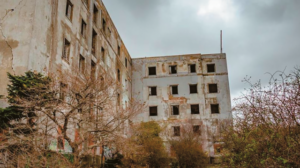
How far is myth from reality? Legend from truth? The logical from the inexplicable? Usually a lot, but there are cases where the boundaries between the two are indistinguishable. It is difficult to distinguish where reality stops and fantasy begins to run wild. So there are some houses in Athens, and in the rest of Greece, that have spooky legends attached to them, linking them to creepy narratives and stories real or imagined, where truths and visions are often confused. Stories full of suspense, tension, horror, and pain, often drenched in blood and death, and always awe-inspiring to hear.
Their origins involve tragic events. Atrocious crimes, murders, and paradoxical suicides, which in a riveting way encapsulate in the walls of these dwellings images of the past that haunt the thoughts of the old inhabitants of each region and pass from mouth to mouth, and through writings to the younger ones. They are now identified in their subconscious as “haunted houses”-signs registered by advocates of Parapsychology.
Villas, old mansions, towers and stately homes, buildings generally abandoned and derelict today. In all of them some patterns can be observed. Shadows on the walls that creep in as soon as night falls, souls hovering, figures projecting from behind windows or curtains, mysterious voices, sounds and noises, from songs and melodies to screams, howls and howls, crackles, jolts coming from the… beyond, strange symbols, satanic rituals, strange phenomena in the area around them and everywhere a sense of mystery, terror and even death. Much is connected to the black period of the Occupation, with places and buildings used as detention and torture sites.
Of course, these are legends that many like to project and scare, with nothing happening in these buildings anymore. Many are absolute figments of the imagination, or based on oral accounts that have survived with no documentation or evidence of what accompanies them.
Besides, some of these lodges don’t even exist today. Their place has been taken by new buildings with completely different uses. And some have not only been preserved and renovated but are truly architectural jewels. But still, many insist that their legends have not been buried, but hover…
Dukissis Plakentias Mansion: The Castello of Rhododaphne
The mansion of Dukissis Plakentias, the Castelo of Rhododaphne as she called her summer residence in Penteli, now belongs to the municipality of the area and hosts the municipal Cultural Centre. It is an iconic space with a library of rare books, as well as an event hall for up to 1,000 people.
Many myths accompany this magnificent Gothic palace, the work of the great Macedonian architect Cleanthi. Sophie de Marbois-Lebrun – the Duchess of Placentia – was the daughter of French diplomat Francis Barbe de Marbois and American Elizabeth Moore, born in Philadelphia in 1785. She acquired the title of duchess at the age of 20 when she married Charles Lebrun, Duke of Plakentia and a protégé of Napoleon. She had one daughter, Caroline-Elizabeth, whom she loved dearly.
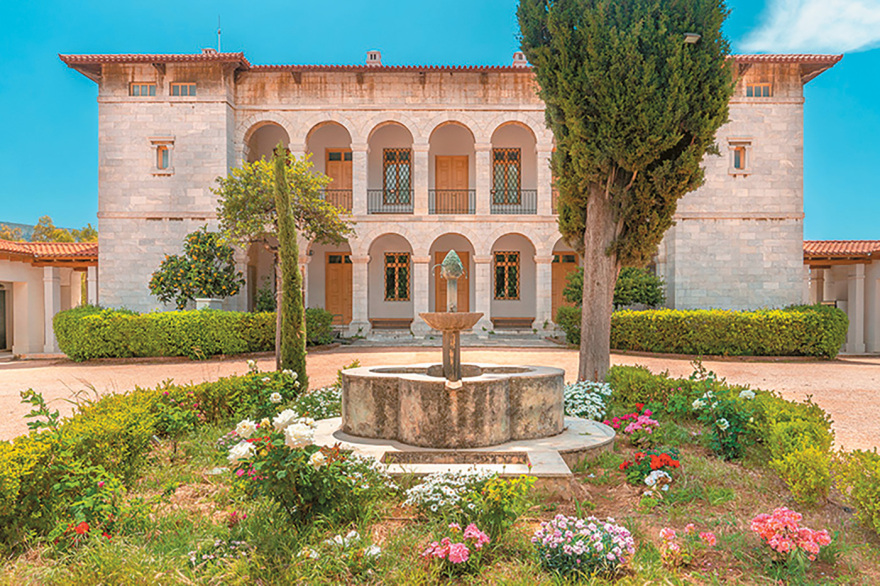
The legends about her began right when her daughter died. She was devastated and refused to accept her loss – it is even said that she embalmed her body so that she would not be separated from her. Her love was so pathological that she kept her embalmed body inside the mansion and acted as if her daughter was alive. She also went around the palace in a white nightgown at night and those who passed by thought she was a ghost or a fairy.
An unexplained fire destroyed the palace and also cremated the embalmed body of her daughter, plunging the duchess further into despair and madness and spawning new legends. Before the area was overrun with new residents and the building was also renovated, no one dared pass by. Many claimed that a white-robed figure prowled the ruins searching, while others heard strange voices and howls.
The mansion was never completed. Why? According to French writer Edmond Abu, who interacted with the duchess, she left her buildings unfinished because of a superstition that when one was completed she would die. After she died in 1854, the building remained unoccupied and dilapidated. In 1959, its restoration began at public expense. When it was completed in 1961, it was given to the heir and later King Constantine II as a country residence.
Around the middle of the 20th century, another legend referred to an illicit love affair between the duchess and the chief architect Christos Davelis.
Their secret meeting was achieved through a tunnel that connected the cave of Davelis with the castle of Rhododaphne. To date, however, research has not proven this to be the case. The cave, at an altitude of 720 meters southwest of Penteli, has also been the subject of metaphysical quests. The rumors began in the 1970s, when researchers reported the occurrence of electromagnetic phenomena, with their measuring instruments being affected, compasses disintegrating, metal detectors going haywire, and cameras malfunctioning.
Pikermi: The Mansion of Mystery
The Mystery Museum
Connected to legends that border on the paranormal is a mansion in Pikermi, the Mansion of the Mystery, built in 1910 by Pericles Kallergis, caretaker of the Skouze estate. The beginning of strange descriptions concern the entire site and start from the 18th-19th century, with reports of strange… flying creatures, tiny misshapen beings that moved spasmodically, and eerie whispers that followed. In it, Kallergis killed, blinded by jealousy, his wife, and then committed suicide. Since then, no tenant has been able to stay in this house for a long time.
Some passers-by said that the soul of the murdered woman used to go out at night and wander about seeking redemption in the empty rooms of the mansion. Also, in the dead of night, the voices and screams of a woman pleading for something could be heard from the house.
Another version says that Kallergis had never married and that the building was used as a garrison by the Italians during the Occupation and torture was carried out in the basement.
Others spoke of strange phenomena, while some claimed that the shadows were due to the particular architecture of the building. Supporters of the haunted house idea, however, were adamant that it was the haunted souls of those who crossed its threshold.
A parapsychologist said, according to a testimony of a well-known singer, that in a survey he conducted he found that there were indeed in the house… trapped spirits that need to be released…
Neo Faliro: The Tower of Haunted Dreams
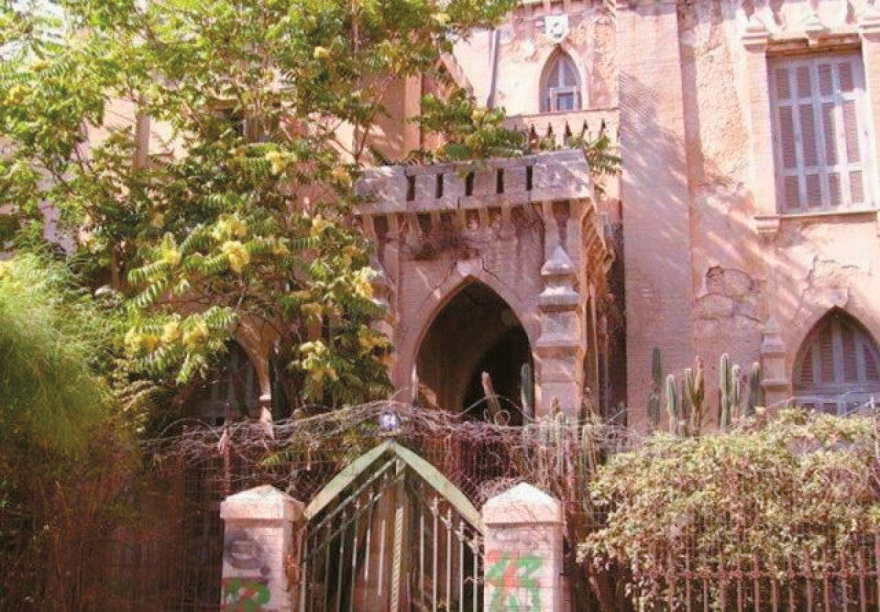
At 4 Smolenski Street in Neo Faliro, a neoclassical building, a real tower, has remained uninhabited and dilapidated for decades. It was built in the 19th century and is known to fans of metaphysical phenomena. It is the house of a cloth merchant, Kyriakos Kourtalis, who lived at the beginning of the last century and is said to be the home of his ghost. Kourtalis was an ambitious man. But he failed to become a tenor, as well as the mayor of the region for only 4 votes. His passion for an office was such that his friends called him “Mr. Mayor” or “Mr. Minister”! He has hated people ever since. Thus, when in the last years of his life he became bankrupt, he began to plunge into madness.
So he secluded himself in his tower and died under unclear circumstances. Later, residents said that while passing outside the house they often heard someone singing behind the closed shutters. But if someone touched the patio door, the voice would change its timbre and sound harsh: “Away. The tower is mine.” Or even, when the sun was setting, they would see an old male figure either standing at the window staring stubbornly and silently outside or prowling around the tower, whispering unintelligible words.
Callithea: The neoclassical house of cursed love
On Laskaridou Street in Kallithea, there is an impressive two-story neoclassical building, Villa Laskaridi, an exquisite work by Ernest Chiller. It is a cursed love, after all, that haunts her. The owner, the painter Sophia Laskaridou, whose life changed after the suicide of her lover, the literary artist Pericles Giannopoulos, who couldn’t bear to have the painter away from him, at Monacho, for studies and on 8 April 1910 he ended his life by pulling the trigger on a white horse in the waters of Skaramanga, dressed in a suit and with heavy stones in his pockets.
He was madly in love with her, but the young artist, although she harbored similar feelings, when he asked her to marry him, she refused. She did not want to give up painting, or her independence. The daughter of a very wealthy family of Trebizond origin, she lived in the salons of cosmopolitan Athens, even dining with King George. She was even the first woman to be admitted to the Athens School of Fine Arts.
She was the first woman to be admitted to the Athens School of Fine Arts.
Yiannopoulos had warned her of his intentions in a letter. When she received it she immediately returned to Athens, but it was too late. She sank into mourning, broke down, dismissed the servants, sealed the shutters to keep the light out of the house, and lived like that until she died.
Legend had her sitting constantly in a rocking chair repeating Yiannopoulos’ name. Later, she opened the house and received visitors, but only on the first Sunday of each month. She mourned Yiannopoulos in her way throughout her life. One of those Sundays Freddy Germanos visited her. She told him a lot, but most of it was what she wrote in her memoirs published in 1955 under the title “From My Diary – Memories and Reflections” and in 1960 in its supplement entitled “Supplement: A Great Love”. Her love for Yiannopoulos.
Kifisia: Villa Kazoulis and the Ghosts of the Occupation
The Villa Kausalini and the Ghosts of Kausalos and the Ghosts of the Ghosts of Kazoulis
Without a doubt one of the most impressive and much-discussed buildings in Athens. A real gem in Kifisia, on an area of 47 acres, having been built at the beginning of the last century by the Egyptian businessman Nikolaos Kazoulis. The heavy iron gate, the ornate sculpted lions, the work of the famous sculptor Dimitris Filippotis, the grand marble staircase, and the imposing dome are a mixture of neoclassicism and Renaissance architecture, while its impressive symmetry and awe-inspiring symmetry.
This famous building, having also passed through the hands of… It finally came into the possession of the Greek State in 1949, initially housing the KAT hospital until 1952 and then the earthquake patients of the Ionian Islands. Much later, in 1999, the building housed the National Centre for Environment and Sustainable Development, while since June 2014 the Green Fund services have been located there.
Since June 2005, the Centre has also been housed at the premises of the Environmental Protection Agency. This jewel of a building for many decades has been associated with various legends. Initially, the fact that it was built on a Turkish cemetery. It acquired its reputation of being haunted because, during the German occupation, it was used as an SS garrison, and in its two basements dozens of Greek fighters were martyred and tortured inhumanely, some of them breathing their last breath there.
Fatefully, after the Germans left, the villa became associated with a series of terrible stories. Residents claimed to have heard the screams and cries of the victims and saw their ghosts roaming in and out of the villa at night, calling for help. Others that they heard songs of despair from within. An additional rumor that reinforced the alleged existence of ghosts was the murder of a journalist by the Germans just outside the villa, which was even used in 1970 for the filming of Nikos Foskolos’ famous movie “Lieutenant Natassa” starring Aliki Vougiouklaki.
Hallandrios Room: The house of Gina Bahauer
On the corner of Prophet Elias and Markos Botsaris streets, next to the well-known Rematia of Halandri, is a dilapidated detached house. It once belonged to the Greek internationally renowned classical pianist Gina Bahauer.
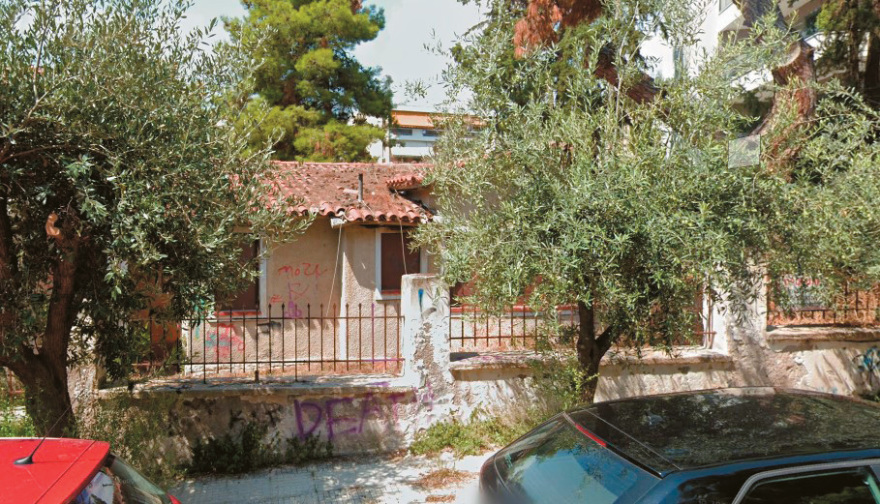
The daughter of an Austrian and an Italian, she was born in May 1913 in Athens, where she experienced her first distinctions on the piano. She continued her studies in Paris and also in London as an apprentice of Sergei Rachmaninoff. She lived with her first husband, businessman Ioannis Christodoulou, in Egypt. After his sudden death in 1950, she married British orchestra conductor Alec Sherman, who left his career to become her manager. She had no children.
It was in this house that Bahauer spent many – and all – of the last years of her life. It was there that Sherman was found dead, of cardiac arrest, on August 22, 1976, before she performed at the Herodion, as part of the Athens Festival, with the Washington National Symphony Orchestra. She had instructed that the house be given to the Athens Conservatory, but this did not come to fruition.
From then on began the legends that haunt the now deserted and abandoned house. They say that noises and sounds were heard from inside the house that seemed to come from piano keys and eventually some people mistook them for melodies. “Gina is giving a concert for her friends,” they said. In the house, however, there is no piano anywhere. And some residents claimed to have seen a black-clad woman walking around. It’s not a rare sight, of course.
Ekali: Butler’s slaughter of a family of four
Linked to a chilling story, the brutal murder of the family of businessman Michael Chrysafidi in June 1991, is a residence – and considered by many for that very reason a haunted or even bloody villa in Ekali 10, Thiseos Street, number 10. But here the facts are crossed and true: the four members of the family, the Chrysafidi couple and their two sons, were found after several days of searching, as they gave no signs of life, all dead in the basement of the villa in blood.
Police suspicions turned to the family’s Thai butler, then 28-year-old Prasert Sertuasana (aka Tai), who, along with his wife, mother-in-law, and mother-in-law’s sister, fled to Thailand. A few days later, Chrysafides’ nephew, Alexander Makridis, a neighbor and the sales manager of his factory broke into the house with the help of a locksmith. In the basement they were confronted with a scene of horror: the bodies of the four family members. 16-year-old Michael-Dmitris, gagged, savagely beaten, and with his skull crushed with a sledgehammer.
In an adjacent room, 18-year-old Giorgios, also gagged and beaten with a scepter. Next to him is the 48-year-old father and in the third room is 43-year-old Liz, wearing a formal dress but no underwear. Among the murder weapons and an axe. The forensic investigation proved that all four victims had been tortured before they were killed.
The murders, however, were carried out in stages. First the two children. A day later the father and two days later the mother. The last clue overturned the original assumption that the only murderer was the butler. It turned out that Liz Chrysafidi had been murdered while the Thai man was in his home country. In the safe were found family jewels, but no cash. Following the revelation of the horrific crime, the Greek authorities asked the Thais to extradite Tai, but to no avail. The quadruple crime remains unsolved. The butler’s involvement is taken for granted, as is the fact that he had an accomplice or accomplices. But who was the mastermind?
A year after the crime was revealed, the Chrysafidi family’s villa was put up for sale at a very attractive price. Journalist Giorgios Tragas then made an offer, but contrary to what many reports claimed, he did not end up buying the house, which ended up with a businessman.
Parnitha Sanatorium: Greece’s most haunted building
The most haunted building in Greece is the most haunted monument in Greece.
But other buildings in Attica are considered by many to be haunted, that they carry and hide a strange, usually eerie legend in their carcass. Like the old Sanatorium of Parnitha, which operated between 1919 and 1965 and then attempted, unsuccessfully, to be converted into a hotel.
It has been described as the most haunted building in Greece and is the symbol of groups involved in metaphysics and parapsychology. It is crumbling and many visitors claim to have heard strange voices, while its walls are dominated by strange symbols.
They have been seen to have strange visions and strange symbols.
Rumour has it that one should not descend at night into the basement, where the morgue of the sanatorium used to be, as the souls of the dead who wander there “set up a dance”. At the same time, it is said that on some nights, groups of Satanists hold their rituals there. A decidedly more logical explanation for much of it.
A street in Metz, in Pagrati, is also a suitable location for similar theories and strange stories, an ideal destination for fans of the paranormal. At 22 Agras Street is a neoclassical building that once belonged to a stable master of King Constantine. Neighbours have reported that there were strange lights, and mysterious movements of figures, and those who have visited it speak of a strange atmosphere and a chilling feeling of unjustified fear
Also, figures and shadows sprang from the house, which, however, never bothered anyone, but at the mere sight of them, one was left statuesque. The strangest rumor concerning this house, however, was that sometimes a road would appear next to it! Out of nowhere…
Another tragic story that grew into a terrifying legend can be found in Thiseio. In the 1930s, next to the Electric station, there lived a beautiful girl, Athanasia, but poor and fatherless, who was working to prepare her dowry when she got married. One day, however, her savings ran out. It had been stolen by her mother, who had disappeared with her lover. Her fiancé, in turn, when he learned that the savings had disappeared, abandoned her.
Athanasia sank into despair. She could not bear it. She hung herself from a beam inside her house that now stands deserted. Some say that a figure behind the electric train station hung around some nights, and women’s cries could often be heard from the house, which suddenly turned into satanic laughter.
Thessaloniki
Bas. 263 Vasil Vaska Street, Vasil Vaska Street.
A much-discussed house, one of those accompanied by legends and paranormal rumors, is the one at 263 Vasilissis Olga Street in Thessaloniki. Its fame dates back to the Turkish era. It belonged to a wealthy Bey who choked one of his wives with a rope when she reacted to his behavior. During the Occupation, his basement was used by the Gestapo for torture. Strange noises, screams, falling objects, doors swinging open, lights flashing, crystals breaking are some of the evidence that passers-by occasionally report.
The strangest mystery story of this particular mansion, however, took place in the 1980s. Its numerous owners gave it away as a quid pro quo.
It is said that on the eve of the start of work, the contractor died of a heart attack, while the architect and engineer were killed in a car accident while traveling from Athens to the capital. Neighbours have spoken of flashes suddenly appearing through windows, but others claim to have never noticed anything. The legend of this particular mansion continues to this day to magnetize many paranormal enthusiasts, who try to confirm or reject this particular urban legend.
The Red House and the Lost Road
Another building with… a history of legend is the Red House in St. Sophia Square, the work of architect Leonardo Genari in 1926. It once belonged to the Longos family, an important textile family, but in 1939 they were financially ruined and were forced to abandon this house, until then a symbol of economic power.
The house was decaying and perhaps for this reason it acquired the reputation of being haunted, which was reinforced by stories of paranormal phenomena running rampant, but involving the appearance not of ghosts but of vampires. Today, under the ownership of Ivan Savvidis, it has passed into another era, free of the negative legends of the past. Another house with a reputation for being haunted in Thessaloniki is the Chatzigiogou House in Aretsou, Kalamaria, a copy, according to many, of the mansion of Vasilissis Olga,
A negative aura also pervades a small narrow paved street, the infamous Mavris Petra Street, in Ano Poli, which, if you walk along it, you think the houses are leaning over it, watching your every step. And it reaches a dead end where legend has it that every three days, at midnight, a lost road appears that no one knows where it leads.
In the Upper City, the “secret” Terpsithea Square stands out, where the turbe (mausoleum) of Moussa Baba is located, which was rumored to be haunted by the ghost of the dervish guardian of the tepee!
Ask me anything
Explore related questions




