





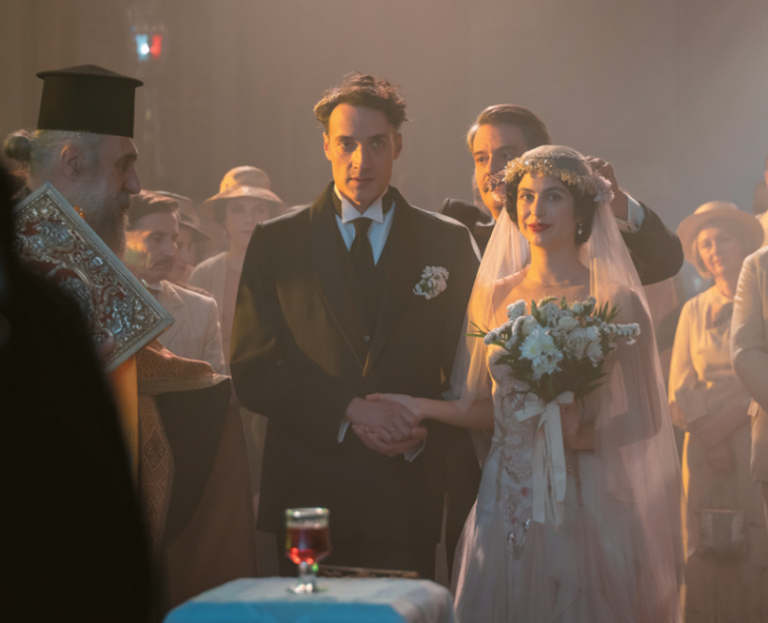
In a somewhat magical way, every time a work by M. Karagatsis makes its way to television, the set created for the journey takes on cinematic dimensions. This happened years ago with Deka, where the old CHROPEI factory was used.
The 4,000-square-meter space was transformed by the set design team, led by Kostas Pappas, into the poor neighborhood of Piraeus where Anastasios Kalogeras’ old winery-turned-apartment building stood at 10 Parasaggi Street. The set design, faithful to the 1950s aesthetic, incorporated authentic old objects from the production company’s collection, enhancing the historical atmosphere.
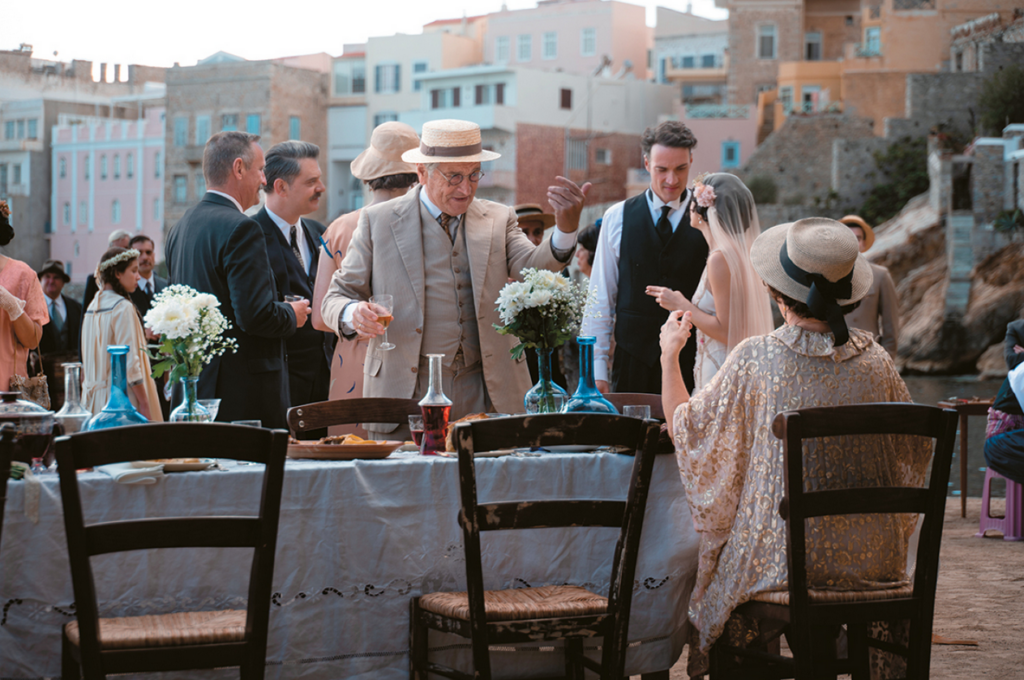
In Syros
A similar transformation took place in Syros before Christmas. Between January 15 and February 5, Athens’ historic center was turned into an impressive set for The Great Chimera, transporting viewers a century back in time.
Set designers and technicians worked tirelessly to recreate the 1930s atmosphere, authentically reconstructing streets, parks, and neighborhoods. Familiar areas of Athens took on a new character, revealing hidden corners of the past. For the 1930s setting, locations were built and redesigned, while extensive VFX technology was used to recreate areas that have since changed.
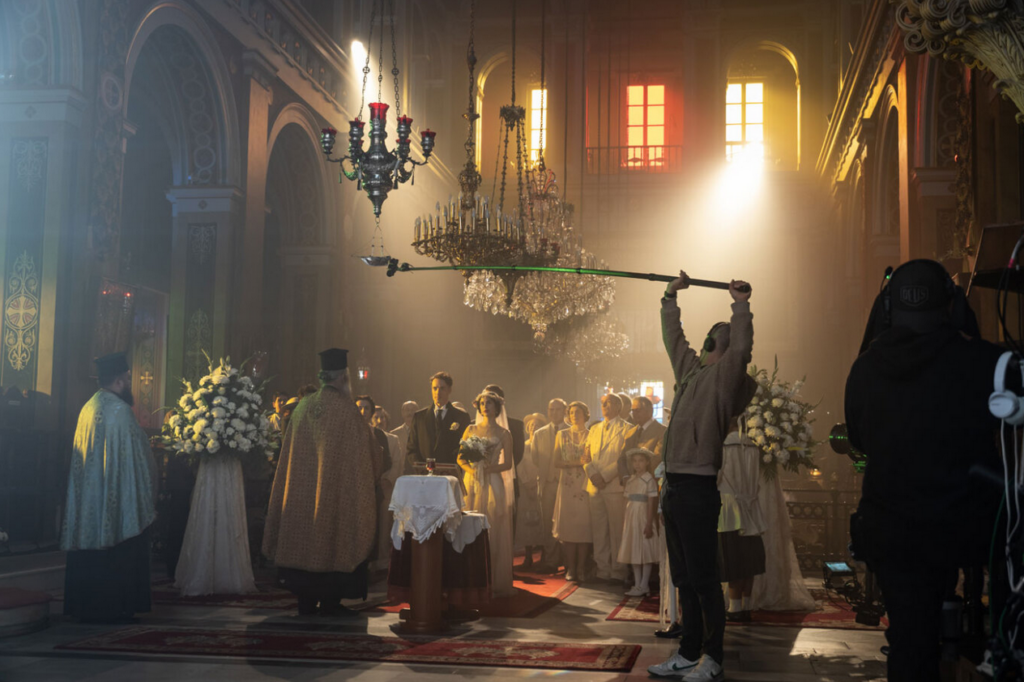
International Filming
In the coming days, production will move to Trieste, Italy, where filming will continue until late February. After that, the team will return to Greece to complete filming on Mykonos, Delos, and Rineia. The series is directed by Vardis Marinakis, with script supervision by Panagiotis Iosifelis, and is produced by Foss Productions, Beta Films, Mompracem Film, and Boo Productions.
Aiming for International Success
The Great Chimera is not just another fictional TV series—it is an ambitious international co-production designed to reach beyond Greece. With a total budget of €6 million for six episodes—nearly €1 million per episode—the series aims to break away from local industry constraints and establish a new production model that justifies its strategic financial backing.
With the participation of major film and television creators from Greece and abroad, The Great Chimera promises to faithfully and respectfully capture the atmosphere and characters of the 1930s. At the same time, it is expected to be distributed in international markets, bringing M. Karagatsis’ timeless work to screens worldwide.
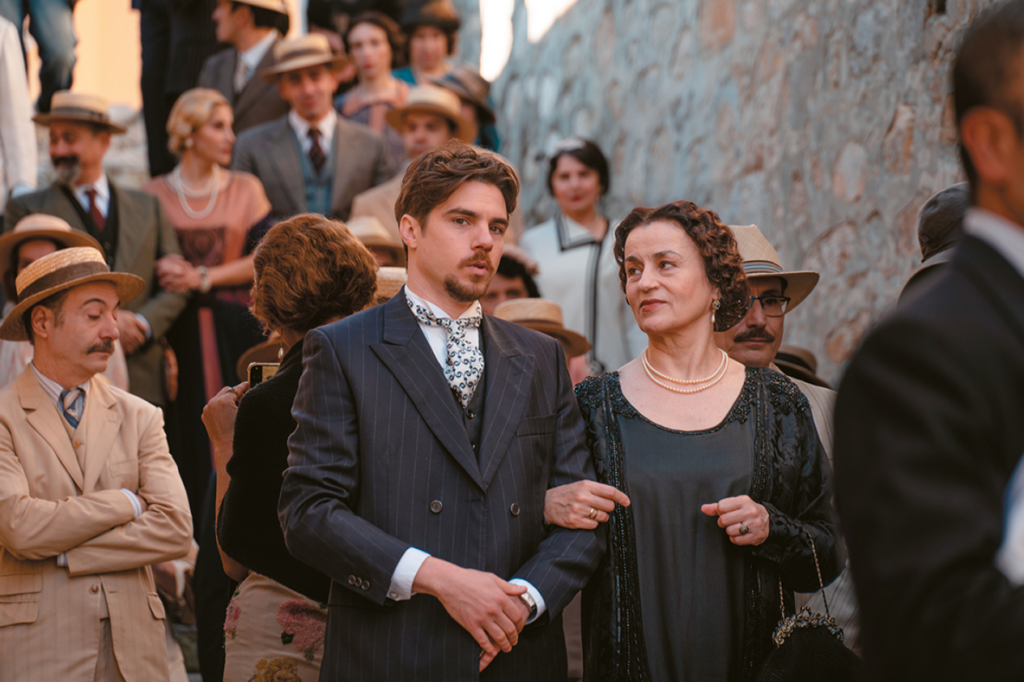
The television adaptation of this landmark novel in modern Greek literature is a major endeavor for ERT. As its executives emphasize, public television “supports Greece’s rich cultural heritage by showcasing a work that explores universal emotions such as love, pain, and self-destruction, while simultaneously blending the magic of Greek literature with international cinematic standards.”
The Great Chimera is set in the 1930s but places at its narrative core a heroine who resonates strongly with contemporary audiences. The story’s protagonist, Marina, is a woman consumed by passion, relentlessly pursuing happiness, only to gradually lead both herself and those around her to destruction.
This is an epic work filled with major events, powerful conflicts, and intense emotions. At the same time, it is deeply introspective, boldly revealing the protagonist’s complex inner world—a woman who dares to claim her desires in an era when such aspirations were not socially acceptable.
In the leading role of Marina, Italian actress with Greek roots, Fotini Peluso, is tasked with embodying the protagonist’s inner struggles and passions. Andreas Konstantinou plays Giannis, Marina’s husband, while Karyofyllia Karabeti takes on the role of Raïzena, a pivotal figure in the story. Dimitris Kitsos brings to life the character of Minas.
The series boasts an impressive cast, including Giannos Perlegkas, Kaiti Manolidaki, Dimitris Tarlow, Vasso Iatropoulou, Kondylenia Konstantelaki, Alexandra Aidini, Giorgos Michalakis, Nikolaos Chanakoulas, Giorgos Frintzilas, Nikolaos Papagiannis, and Giannis Dalianis.
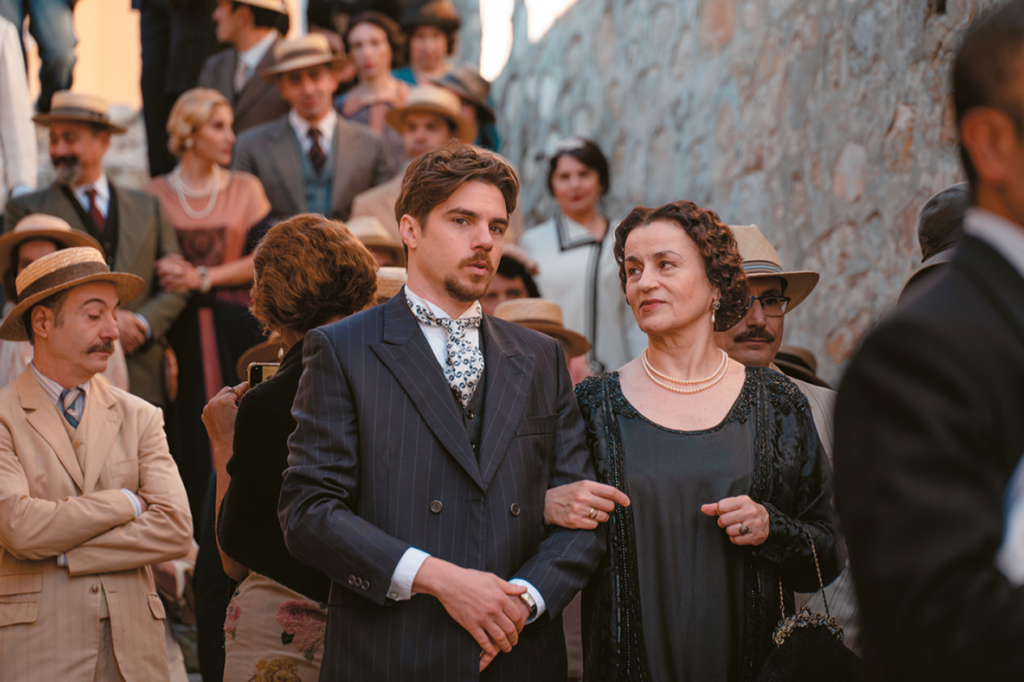
In Athens
Panepistimiou Street has changed. It has been transformed into a 1930s cityscape, and according to Foss Productions producer Stelios Kotsonis, “In Syros, we didn’t need to do much—it is already a natural set. We wouldn’t have achieved anything without the support of the local government and community. They embraced us, and that was the moment when the book started coming to life. We had a crew of 60 people and dozens of citizens who helped us with the wedding scenes, the carnivals, and the theater sequences.”
Panepistimiou Street was closed from Saturday afternoon until Sunday night. Above all, the person who truly helped and secured the numerous permits was Stathis Kalogeropoulos from the Athens Film Office. He was enthusiastic from the very beginning and took immediate action, ensuring all the legal permits required for filming.
Approximately 300 people were involved in the production. Significant support was provided by Diamantis Karanastasis and Deputy Minister of Culture Iason Fotilas. Soil had to be placed on both Panepistimiou and Dionysiou Areopagitou streets, and for this, assistance was given by the Central Archaeological Council (KAS), which also granted permission for filming at the Acropolis. Additional support came from various Archaeological Services, the Ephorates of Antiquities, the Regional Governor of Attica, Nikos Hardalias, the Mayor of Athens, Haris Doukas, and, of course, the Minister of Culture, Lina Mendoni.

Traffic police closed the roads, and law enforcement ensured security. All relevant organizations—OASA (Athens Urban Transport Organization) and the Metro—adjusted routes and starting points. The Ephorate of Modern Monuments, the University of Athens administration, and the National Library opened their doors for filming. More than 150 extras participated, contributing to scenes that now evoke strong emotions.
The man whose assistance and coordination made all this possible, Stathis Kalogeropoulos, described the process to Proto Thema: “First, we coordinated with municipal services and began communicating with all relevant entities to facilitate the demanding shoots. We mapped out the initial needs and moved forward. It was something unprecedented—nothing like this had been done before. Chimera represents an effort to showcase Greek intellectual property with an outward-looking perspective.
This is the model we should be following. This is what will move us forward, rather than simply copying foreign formats. We wanted to ensure that no problems arose—both in terms of public disturbance and safety. The public was very supportive, and the production team was highly considerate of them. When they heard that the filming was for a series based on a work by Karagatsis, there were no complaints.
Athens is a magical city—it is a welcoming city for filming. Everyone wants to return to Athens, even international crews. There is enormous potential for more productions here. Hopefully, the industry will expand, creating more job opportunities and fostering further projects.”
Karagatsis on Television
There have been numerous attempts to adapt Karagatsis’ works for television in the past, with varying degrees of success. For instance, the 1976 Junkermaan adaptation on YENED, starring Alekos Alexandrakis, did not achieve massive success but still fared better than the 2007 version on ANT1 featuring Konstantinos Markoulakis, which was canceled due to low viewership and other issues.
In 1979, Colonel Liapkin was also aired on YENED, while the 1981 adaptation of The Yellow File for ERT was never broadcast. However, this series would later make history when it was aired on ANT1 in 1990, directed by Kostas Koutsomytis, starring Giorgos Kimoulis, Karyofyllia Karabeti, Ilias Logothetis, Giorgos Michalakopoulos, Vladimiros Kyriakidis, Petros Fyssoun, Gerasimos Skiadaresis, and many others.
In 2007, ALPHA decided to air an adaptation of Karagatsis’ final, unfinished novel, Ten, spanning 18 episodes. The series was highly successful, featuring Dimitris Kataleifos, Lydia Fotopoulou, Reni Pittaki, Kora Karvouni, Dimitris Imellos, Vasilis Charalampopoulos, Rania Oikonomidou, Alexandros Logothetis, and a musical score by Eleni Karaindrou.
Ask me anything
Explore related questions




