





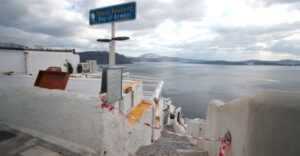
A relative calm prevails in the wider Santorini area, as the tremors that are occurring are of lesser intensity.
Yesterday, there were a few earthquakes measuring 4 on the Richter scale, while the largest earthquake was a 3.5 on the Richter scale at dawn on Thursday.
The Director of the Geodynamic Institute of Athens, Vassilis Karastathis, spoke to MEGA about the earthquakes and the evolution of the phenomenon.
“There is a gradual decline,” he said initially.
“We are seeing a decline in seismicity. If this holds for 4-5, then things will be more optimistic,” he said, among other things. “Less tension in Santorini than in other areas,” he added.
Professor of seismology Akis Tselentis said it would be “lucky” to have a 6 magnitude earthquake – and 7 as a very, very low probability.
Slowly the residents are returning to the island in order to resume their activity.
“At first I thought it was almost certain that it would be a 6.”
Commenting on the developments, Dimitris Papanikolaou, Professor Emeritus of Geology, stresses:
“At the moment we expect this activity to continue, regardless of the individual fluctuations in both magnitude and frequency, and we are always waiting to see if this activity will be able to activate the Anydros fault, which has a potential of about 6, to see if and when the situation will be relieved. If the fault is activated, we expect it to vent much more quickly, within a couple of weeks, but as long as it doesn’t vent and this situation continues, it’s very likely that we’ll be pulling into Easter, maybe even after Easter with these 5s.”
For a possible earthquake of 6 magnitude, it says:
“At first I thought it was almost certain to be a 6, when we had not yet realised that it is not a completely ordinary process of tectonic deformation, but we saw that it is tectonomagnetic.”
“Here we have ‘x-rayed’ the area, we know the area underwater very well, we have drilled deep wells. (…) We cannot have a better radiography in one place. Here we have the many small faults and we also have the big one of Andros, if we stay in the area where we currently have the earthquakes,” he adds.
“On the issue of the magnitude, I stick to the very specific estimate that we can make based on the maps and the subsea data and I think that 6, 6.1 is indeed the representative magnitude that could be made,” he stresses, noting:
“There is no question of volcanic activity.”
It should be noted that the Seismic Risk Assessment Committee meets again tomorrow, Saturday.
Ask me anything
Explore related questions




