





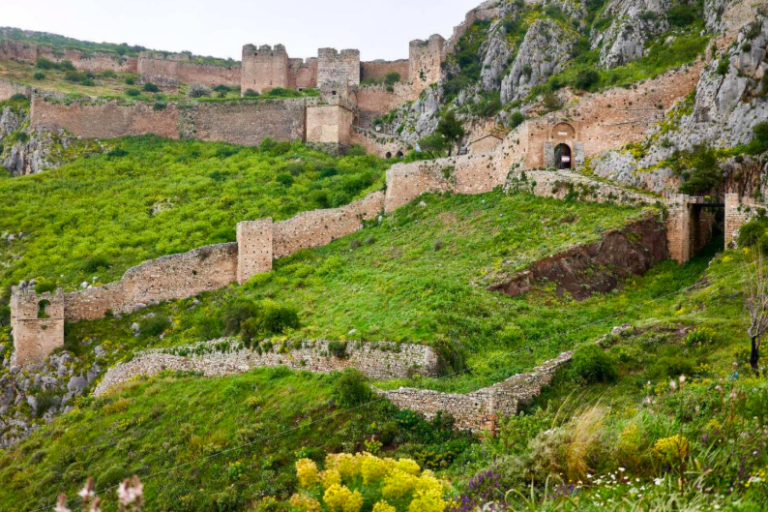
The Acrocorinth Castle, which has historically served as a refuge for the residents of Ancient Corinth during times of invasion, is undergoing a series of protection and enhancement works initiated by the Ministry of Culture. The Ministry, through the responsible Corinthian Antiquities Ephorate, is working under Cultural Development Agreements with the Peloponnese Region. These projects aim to ensure both the preservation of the site and the safety of its visitors, with particular focus on addressing rockfall issues.
Additionally, the restoration of the Ottoman mosque (Ottoman Mosque A), the study for the restoration of parts of the outer castle walls, and a lighting study for the site are underway. The Acrocorinth Castle, located on the prominent hill of the same name, overlooks the ancient Corinthian surroundings and has served as a steadfast stronghold throughout history. Its formidable walls rise from the upper parts of the hill, and the vulnerable western section is reinforced with a trench and three lines of fortifications, each with its own gate. The castle’s current form is the result of successive construction phases, with the earliest known phase dating back to the Archaic period when Corinth was ruled by the tyrant Cypselus and his descendants (657–583 BCE). Significant expansions and modifications were made during the Byzantine, Ottoman, and Venetian periods.
Minister of Culture Lina Mendoni stated: “The protection of the Acrocorinth Castle and the safe visitation for guests are top priorities for the Ministry of Culture. We are working in close and constructive collaboration with the Peloponnese Region to highlight and utilize this historic fortress. Our restoration efforts will address rockfall problems near the entrance of the Castle (Gate A). The project includes creating event spaces, completing visitor pathways, stabilizing and enhancing various areas and monuments, such as the Ottoman mosque, and establishing a digital tour. Additionally, studies are being developed for wall stabilization and lighting. Our goal is to ensure the protection and security of the monument and its visitors, while highlighting its various historical phases, including its evening presentation.”
Due to rockfall hazards near the entrance, for public safety, the Corinthian Ephorate has temporarily altered access to Gate A, with a newly designed alternative route. The ongoing stabilization work of the rocky slopes is based on a geological-geotechnical pre-study. The castle’s walls, which stretch over 3,000 meters, enclose an area of 240,000 square meters, a significant portion of which developed into a settlement with numerous monuments. Once the stabilization and conservation plans for the most damaged sections of the walls are completed, alongside the rockfall stabilization work, the cobbled path leading to Gate A, which was closed in 2023 due to rockfall, will be reopened.
The Ottoman Mosque A, located within the third enclosure of the castle walls, is one of the few remaining structures of the castle in relatively good condition. It dates back to the first Ottoman period (1458-1687) and has undergone at least one phase of reconstruction. The mosque follows the typical architectural style for such buildings in Greece, featuring a prayer hall (mihrab), a portico (revak), and a minaret. The Ministry of Culture’s goal is to restore this mosque and integrate it into the network of accessible monuments at the castle, converting it into a space for cultural events.
Ask me anything
Explore related questions




