





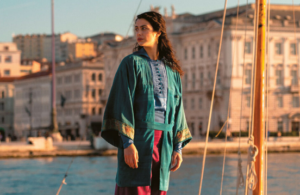
Arriving in Trieste, this beautiful port with its imposing buildings, amphitheatrical view, and aristocratic cafés, you immediately understand why this melancholic city is the perfect setting for adapting a book like The Great Chimera. Here, in the former center of the Habsburg Empire, in the shadow of the Balkans with a strong Greek presence, the cosmopolitan vision of the incomparable—so it seems—M. Karagatsis, born Dimitrios Rodopoulos, comes to life. This vision is now being brought to the small screen with fully cinematic standards by the national television network.
ERT’s most expensive television series to date—a six-episode production with a budget reaching €1 million per episode—is a bold step toward reviving grand, high-quality productions that can rival cinematic films in every aspect.
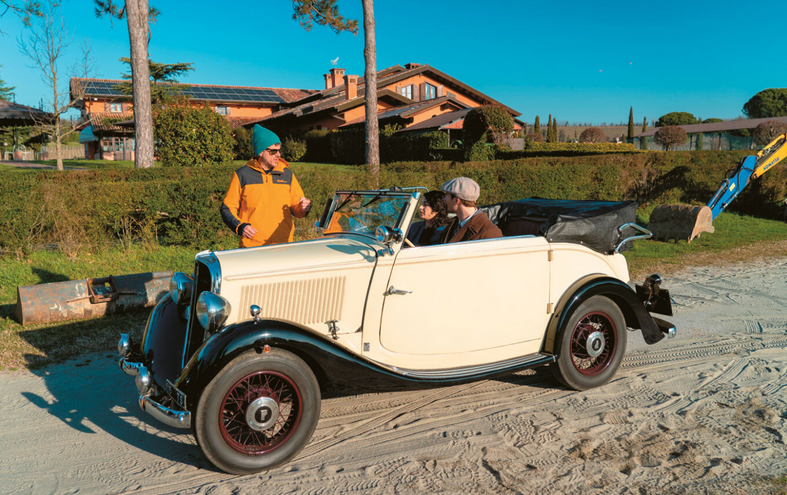
That’s why the attention to detail—both in terms of performance and the absolute authenticity of the atmosphere and era—can only be compared to cinematic standards. This approach is shared by director Vardis Marinakis and the entire Greek-Italian co-production team. Karagatsis’ and Marinakis’ Marina—beautiful, timeless, modern, and free—speaks different languages, thinks beyond borders, and embarks on her own existential journey against the backdrop of some of the most stunning landscapes in Greece and Europe.
In Historic Locations at Minus Five Degrees
From the picturesque island of Syros—a Greek painting in the heart of the Aegean—to Athens, reflecting the author’s urban vision, and the grand estates of the North that align with the novel’s haunting atmosphere, every setting contributes to reviving the old cinematic approach, where unique locations and moods mattered more than lifeless studios with artificial green-screen backdrops.
Here, everything is real: the cast and crew anxiously watching the weather, as strong winds once again delay filming at Trieste’s port; the dedication of the lead actors to deliver their best—how much, indeed, did Fotini Pelouzo have to freeze so that the silent grief on her face could be captured in full? The creative tension of director Marinakis, who might spend an entire day perfecting a single scene; the enthusiasm of the technical team, dropping their lunch mid-bite to rush back to the set.
“The Great Chimera” is a gripping cinematic mini-series with a contemporary script, steering clear of stereotypical representations. It will focus on the emotional weight of the story and Marina’s agonizing internal journey toward a redemption she never finds.
“The form, the scenes, the dialogues, the acting, the use of the camera and light, the sets, the costumes, the music—all will come together organically, allowing the audience to experience Marina’s journey with the same emotional intensity as when reading M. Karagatsis’ novel,” notes Vardis Marinakis in a statement. He explains his vision up close: to bring this timeless story to life while staying faithful to the author’s spirit—yet through a modern lens that highlights its enduring relevance to today.
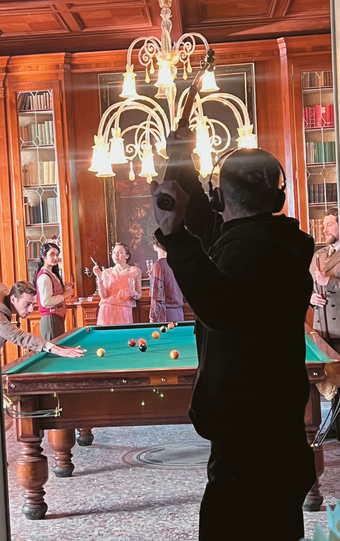
As we learn, the series has received the approval of director Dimitris Tarlou, the son of Marina Karagatsi, who closely followed the adaptation of the book. This is the first time the rights have been granted for the book to be adapted for television—something that had never happened before, in contrast to other works by Karagatsi.
The project, which faced numerous difficulties and delays, involves companies with experience in large productions, ensuring that the series will transcend borders. These include Foss Productions, known for its international success with Christoforos Papakaliatis’ Maestro, as well as the award-winning Milky Way by Vasilis Kekatos, Boo Productions, which produced Giorgos Lanthimos’ Dogtooth, and Blonde Productions, which worked on the Apple TV series Tehran.
For anyone with experience in filming, it’s clear that the conditions under which this series is being shot are purely cinematic—a clear reminder that even in challenging times, great films and series can still find the people with the vision to bring them to life.
On the Road to Syros
In this way, the dynamic yet wounded heroine of Karagatsi’s Marina functioned, from the moment she first boarded a ship named Chimera, following her own chimera-like vision, later meeting her captain husband and eventually reaching Syros. While Trieste may not be the French town of Rouen, Marina’s place of origin and starting point, it retains the same atmosphere and logic of a Northern city.
“The sweetest place where people were thoughtful, the sunsets golden, and the church bells melancholic,” as Marcel Proust famously described the city. It was in such an environment, in a Baroque church built on top of a Roman temple—evident from the Roman fence—that we found ourselves on a cold February morning to closely observe the filming.
The temperature reads 5 degrees below zero, and it is nearly impossible to stand in one place, even inside the church where the cold penetrates every pore of our bodies. In vain, Fotini Pelouzo seeks occasional warmth in a huge jacket that someone from the production rushes to offer during breaks between scenes.
But she is undeterred: seated in a corner of the San Giusto church, with its intricate frescoes and stunning mosaics, she focuses to later embody the ever-sorrowful Marina inside the confessional, as she attempts—an atheist Catholic who probably loved the ancient Greek gods more than the Christian ones—to rid herself of the weight of her internal conflicts and guilt.
The faint light that enters the church through the beautiful stained-glass windows illuminates her face, bringing out the same unchanging melancholy that has united in this city different religious groups, artists, adventurers, cursed poets, and writers throughout the ages.
A little later, we follow her, along with the entire crew, to the impressive setting of a Catholic cemetery, where the trial with the cold is truly unimaginable. As we search in vain for shelter among the imposing tombs with their intricate statues, we observe the extras trying to withstand the cold by drinking tea during breaks while wearing the beautiful period costumes. These, too, are a testament to the importance placed on detail, as they were not borrowed from costume shops but were sewn with great care from the beginning to follow the demands of the series and the period drama.
Six thousand pieces (costumes, shoes, antiques) arrived from various parts of Italy and Spain to provide the best possible result. “You must trust the production, which won’t hesitate to go to the ends of the earth to procure the missing piece,” I remember Daniel Day-Lewis telling me in an interview, revealing that he once even sought an audience with the Pope himself to learn where to obtain his silk crimson stockings.
Here, too, the objects tell their own story: from the shoes worn by the protagonist along with the corresponding stockings from the interwar period, and the cigarettes smoked back then, to the crystal glasses and wines they drank, all of which are called upon for the next party scenes set in a beautiful castle. All of these conspire in the transition to a state that seems like non-existence, something that, as Viennese author Hermann Bahr said, is born from Trieste itself.
From the velvet seats of the Caffè degli Specchi at the edge of the square, where James Joyce once had his first drink, to the walks among the graves, every corner of the city exudes that sense of the unfamiliar that tortures the heroine from the start. “Marina is indeed a woman who fits nowhere,” admits Fotini Pelouzo in response to a related question. She admits that understanding this character is a very difficult task for her.
In the same way, Marina tried to understand her mother, whom she now silently bids farewell to over the grave in this scene we are observing during the shoot, knowing that it was this mother, despite being a prostitute, who turned out to be incredibly generous even after her death, leaving a vast fortune to her daughter. However, she had already scarred Marina with wounds that marked her throughout her life, preventing her from ever escaping her tragic fate.
What about the Love Scenes?
Marina’s story essentially aligns with the journey of a foreign woman coming to Greece during the interwar period, following her love for her husband, Yiannis, portrayed by the excellent Andreas Konstantinou, whom we have enjoyed in various theater roles and in the films of Pantelis Voulgaris, as well as in TV series. Dimitris Kitsos, known from Maestro and Paralia, plays Yiannis’s younger brother, Mina, with whom Marina becomes involved in a doomed relationship.
The iconic mother-in-law, the famous Raizena, is played by Karyofyllia Karabeti, and in the remaining roles, we find Elissaios Vlachos, Giannis Dalianis, and Alexandra Aidini. This is an excellent cast of actors who are well-versed in the keys and conditions of cinematic work with corresponding demands.
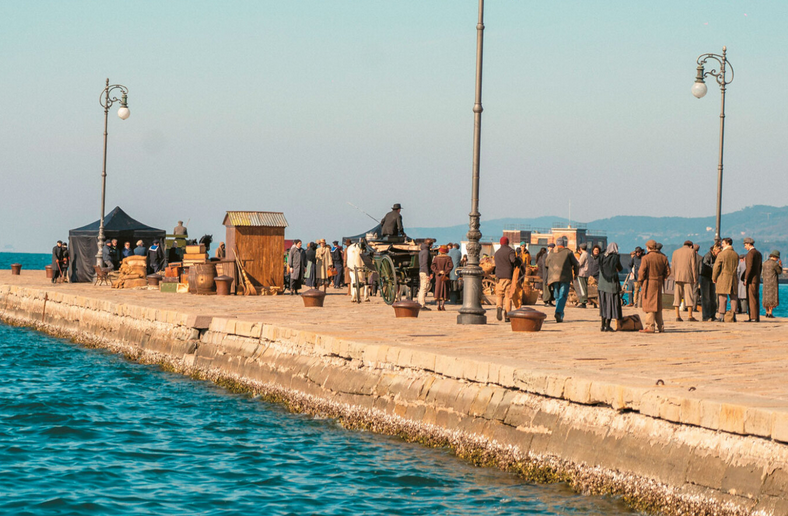
In order to approach the complex role of Fotini, who was submissive to her fate but at the same time fought against the norms of her time, Fotini Pelouzo read extensively, not only Karagatsis but also other novels that seem to converse with The Great Chimera, such as Madame Bovary. She delved into her own darkness, examined the contradictions within, and ultimately fell in love with the character. “All you have to do is think about the fact that the story is about a heroine who lived when my grandmother was born and did things that no one would have ever imagined.
Marina is portrayed as a woman who leaves and travels alone at a time when women couldn’t even dream of such things. She had the opportunity to live out her desires, and she had the fortune and misfortune of having a heavy past, very different from everyone else’s. Why do we condemn her for having a mother who was a prostitute? And since when is her reaction to claim her body and her sexual desires considered sexist? It seems completely hypocritical and superficial to label a work like this, which dares to speak about a woman who went against the times, at a time when today, we still encounter conservative minds and views,” Fotini says.
In the series, they are not afraid to show the romantic dimension of the work and the sensuality of the protagonist. Therefore, as we learn, they employed intimate coordinators, who double for the actors in the very sensual scenes. This was done by Lanthimos in Poor Things, and it is a common practice in Hollywood films, though it is rarely implemented in Greek productions. Even in this, the production demonstrates that they are seriously considering every aspect that could help the actors deliver their best performance.
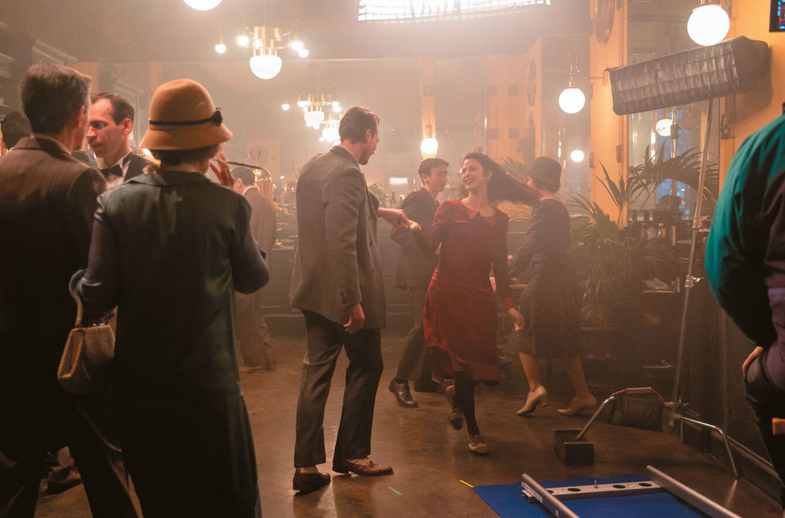
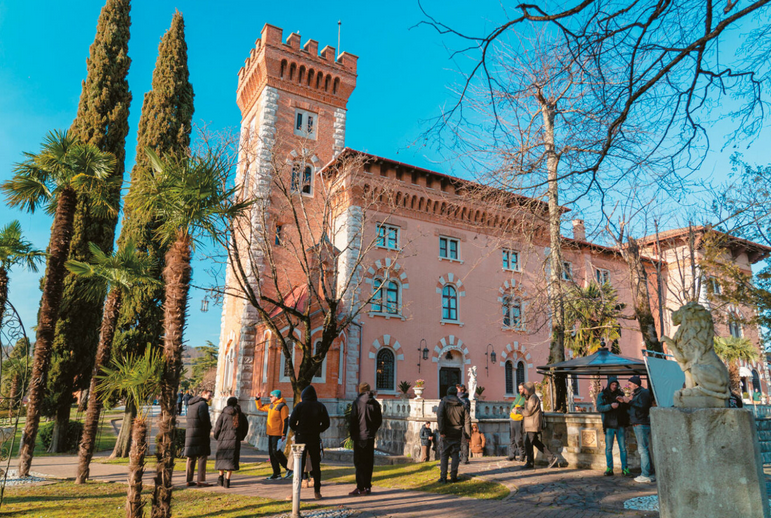
In this context, aiming to bring out the full erotic potential of Marina’s character, Fotini Pelouzo tries to highlight, as much as possible, her sensual side and the great cultivation that is evident in the book. The scenes we observe at the Rusic Castle, located in the northeastern corner of the Friuli Venezia Giulia region, just a breath away from Slovenia, embody a blend of Central European city features and the air of the old empire, alongside that of the Balkans. This setting captures much of that atmosphere.
These places, with their countless towers, statues that seem to have sprung from the old bridges of Charles, with refined gardens and vineyards stretching like beautiful paintings across the slopes for centuries, add yet another layer to the entire project. It’s no coincidence that the tower where the scenes were shot is said to have been the setting for the romantic adventures of Giacomo Casanova, who sought refuge in this region from Venice.
At the entrance of the estate stands a statue of Casanova, and marble plaques, scattered in various parts of the garden, bear some of the monumental quotes that inspired the nights of the visitors to the tower. This tower is said to have been a gift from the former owner, Giulio Ettore Ritter of the former Austro-Hungarian Empire, to his daughter, later passing into the hands of a count who made sure to resurrect the Casanovian spirit.
Karagatsis’ Vision
Even now, the enormous ballroom, as well as the cigar room with preserved animals from various hunts adorning the walls, exude the scents and style of the era. The castle was not chosen by chance for the party scene, where Marina will have the opportunity to flirt during a dance that steals the show with costumes and sets that truly seem to have emerged from the wildest dreams. Everything has a reason for being in this paradoxical chimera-like world. And to imagine, the restaurant where we all gathered after filming, in the center of Trieste, is called “The Bacchic Chimera.”
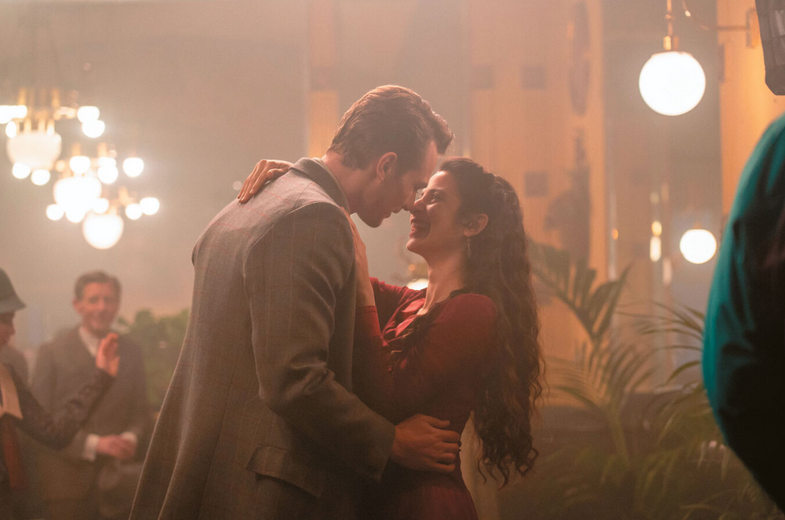
When the universe, in the end, conspires in your favor and not against you, you can see Karagatsis’ Bacchic vision and his eerie, secretive fantasies coming to life, turning into vivid, haunting images, like those with the moon that “illuminates the dead sea, the scorched rock, and the hedonistic city with its cold rays, like a massive irony of the pale sky towards the golden land,” as he famously wrote, referring to himself as the Dionysian Karagatsis in The Great Chimera. Ultimately, speaking in conclusion, “beauty will save the world,” as his beloved Dostoevsky said. If we judge by the beauty we experienced during the filming days, it will certainly save viewers from the ugliness of the days and the world we live in, with the largest and most polished television production to date. As for the filming, it continues in Greece, on Delos and Mykonos.
Ask me anything
Explore related questions




