





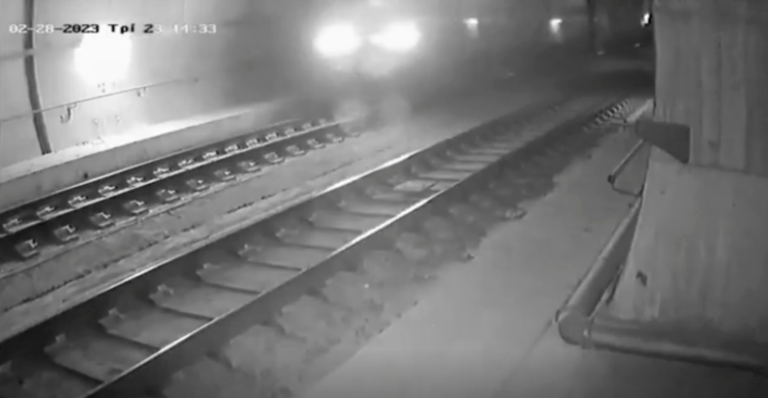
Nikos Plakias, who tragically lost his twin daughters and niece in the Tempi train crash, uploaded a post claiming that the videos circulating recently, showing the commercial train moments before the fatal collision, were authentic. Then, Mr. Plakia deleted the post, and relevant sources told protothema.gr that it will take some time before the authenticity of the videos is officially confirmed.
At the same time, judicial experts have discovered a piece of the cockpit of the second electric locomotive of the commercial train in Koulouri, where the wreckage of Hellenic Train’s trains is stored. This cockpit was believed to have been destroyed in the explosion following the collision between the two trains. The cockpit’s initial disappearance fueled rumors about the presence of unknown fuel that might have caused the fireball after the crash.

According to a report by Eleftheria in Larissa, the discovery of parts of the cockpit is a crucial element in the investigation into the causes of the Tempi train tragedy. The cockpit, which had “disappeared” after the collision, was said to have been carrying “illegal cargo,” and it is suspected that the unknown fuel was stored in this vanished compartment, not in the open wagons carrying metal sheets. In the final report by the National Organization for the Investigation of Aviation and Railroad Accidents (EOADSAAM), it was suggested that 5 to 8 passengers had died in the fire caused by the unknown fuel, although they survived the initial collision.
The investigation reveals that the back driver’s cabin of the second locomotive appeared to be detached from the rest of the vehicle, and it could not be fully located amidst the debris, except for small pieces of the roof and the upper headlight. On the morning of the discovery, firefighters from the Fire Department’s Arson Investigation Unit (DAEE) and judicial experts went to Koulouri, where they located parts of the cabin, including seats, which they planned to reassemble to determine whether the deformation of the second engine was due to the collision with the rear wagon carrying metal sheets or the fire caused by the unknown fuel.
The discovery of these parts contradicts the initial theory of the cockpit’s disappearance, and now the investigating judge is waiting for a report from the DAEE’s inspection team. The DAEE, along with the Chemical Service of Larissa and judicial experts, have been present in Koulouri since last Friday afternoon, conducting a crucial forensic investigation mandated by the investigating judge, after new developments were revealed in the EOADSAAM report, which was published just ten days ago on February 27, 2025.
Autopsy Report
During the recent inspection, members of the chemical inspection teams from Larissa and Thessaloniki gathered samples from the wreckage of the commercial train. These samples will be sent for laboratory testing to the Chemical Service in Athens. Once the chemical analysis is complete, the DAEE inspection team will deliver its report to the investigating judge, addressing the critical question of whether the rear cabin of the second engine was destroyed due to the collision with the freight car carrying metal sheets or due to the fire triggered by the unknown fuel following the head-on collision.
Relatives of the train drivers and victims of the railway tragedy, as well as trade unionists from the sector, have strongly reacted to the theory that the unknown fuel was hidden in the engine’s cabin. They have filed a request for an independent inspection of the Koulouri site.
Ask me anything
Explore related questions




