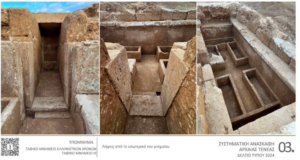
A significant archaeological discovery has been made in Kiliomodi, Corinth, as a monumental Hellenistic tomb structure was revealed during the systematic excavations carried out as part of the “Ancient Tenea” research project. This find, which emerged in October 2024, sheds light on the rich history of the region, with a direct connection to ancient burial practices and possibly even healing rituals.
The Ministry of Culture’s announcement highlights that this is the first time such a large Hellenistic tomb structure has been uncovered in Corinth. The structure follows the architectural style of Macedonian tombs, with both internal and external findings offering valuable insight into its long-term use, including rituals tied to healing.

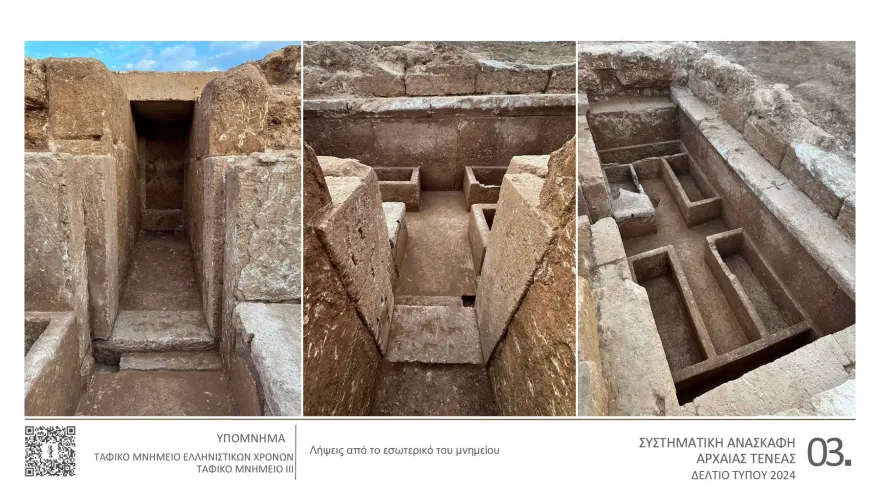
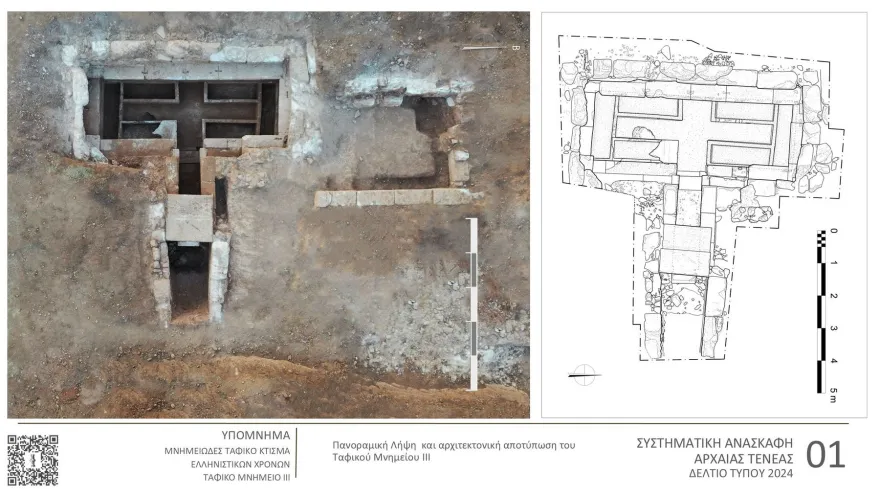
The tomb’s layout features an irregular “T” shape, comprising two sections: an access corridor measuring 2.80m x 1.20m, and the main burial chamber, which measures 2.75m x 7.40m. The tomb’s orientation runs along a north-south axis, with the corridor intersecting the eastern side of the burial chamber. The corridor itself is divided into an open section, which can be considered a “road,” and a covered part, with a preserved horizontal roof. The entrance to this covered section was found sealed with a rectangular stone slab.
Inside the burial chamber, archaeologists discovered a monolithic sarcophagus, as well as five other rectangular stone caskets along the walls. Interestingly, in two of these caskets, the cover slabs had been visibly tampered with, while the remaining tombs lacked covers entirely. Among the six tombs, only the sarcophagus contained an anatomically intact burial of an adult individual, likely a woman, while the other graves showed signs of disturbance. Notably, within the sarcophagus, a significant number of animal bones from both large and small domestic animals were found, including a turtle shell.
The surrounding fill of the monument and the burial chamber contained not only animal bones but also 5th- and 6th-century AD vessels, suggesting that the tomb was used for burials up until the 4th century AD. After this, the tomb was sealed, only to be reopened in the late Roman period, when the roof was violated, the burials were looted, and the space was repurposed for feasts and other activities.
The finds from the tomb include various items dating from the Hellenistic and Roman periods, including a gold ring with an engraved gem depicting Apollo with a healing serpent, two gold pendants imitating Hellenistic coins from the period of Sicyon, a clay votive finger, gold leaves from a crown, a silver tetradrachm of Philip III Arrhidaeus, iron stamps, a bronze knife, and glass beads, among others.

The area outside the tomb, where excavation is ongoing, has also provided intriguing finds. East of the tomb’s entrance, a section of a paved road was uncovered, sloping southward, while a 6.50m x 4.10m section of a surrounding wall was discovered to the north. Inside the enclosed area, archaeologists found votive offerings—clay models of human fingers with holes for hanging, as well as a clay model of an arm. These are indications of a space dedicated to particular forms of worship, likely associated with healing.
Architectural remains, such as a decorative crown, a shield fragment, and part of a column, suggest that the tomb may have been part of a larger complex that could include a mausoleum or small funerary structures nearby. As excavation continues, it is expected that the full scope of the monument will be revealed, providing further understanding of its role and the different historical periods that influenced its use.
The “Ancient Tenea” project is being conducted under the direction of Dr. E. Korka, with the archaeological team led by P. Evangeloglou, a Corinthian Ephorate archaeologist. The team is supported by experts in various fields, including Dr. K. Lagos, a numismatist, Ch. Papageorgopoulou, a professor of anthropology, and A. Georgopoulos, a professor emeritus of photogrammetry.
This discovery offers a remarkable glimpse into the ancient world, shedding light on burial practices, religious rituals, and the enduring cultural legacy of the region.
Ask me anything
Explore related questions