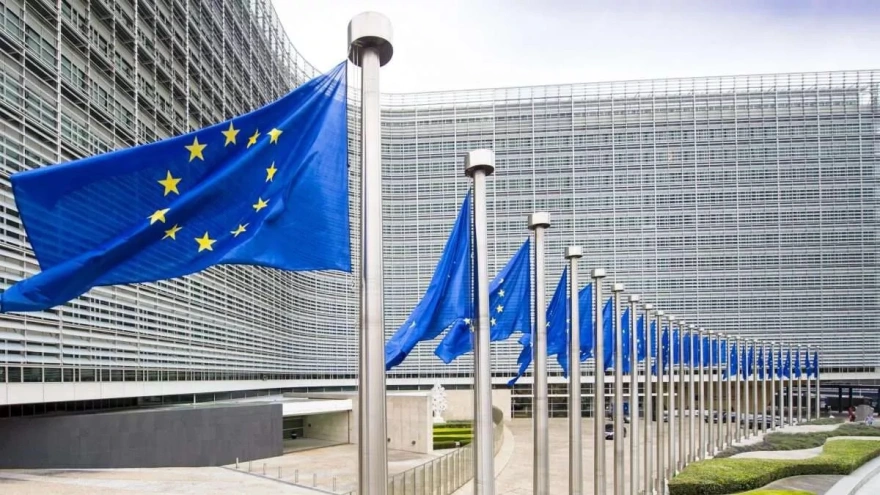
As the European Union accelerates its defense strategy in response to shifting geopolitical realities—most notably the re-evaluation of the Russian threat and the U.S.’s evolving stance on transatlantic security—the continent’s military industry stands to benefit from an unprecedented surge in orders.
A Paradigm Shift in European Defense Strategy
For decades, European nations have reduced their defense expenditures, often prioritizing social welfare over military capabilities. However, the war in Ukraine and rising global tensions have forced the EU to rethink its approach. The decline in military readiness is evident: since the mid-1990s, Germany has cut its armored vehicle fleet by 77%, the UK has reduced fighter jet procurement by 72%, and France has scaled back its surface warship budget by 34%. Now, with the EU acknowledging its vulnerability, the focus has shifted towards rearmament and strategic military investments.
The new €800 billion defense package is structured around five funding pillars, including:
- Increased national defense spending of up to 1.5% of GDP, exempted from EU budgetary constraints for the next four years.
- Greater mobilization of private capital.
- An expanded mandate for the European Investment Bank (EIB) to finance defense-related projects.
- Direct EU budget incentives for defense sector investments.
- Coordinated procurement initiatives to streamline the defense supply chain across member states.
Industry Boom: Key Players in the Defense Market
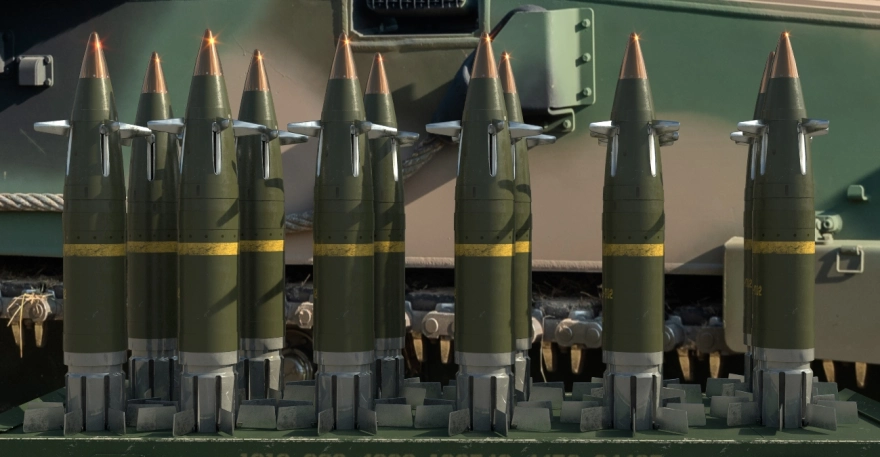
As Europe moves towards a more unified military framework, major defense contractors are poised to secure lucrative contracts. The demand for high-tech weaponry, conventional munitions, and logistical support has surged, driven in part by the ongoing conflict in Ukraine.
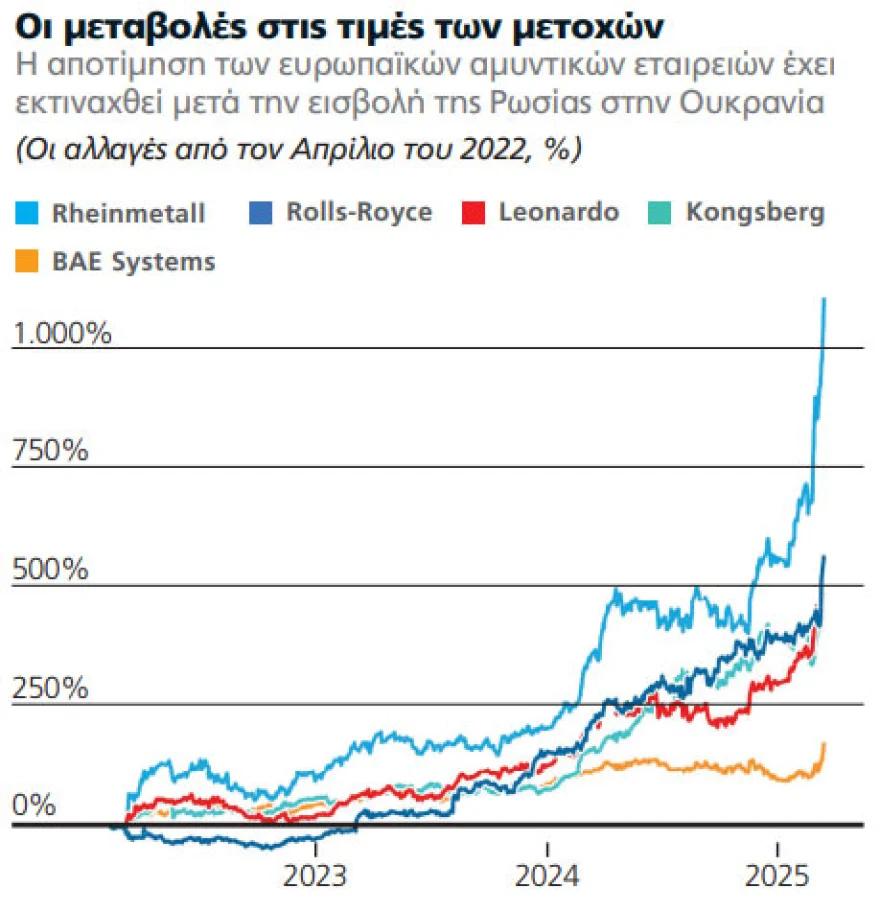
Defense industry giants, particularly in the UK, France, and Germany, are witnessing record-breaking orders. British firm BAE Systems, for instance, reported over £3 billion in annual profits in 2024, while its stock value has doubled since the onset of the Ukraine war. Analysts view Europe’s rearmament drive as a prime investment opportunity, with reports from Deloitte and Forbes forecasting sustained growth in global defense spending throughout 2025.
The Greek Perspective: Upgrading Military Capabilities
Greece, long accustomed to high defense spending due to regional security concerns, is also adapting its procurement strategy in light of the EU’s evolving defense landscape. The country has already taken significant steps to modernize its armed forces, securing air superiority in the Aegean and enhancing its naval capabilities.
Athens is now revising its €7 billion multi-year defense program, aligning with new EU funding opportunities. Key focus areas include:
- Investment in strategic and precision-guided weaponry.
- Expansion of defense technology applications.
- Strengthening domestic defense production to leverage EU funding.
One of Greece’s flagship defense projects is the “Achilles Shield,” a multi-layered defense system aimed at countering ballistic missile threats, drones, aircraft, naval vessels, and submarines. Other key procurements include:
- F-35 fighter jets.
- Meteor air-to-air missiles for Rafale aircraft.
- Three state-of-the-art FDI HN (Belh@rra) frigates for naval power projection in the Eastern Mediterranean.
- SCALP Naval cruise missiles, capable of striking strategic targets over 1,000 km away.
A New European Defense Doctrine
The broader European defense integration effort faces significant operational challenges, particularly in terms of interoperability. A report by the Atlantic Council highlights inefficiencies within EU military structures, citing issues such as the lack of standardized ammunition types across national armies.
To address this, European military leaders are intensifying coordination efforts, with France taking a leading role in convening defense chiefs to streamline operational planning. At the same time, discussions are emerging over the expansion of France’s nuclear umbrella to cover EU allies—an initiative endorsed by German and British leaders in light of increasing security concerns over Russia.
As the EU embarks on this historic defense transformation, the coming months will be pivotal in determining how funding is allocated and which nations and companies will emerge as key beneficiaries in the rearmament drive.
Ask me anything
Explore related questions