The Trump administration is considering “targeting” citizens of as many as 43 countries as part of a new travel ban on the United States, which would be broader than the restrictions imposed during President Trump’s first term, according to a report by New York Times citing administration officials.
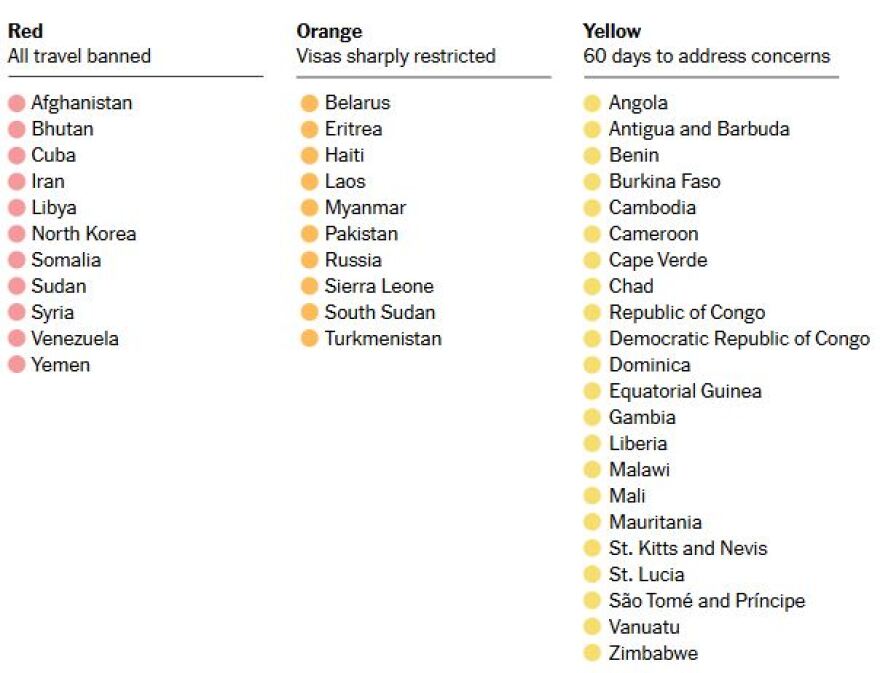
Trump’s draft list proposes a “red” list of 11 countries whose citizens would be collectively banned from entering the United States.
The table below is the Trump administration’s proposed list of countries whose citizens could face restrictions on entering the U.S.
The table with the three tiers
The officials, who spoke on condition of anonymity, revealed that the list was compiled by the State Department several weeks ago and that there were likely to be changes by the time it reached the White House.
Officials in embassies and regional State Department offices, as well as security experts in other departments and intelligence agencies, have reviewed the draft.
The draft proposal also included an “orange” list of 10 countries for which travel would be restricted but not stopped. In those cases, wealthy business travelers could be allowed entry, but not people traveling on an immigrant or tourist visa.
Citizens on this list will also undergo mandatory personal interviews to obtain a visa. The list includes countries such as Belarus, Eritrea, Haiti, Laos, Laos, Myanmar, Pakistan, Russia, Russia, Sierra Leone, South Sudan and Turkmenistan.
When he took office on Jan. 20, Trump issued an executive order requiring the State Department to identify countries“for which screening and vetting information is so incomplete as to warrant partial or complete suspension of admission of nationals from those countries.”
He gave the department 60 days to complete a report for the White House with that list, meaning it must be submitted next week. The State Department’s Bureau of Consular Affairs has taken the lead, and the order said the departments of Justice and Homeland Security and the Office of the Director of National Intelligence would assist in the effort.
The State Department said it is following Trump’s order and that it is “committed to protecting our nation and its citizens by maintaining the highest standards of national security and public safety through the visa process”, while declining to discuss specifically the internal deliberations going on behind the scenes.
The Times and other news outlets reported this month that Afghanistan, which was not part of Trump’s first-term travel ban but fell into Taliban hands when the US withdrew its forces in 2021, was likely to be part of the second-term ban.
It is also unclear whether people with existing visas would be exempt from the ban or whether their visas would be cancelled. Nor is it clear whether the government intends to exempt existing green card holders who have already been approved for lawful permanent residence.
The Trump administration said last week that it canceled the green card of a Syrian-born former Columbia University graduate student of Palestinian descent, Mahmoud Khalil, for leading high-profile campus demonstrations against Israel’s war in Gaza, which the administration said were anti-Semitic, prompting a court battle.
Some of the countries on the red and orange lists were sanctioned by Mr Trump in his first-term travel bans, but many are new. Some share characteristics with the previous lists and are generally Muslim-majority or non-white, poor and have governments that are seen as weak or corrupt.
But the reason why several others were included was not immediately clear. Bhutan, for example, was proposed for an outright ban on entry. The small Buddhist and Hindu country lies between China and India, which were not included on any of the proposed lists.
The proposal to drastically limit, if not completely ban, visitors from Russia raises a different issue. While the Russian government has a reputation for corruption, Trump is trying to reorient U.S. foreign policy in a more Russia-friendly direction.
The proposal also includes a draft “yellow” list of 22 countries that would be given 60 days to remedy deficiencies, with the threat of being moved to one of the other lists if they do not comply.
During Trump’s first term, the courts prevented the administration from enforcing the first two versions of the travel ban, but the Supreme Court eventually allowed a ban to go into effect – one that banned citizens from eight nations, six of which are predominantly Muslim.
Shortly after taking office as president in January 2021, Joe Biden issued a proclamation revoking Trump’s travel bans, calling them“a stain on our national conscience”and “inconsistent with our long history of welcoming people of all faiths.”
Trump’s executive order in January said he would bring in bans to protect American citizens “from aliens who intend to commit terrorist attacks, threaten our national security, espouse hate ideology, or otherwise exploit our immigration laws for malicious purposes.”
Ask me anything
Explore related questions