





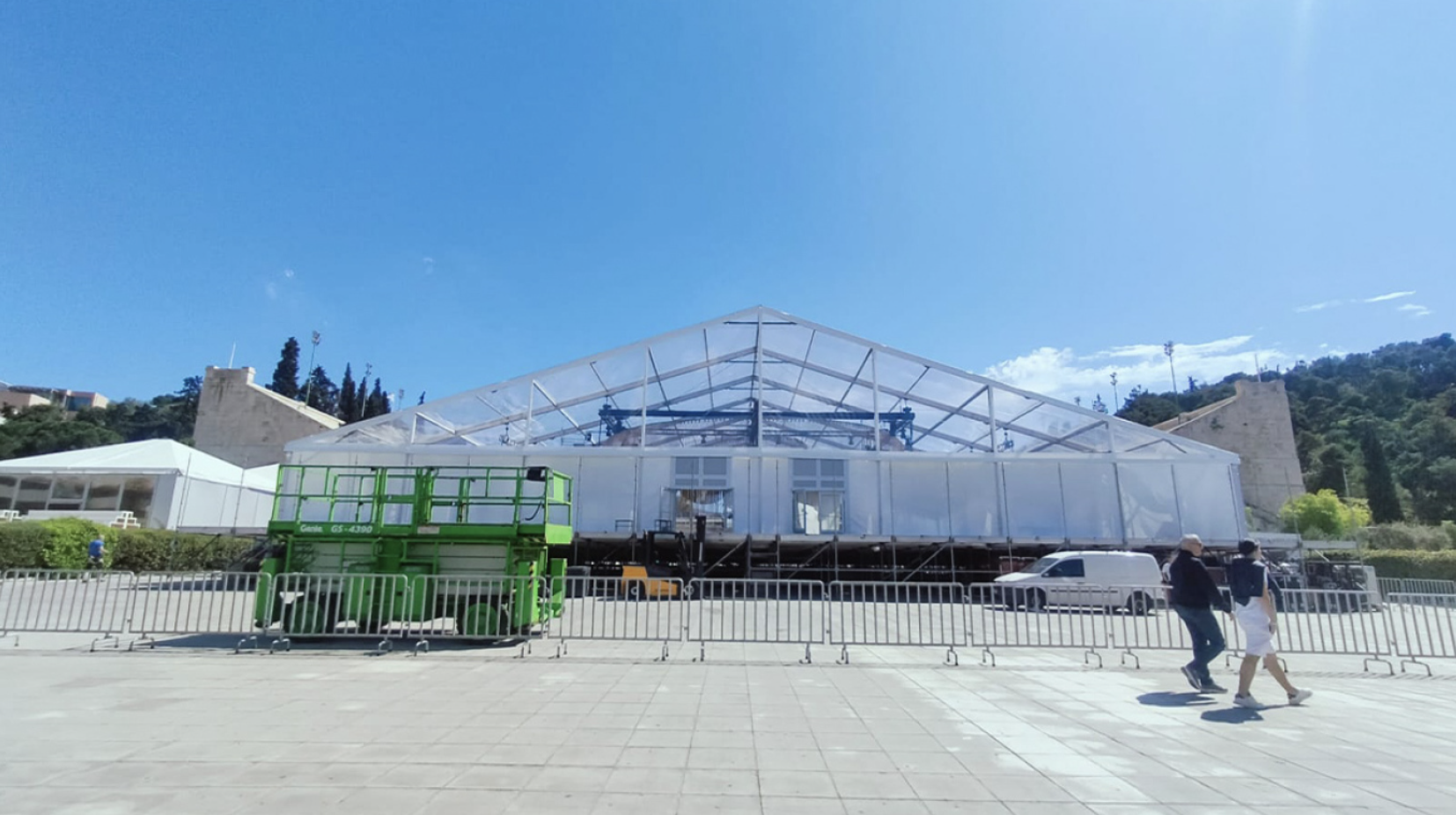
The Ministry of Culture has revoked the permit for Coca-Cola’s temporary construction near the Panathenaic Stadium, citing serious violations of approved terms. The decision was made during an emergency meeting of the Central Council of Modern Monuments (KSMN), convened at the request of Culture Minister Lina Mendoni, to reassess the temporary structure being assembled outside the stadium for a Coca-Cola conference.
Chaired by the Secretary General of Culture, the KSMN reviewed all available data and recommended revoking its previous approval of the request by TEMPO G. Argyropoulos EE for a temporary usage license. The reason: violations of terms 2, 3, 4, 6, 7, 10, and 12 of the approval decision, as revealed by site inspections and new findings.
Key violations included:
- The relevant Regional Service of Modern Monuments and Technical Works of Attica was never notified by the organizers about the start or progress of construction works (terms 2, 4, 7, 10, 12).
- Lighting renderings submitted to the Directorate for the Protection and Restoration of Modern Monuments—examined in the March 13, 2025 KSMN meeting—showed the structure set back from the stadium façade with flagpoles left intact. In reality, the façade was almost completely obstructed, and the flagpoles had been removed (terms 3, 4, 6, 12).
- The final structure differed significantly from the one presented in the original application: • No dimensions were provided for the final structure in the architectural or structural study, although this was required (terms 2, 4, 7, 12).
• The platform built did not match the specifications submitted in German nor the dimensions listed in the application (terms 2, 4, 7, 12).
• Metal frames placed on the elevated platform were not mentioned in the application or in the studies (terms 2, 4, 7, 12).
• Nowhere in the application was it stated that the height of the main structure would exceed the three meters indicated (terms 2, 4, 7, 12).
• No final mock-up or rendering showing the full construction was ever submitted to the Ministry or the Council (terms 2, 4, 7, 12).
• Heavy vehicles entered the site for transporting equipment and materials, causing damage to the surrounding area (terms 6, 10).
• The approval only allowed for a lightweight structure—not the heavy construction that was ultimately carried out and which was never described in the application (term 4).
• No study was submitted for the installation of air-conditioning units around the structure (term 7).
In light of these violations, the Ministry has officially revoked the permit, emphasizing the need for strict compliance with cultural heritage regulations—especially in such sensitive historic environments.
Ask me anything
Explore related questions




