The trade war between the United States and China is entering a new, heated phase. President Donald Trump has threatened to nearly double tariffs on Chinese imports, reaching 104% levels, and Beijing is responding that it will “fight to the end.”
This new escalation is expected to affect nearly every Chinese product imported into the US – from cell phones, computers and lithium-ion batteries to toys, screws and boilers. The question now is who will retreat first.
“It would be a mistake to think that China will back down,” warns Alfredo Montufar-Helu, a consultant at the China Center at the think tank Conference Board. “It would look like a defeat and would give Washington leeway to demand even more.”
As BBC reports, global markets have already suffered strong shocks, while Asian stocks experienced their biggest drop in decades on Monday. Although they posted a modest rebound on Tuesday, uncertainty ahead of the imposition of new tariffs on Wednesday remains.
The new measures include tariffs of up to 54% on Chinese imports, while Vietnam and Cambodia, also in the crosshairs, may face tariffs of 46% and 49% respectively.
Peking’s strategy
China has responded with punitive 34% tariffs on US products, controls on rare metal exports, and antitrust investigations into US companies such as Google. At the same time, it allows the yuan to slide to boost the competitiveness of its exports and taps state-owned enterprises to support markets.
However, the broader picture in the Chinese economy is fragile. The property market crisis, rising unemployment, and over-indebted local coffers create an explosive backdrop.
“Tariffs are exacerbating the problem,” notes Andrew Collier of the Harvard Kennedy School. China relies on exports for much of its growth, and although it is seeking a shift to technology and domestic consumption, external demand remains critical.
Who is suffering the most?
“We are in a showdown of strengths,” says Mary Lovely of the Peterson Institute in Washington, DC. “We’ve stopped talking about profits. The question is who can take the pain the most.”
But the damage is not just to China. The US imported $438 billion worth of Chinese goods last year and exported just $143 billion worth of goods, leaving a massive $295 billion trade deficit. Replacing Chinese suppliers cannot be done immediately and without cost.
Deborah Elms, head of trade policy at the Hinrich Foundation in Singapore, highlights: “We are economically interconnected in many ways. It’s not just about physical products. Investment, digital trade, and data flows are huge.”
Global anxiety and the uncertain end
Amid the turmoil, Southeast Asian countries are preparing to welcome Chinese products rejected by the US market. However, their economies are also in the crosshairs of tariffs.
“We are in a completely different reality. The risks are enormous and the rate of escalation is alarming,” Elms says. “No one knows how this will end.”
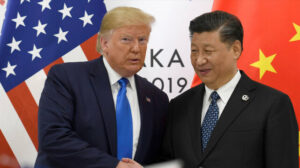
Experts hold out little hope for an immediate de-escalation, since Trump has yet to hold talks with Xi Jinping. China has left open the possibility of dialogue, but for now, uncertainty prevails.
Ask me anything
Explore related questions