





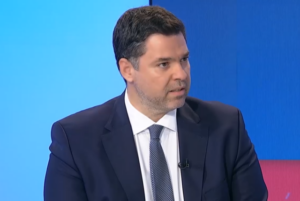
The tariff war and the tragic case of Tempi were the subject of a radio interview with the Deputy Minister to the Prime Minister, Thanasis Kontogeorgis, on ERT’s First Program.
First of all, “yesterday’s development, the statement and decisions of President Trump highlight to a certain extent the necessity to exhaust every diplomatic means in order to avoid a global economic crisis, which also has a historical character, as certainties and functions of the economy and the economic system of the last decades are being overturned.” While on Euro-Atlantic relations, he said that it is “extremely useful to act in a prudent manner, to exhaust every diplomatic means in order to keep them strong. Everyone must work in this direction. It was, after all, the Greek Prime Minister’s statements that had a positive impact on the other side of the Atlantic,” he noted.
At the same time, “there are various tendencies within the European Union, the Greek side is doing what safeguards Greek interests, but always within the framework of the European family. The response must be coordinated, prudent. The EU has a toolbox that can respond to what may come from the other side of the Atlantic.”
But, he warned, it is “an uncharted period, we don’t know how things will play out. We will see how the economies, the markets will work.” In any case, “the Greek side will be lined up with the European response,” the deputy prime minister noted, calling for our continent’s response “to be done in a prudent way that will not harm European societies, but at the same time to exhaust every diplomatic space that exists.”
This was followed by a remark, on behalf of Th. Kontogeorgis, that “the Greek economy is in a much better state than it was some years ago. We are now in a strong position but even stronger economies will be affected by such a situation,” he stressed. And, he said, “even though Greek exports to the United States are less than 1 percent of GDP, we will see how this will affect other European economies with which the Greek (economy) interacts and the broader implications that may exist.” In conclusion, he said, “the Greek government is doing its homework, we’ll see how this case plays out.”
On the other topic of the interview, Tempe, initially the Deputy Minister to the Prime Minister recalled that “the government proceeded with the establishment and operation of the EODASAM (ed. National Air and Rail Accidents and Safety Agency) in order to have a reliable, independent body to investigate the causes of the tragedy and at the same time, for every, no doubt, accident, to be able to investigate the causes and give directions in order to have safe transport. The EODASAM report has done very detailed work, and the recommendations in the report are being worked on by the government in terms of the changes that need to be made to the railways, and we will be bringing forward those changes shortly. In terms of the fireball the conclusion itself said that it needs further investigation,” said Th. Kontogeorgis, while acknowledging the confusion caused by the statements of the now former deputy chairman of the Agency, Christos Papadimitriou.
At the same time, he pointed out, “all the events of the last few weeks contribute decisively to the disconnection, to a certain extent, of this accusation that there was an alleged cover-up on the part of the government. There are a lot of facts, which are being evaluated by the regular criminal justice system, but also in the context of the proceedings of Parliament.”
In closing, the deputy prime minister noted that “we need seriousness and responsibility when we take a stand on such events, which have shocked the entire Greek society.” On top of that, “we insist on the institutional way of doing things,” he assured, while noting that “citizens want there to be no backsliding.”
Ask me anything
Explore related questions




