





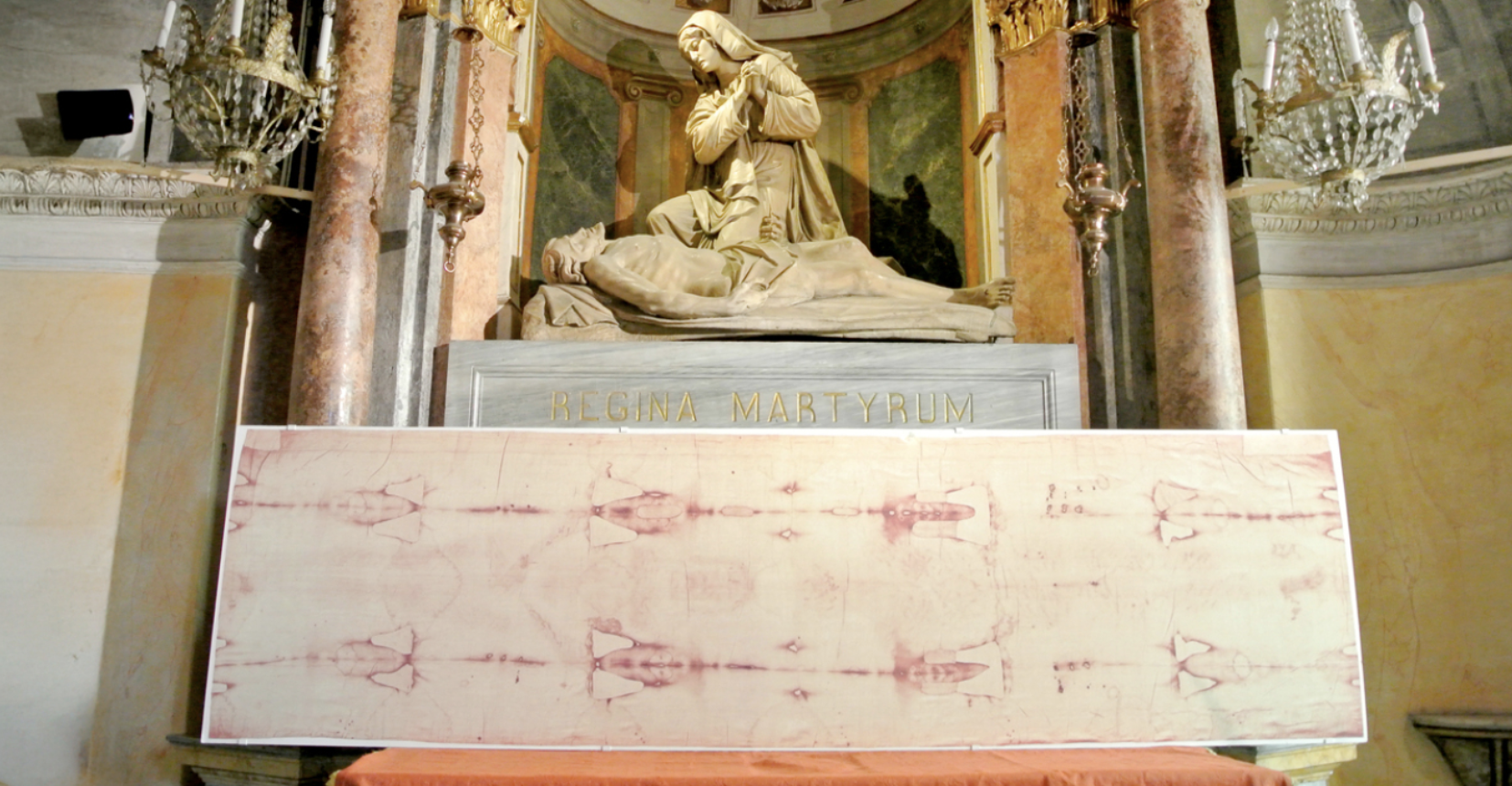
The story of the Holy Shroud—the cloth bearing the image of a crucified man, believed by many to be the burial shroud of Jesus Christ—continues in the digital age and takes on new dimensions in two key ways.
First, Artificial Intelligence (AI) has been used to reconstruct the facial features of the man whose imprint appears on the cloth.
Second, a digital replica of the Shroud will be available for public veneration after Easter.
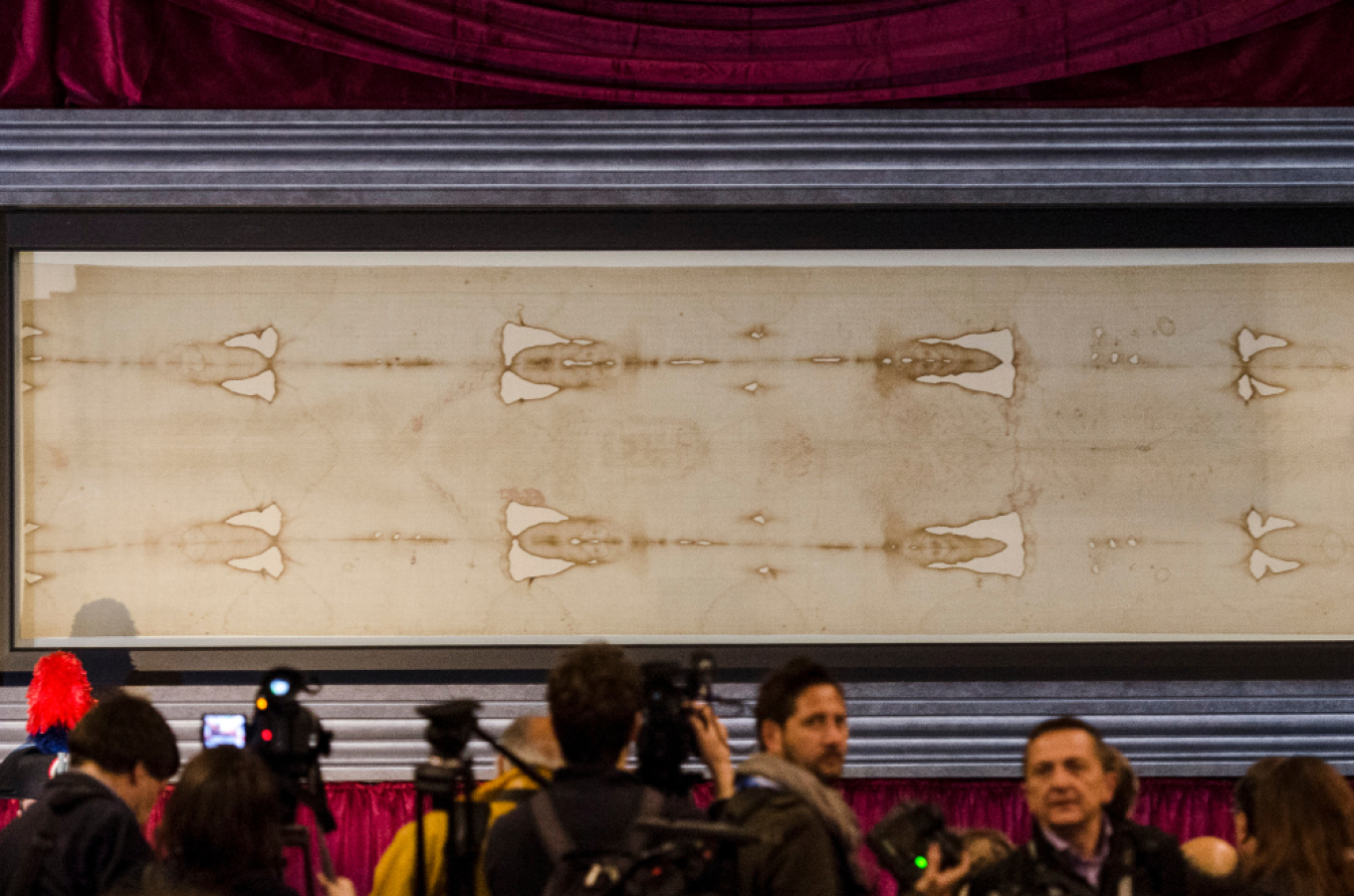
Public Display of the Digital Shroud
From April 28 to May 5, a life-size digital copy of the Holy Shroud will be on public display in Piazza Castello in Turin, attracting thousands of pilgrims. Though not the original, the e-Shroud will be laid out on a large table inside a tent structure.
Visitors will have a unique opportunity to interact virtually with the digital replica—exploring in detail the face, the crown of thorns, the marks of crucifixion, and more.
Faces Within the Face
Inside the tent, an exhibition titled “Faces Within the Face” will also be held, showcasing portraits and images of Jesus Christ as represented throughout history, inspired by the image on the Shroud and its many pilgrims.
After the display period, the digital Shroud will be freely accessible online to anyone interested. This initiative is part of the celebration of the Catholic Holy Year 2025, aiming to bring the Shroud closer to the global public—even if only in virtual form.
Reconstructing the Face of the Shroud with AI
Using AI platform Midjourney, commissioned by the Daily Express, researchers analyzed the Shroud in fine detail. The image that emerged is striking: a slender man with shoulder-length hair, a well-kept beard, and a sorrowful gaze—consistent with traditional Christian iconography.
L'IA dévoile le "visage de Jésus-Christ" en utilisant le suaire de Turin après une découverte stupéfiante.https://t.co/di03uiwApk pic.twitter.com/hJlfsLTJCL
— Souveraine Tech (@SouveraineTech) August 22, 2024
The Ongoing Controversy
The debate over the authenticity of the Shroud—whether it truly depicts Jesus—has raged for centuries.
In August 2024, Italian researchers used a new X-ray technique to more precisely date the fabric. Their conclusion? The material originates from the era of Jesus Christ.
The Shroud, kept since 1578 in the Cathedral of Saint John the Baptist in Turin, is a 4.3 x 1.1 meter linen cloth woven in a herringbone pattern. Analysis of the materials confirms the style was in use during Jesus’ time, although some scientists have dated it to the Middle Ages.
A 1988 radiocarbon dating study suggested the cloth was made between 1260 and 1390 AD, long after the Crucifixion. However, the new Italian study argues that environmental conditions may have compromised those earlier results.
New Dating Method: WAXS X-ray Scattering
Scientists from the Italian Institute of Crystallography (CNR) used Wide-Angle X-ray Scattering (WAXS) to analyze the cellulose degradation in the linen over time, providing an estimate of its age. They examined six tiny samples from the Shroud, comparing their structure to other linen samples from 1260–1390 AD—but found no match.
All signs, they argue, support the view that the Shroud is genuinely ancient and could have wrapped Jesus after his crucifixion.
Lead researcher Liberato De Caro explained that the 1988 study is likely flawed:
“Textile samples are inherently contaminated in ways that are impossible to fully eliminate. Without meticulous cleaning, carbon-14 dating isn’t reliable.”
Whether a sacred relic or a historical enigma, the Holy Shroud continues to inspire awe, devotion, and debate—now brought into sharper focus through the lens of modern science and technology.
Ask me anything
Explore related questions




