





An international network of organ trafficking is exploiting vulnerable people in Kenya and the hopes of those in desperate need of organs in Germany.
Twenty-two-year-old Amon Kipruto Melly thought that by selling his kidney, he could start a new, better life. Life in a village in western Kenya was difficult for him after the COVID pandemic. He struggles to find a steady income, moving from one job to another – at a car dealer, a construction site and elsewhere. One day, a friend told him about a quick and easy way to earn $6,000. “He told me it would be a good deal to sell my kidney,” Amon said. It sounded like an opportunity, but it led him into a dark web of exploitation, despair and remorse.
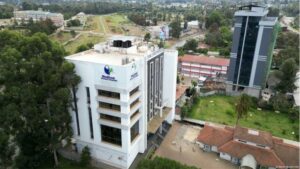
German media outlets Der Spiegel, ZDF and DW traced the paths of organ sellers and buyers, analysed documents, spoke to whistleblowers and health professionals and revealed how an international network – stretching from a hospital in Kenya, attracted shadowy traffickers from Germany. The young, desperate for money, and the old, desperate for a life-saving organ. Amon was introduced to a middleman who arranged the transfer to Mediheal Hospital in the town of Eldoret, in western Kenya. There he was received by Indian doctors who gave him documents in English, a language he did not understand.
A syndicate of exploitation
He was not informed of any health risks. “They didn’t explain anything to me. The person who had taken me showed the people around us and said: Look, they all donated, and they will even go back to work.” After the surgery, he was paid only $4,000 instead of the $6,000 he was promised. With that, he bought a phone and a car that quickly broke down. Soon after, his health deteriorated. He felt dizzy and weak and eventually passed out at home. His mother was shocked to learn that her son had sold his kidney. Amon’s story seems to be one of many.
Vilis Okumu, a Nairobi-based researcher on organised crime issues at the Institute for Security Studies in Africa, spoke to several young men who told him they had sold their kidneys in the town of Oyugis, 180km southwest of Eldoret. “In reality, it’s organised crime,” he said. He estimated that up to a hundred young men in Oyugis alone may have sold their kidneys, many of whom are suffering from health problems as well as depression and psychological trauma. “I don’t think they will reach 60,” he added. DW spoke to four young men in Oyugis who say they sold their kidneys for as little as $2,000. They recounted how, after their surgery, their brokers asked them to “recruit” new donors for a commission of $400 each.
The donor became a recruiter
A chain of exploitation “There is a legal grey area that this syndicate is exploiting,” Okumu explained. “There is no law that prevents you from donating your kidney for money and you cannot be prosecuted for it,” he said, referring to information he received from the international organised crime unit at the Kenya Police. What is allowed, according to Kenyan law, is organ donation to relatives or for altruistic reasons.
Speaking to DW on condition of anonymity, a former long-time employee of Mediheal Hospital revealed that the buying and selling of transplants began many years ago. Initially, recipients came from Somalia and donors from Kenya. But then in 2022, recipients started coming from Israel and, from 2024, from Germany. Donors for these wealthy clients were shipped in from countries such as Azerbaijan, Kazakhstan or Pakistan.
The source said the donors were asked to sign documents stating that they were related to recipients they had never met and that they consented to kidney removal without being informed of potential health risks, and some were not even old enough. “Because of the language barrier, they just sign,” the former employee said.
Transition to a more lucrative market
Since switching from Somali recipients to Israeli and German recipients, business has boomed, with each recipient paying up to $200,000 for a kidney – a figure confirmed by multiple sources. The former hospital official told DW that an agency called “MedLead” was responsible for finding international donors and recipients.
On its website, MedLead claims to provide kidney donations within 30 days “in accordance with organ donation legislation”. Its Facebook page has videos of people thanking MedLead for helping them get a new kidney in Kenya. The most recent video on the site shows Sabine Fischer Kugler, a 57-year-old woman from Gutenhausen, Germany, who has been suffering from kidney disease for 40 years.
After a first replacement kidney stopped working, she was desperate to find a second. But the waiting list for a new kidney in Germany is long; it can take eight to 10 years. In Germany, only the kidneys of deceased people who explicitly agreed to organ donation can be used for transplants, and there are not enough donors for the more than 10,000 people waiting for a kidney.
Armed with their desperation
The shortage of organ donations is turbocharging desperation and driving it abroad. Sabine only briefly met her donor, a 24-year-old man from Azerbaijan. The contract claimed she was not being paid, though she said she paid between $100,000 and $200,000 to MedLead. “Maybe I’m a little selfish because I wanted that kidney and more importantly the contract seemed OK. But it’s clear. The surgery is not as clean as it looks.”
Under German law, paying for an organ is illegal and offenders face up to five years in prison. The man behind MedLead is an Israeli citizen named Robert Spolansky, who, according to a 2016 indictment from the Tel Aviv Magistrate’s Court, has been accused of carrying out a large number of illegal kidney transplants in Sri Lanka, Turkey, the Philippines and Thailand, along with a man named Boris Wolfman, who allegedly headed the network. Wolfman was accused of previously being involved in illegal transplant activities elsewhere.
“It’s a bit of a mystery”
Spolansky denies any connection to Wolfman. In an email to Der Spiegel, ZDF and DW, MedLead said it has no involvement in donor tracking, that all donors are 100% volunteers with pure motives, and that MedLead has been operating transparently and in full compliance with the law since its inception. The research team went undercover to the Eka Hotel in Eldoret, just one kilometer from Mediheal Hospital, to talk to foreign patients awaiting transplants.
Some are visibly weak, traveling with family members. One Russian woman, who was waiting for kidney surgery for her husband, said: “Nobody gives their kidney for free.” A 72-year-old Israeli man undergoing dialysis at Mediheal hospital said: “It’s a bit of a mystery. You don’t have to pay, but you pay. The story is that it’s a cousin of mine somehow found himself in East Africa at the same time as me.” At his age, he would have had no chance of receiving a kidney in Israel, he said.
Back in Nairobi, Dr Jonathan Walla, head of the Kidney Society, has treated several patients who have returned with post-operative complications. “We have reports of Israeli patients returning with severe infections, some with kidneys that have basically died.” His colleagues raised the alarm with Kenyan authorities about unethical transplants being carried out at Mediheal Hospital.
Operation under high protection
In 2023, Kenya’s Ministry of Health conducted an investigation at Mediheal Hospital and found that donors and recipients were often unrelated. Some high-risk transplants were carried out, such as in cancer patients or the extremely elderly. Almost all procedures were paid for in cash. The report recommended that “the allegation of organ trafficking should be investigated by the competent authorities”. Despite the disturbing findings, the report was never made public and no action was taken.
A local private investigator in Eldoret, who has been following the illegal trade, said at least two other hospitals were also involved. But, he said, “if I investigated these cases, my life would be in danger.” “There are very powerful people who may be involved.”
The founder and chairman of the Mediheal Group is Swarup Mishra. The Indian is a former MP and is said to be on good terms with Kenyan President William Ruto. Despite persistent accusations of organ trafficking, the president appointed him president of Kenya’s state-run BioVax Vaccine Institute last November, a role that allows Mishra to represent Kenya at the World Health Organization and to foreign government officials.
Mishra did not respond to repeated requests for an interview and left a list of questions unanswered. Meanwhile, Amon and others like him are struggling to survive on one kidney, their health in jeopardy and their hopes crushed. “If I could turn back the clock, I would not have accepted having my kidney removed. I hate myself for that.”
Ask me anything
Explore related questions




