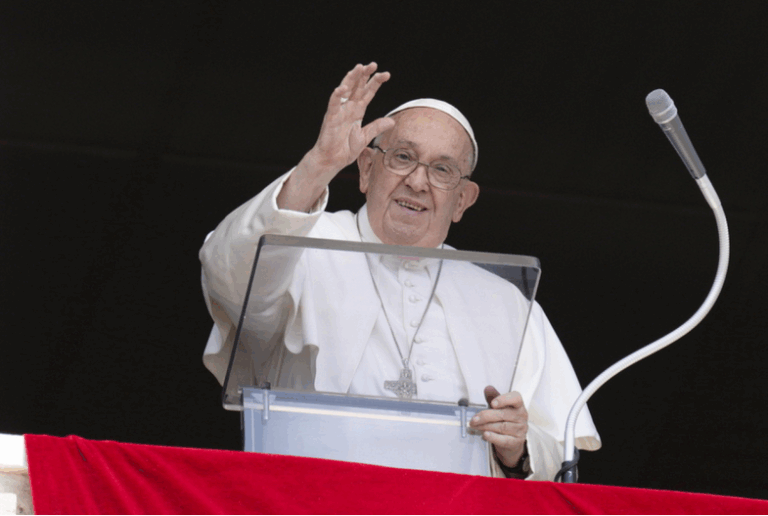
Jorge Mario Bergoglio, the first pope from Latin America, whose death was announced today by the Vatican, was born on December 17, 1936, in Buenos Aires, Argentina. His family originated from Piedmont in northern Italy: his father was an accountant for the Argentine railways, and his mother was a homemaker.
After graduating from a technical high school, he decided to enter a Catholic seminary. He later became a member of the Jesuit order and studied philosophy. In 1965, he began teaching literature and psychology at the Catholic College of Santa Fe and, a year later, at a religious institute in Buenos Aires. In 1969, he was ordained a priest and completed his theological studies a year later.
For fifteen years, he taught at Catholic university institutions, and in 1986, he traveled to Germany, where he completed his doctoral studies. In 1992, Pope John Paul II appointed him bishop of the city of Auca and auxiliary bishop of Buenos Aires. On February 28, 1992, he was chosen as Archbishop of Buenos Aires and of all Argentina.
In 2001, John Paul II appointed him cardinal, and in April 2005, he participated in the conclave that elected Pope Benedict.
As Archbishop of Buenos Aires, he emphasized support for the poorest citizens, spreading the word of God to every corner of the city, keeping the doors of all churches “always open,” and encouraging close collaboration between clergy and laypeople.
Jorge Mario Bergoglio was elected pope on March 13, 2013. He chose the name Francis—emphasizing mainly the title of Bishop of Rome—and wore an iron cross instead of a golden one. “My brothers, the cardinals, went to the ends of the earth to choose the new pope,” he said in his first greeting to the faithful.
According to all analysts, and in the hearts of millions of believers, he was “the pope of the poor,” the Holy Father of Catholics who emphasized aid and solidarity toward migrants, the marginalized, and the forgotten. He ordered Vatican authorities to allow homeless people to sleep on the streets around St. Peter’s, and even within the basilica’s square. “Who am I to judge a homosexual who seeks God?” he responded to a journalist on a flight during one of his first trips as pontiff.
Referring to the war in Ukraine and the humanitarian crisis in Gaza, Francis repeatedly stated that “war is always a defeat and must never be forgotten.” A day after Russia launched its attack on Ukraine, the Argentine pope walked to the Russian embassy to the Holy See to emphatically ask the Russian envoy for the weapons to fall silent.
His relationship with Ecumenical Patriarch Bartholomew was extremely close. He invited him and had him by his side in all interfaith dialogue initiatives, calling him a “dear brother.” He was inspired by the Patriarch’s work when he wrote his encyclical on environmental protection, Laudato si’, and was preparing to meet him this coming May in Asia Minor to mark the 1,700th anniversary of the First Ecumenical Council of Nicaea. A deeply held wish—shared with the Orthodox Primate—was for the two Churches to soon return to a unified celebration of Easter.
There were, of course, conflicts and critics—those who accused the Latin American pope of not giving enough weight to hierarchy and ritual, of speaking in an overly simple language that often sounded more like a local priest than the spiritual leader of over a billion believers. But this was precisely Francis’ true strength: his focus on the essence of the Christian message, his awareness that a good believer and human being is judged above all by their daily life and actions. A shift toward a spontaneous, profound humanity that will be very hard to forget in the coming years within the Roman Catholic Church.
Ask me anything
Explore related questions