





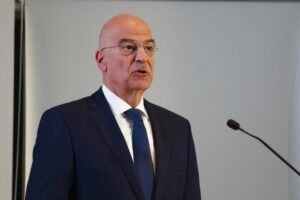
“We are implementing the biggest reform, Agenda 2030, in the Armed Forces. We are creating the necessary conditions for them to be able to meet modern challenges and confront all kinds of threats, hybrid and conventional, building on the lessons of recent conflicts. With a new philosophy guiding and spearheading innovation, we are creating a broader power projection plan as a total defence policy”, the Minister of National Defence stressed. protothema.gr Nikos Dendias in an article in the special edition “Turning Points – Global Agenda 2025” of Euro2day gr in cooperation with the New York Times, entitled “Changing Standards – Challenges and Proposals at the Crossroads of an Era”.
“We live in a time of major upheavals, which create new challenges, but also opportunities. In the global geopolitical scene, which is being rearranged and characterized by instability, we have a duty not to allow Greece to become a prisoner of developments. We must strengthen its defence footprint and its role as a pillar of stability and security provider in the wider region of the Eastern Mediterranean and South-Eastern Europe.
Regarding the new philosophy, he explains that the national security plan is about addressing “not only a practical challenge to the sovereignty and sovereign rights of the country, but also any threats that endanger the well-being of citizens (such as cyber attacks against critical state infrastructure) or their safety during the occurrence of natural disasters, which are increasing due to the climate crisis.”
And he adds that these roles “are highlighted through, for example, the selection of Greece as one of the two seats of the European Union’s secure satellite telecommunications programme (GOVSATCOM) or, respectively, through the assistance of the Armed Forces in Civil Protection actions, with the creation of the Construction and Natural Disaster Response Command (DIKAFKA).”
“We are not falling into the trap of fatalistic inaction and political cost. We are promoting a new structure for the organization and operation of the Armed Forces, with the merger and restructuring of commands, formations and units,” the Minister of National Defense underlines.
“At the same time,” he adds, “we are proceeding with the development of the Greek defence ecosystem. The domestic production of capabilities in Defence is not a potential option for us, but an existential necessity. The foundations for the implementation of the innovation ecosystem were laid last year, with the creation of the Hellenic Centre for Defence and Innovation (ELKAK).”
Specifically, as he points out, “with its operation, we are consolidating Greece’s presence as a producer of defense innovation and implementing the strengthening of the Armed Forces with ‘smart’, technologically advanced and efficient systems. At the same time, we aim to reduce our country’s dependence on imports of similar systems and to increase the participation of the Greek defence ecosystem in GNP”.
Regarding the creation of the anti-drone “Centaurus”, he said that it is “currently being carried by the Greek frigates sailing in the Red Sea in the framework of Operation Shields”, while he continued by stressing that “the announcement of the first two calls for interest by the Hellenic Centre for Defence Innovation is already a proof of Greece’s capabilities in the field of defence innovation”.
“Greece is changing the narrative, with the exploitation of systems that combine low cost with high operational value, with emphasis on drone systems and the exploitation of artificial intelligence, among others. The cornerstone of the reform is operational adaptation to new geopolitical conditions. For the first time in the history of our country, an arms program for the Armed Forces was drawn up for a 20-year horizon, 12 + 8 years, which we presented in Parliament, with Prime Minister Kyriakos Mitsotakis. The guiding principle is the harmonization of the needs of the General Staff to meet modern threats with the country’s fiscal capabilities,” the Minister of National Defence clarified.
“At the same time, we remain ready to exploit the widening of the budgetary margins, in implementation of the conclusions of the extraordinary Council of Leaders of the European Union on the escape clause and the European Commission’s proposal for ReArm Europe. The “Shield of Achilles” will now be at the heart of Greek Defence. An integrated defence system covering anti-missile, anti-aircraft, anti-drone, anti-ship, and anti-submarine defence. Its creation will allow the fleet of new frigates and the 4.5 and 5th generation aircraft to be released from their current role of territorial defence, enabling them to take on a broader deterrent role, with strategic weapons being included in our defence balance for the first time. From now on, Navy ships and Air Force aircraft will no longer be limited to defending the Aegean and will not be tasked with the main role of the country’s air defence.”
“Special emphasis is being placed,” he adds, “on homogenization of aircraft types and autonomous flying systems, modernization of frigates, as well as increasing the availability of the transport aircraft fleet and consistent maintenance of helicopters. At the same time, the possibility of the country’s participation in the design and construction of Constellation frigates with the United States is under consideration.”
“Our focus is still on the practical support of Armed Forces personnel, the main and indispensable force multiplier. Support that will take place not only through the coverage of their housing and health needs, with the respective programmes currently underway, but also through actions to upgrade their education and remuneration, as well as the creation of a modern career path,” Dendias said.
“Legislation on changes in the service, reserve, National Guard, and voluntary conscription of women also plays an important role in the 2030 Agenda,” he adds.
“With all these actions and several others that are currently being finalized, Greece is moving with determination on the path of full modernization of its Armed Forces. A path that will allow our country not only to ensure its sovereignty and sovereign rights at a critical juncture, but also to play an important role in developments in the wider region,” the Minister of National Defence concluded.
Ask me anything
Explore related questions




