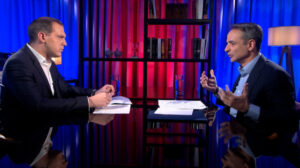
In the wake of yesterday’s announcements aimed at supporting tenants, students, and retirees, Prime Minister Kyriakos Mitsotakis speaks candidly to “Direct” on protothema.gr, emphasizing that the measures announced are a result of the country’s strong economic performance. Responding to claims from the opposition and certain social groups regarding their omission from the announcements, the Prime Minister points to the upcoming Thessaloniki International Fair (TIF), stating that support measures for the middle class will be unveiled then, set to take effect in 2026. “The next TIF will specifically target tax reductions for the middle class,” he notes.
Mitsotakis stresses that many moves have been made to ease the tax burden and to tackle the housing crisis. “As long as the economy performs well, without disturbing fiscal balance, and as long as international agencies continue to upgrade the Greek economy despite global trends, Greek citizens can expect better days,” he asserts.
Kyriakos Mitsotakis at Protothema.gr
Mitsotakis rebuffs speculation that the supportive measures for society carry pre-election undertones, emphasizing that elections will take place in 2027. He clarifies that he has no intention of changing the electoral law and insists on a strategy of self-reliance, making it clear in no uncertain terms that he will seek a third term as leader of New Democracy. He also explains why he is determined to pursue a third term.
“Marine parks and interconnection cables will be developed”
In response to questions about the submission of the maritime spatial planning document, Mitsotakis states that this should not be linked to the electricity interconnection project, GSI. He highlights that the cable will progress “in due course,” and the same will be true for the marine parks.
Mitsotakis clarifies, “I am not looking for a fight with Turkey,” and emphasizes that the meeting with President Recep Tayyip Erdoğan will take place, although he does not specify a timeline. Answering accusations of yielding on national issues, he questions why the government allowed Chevron to conduct exploration in Greece’s Exclusive Economic Zone (EEZ) south of Crete with Egypt.
He expresses optimism about a trade agreement between Europe and the US, while stating that as Prime Minister of Greece, he is committed to enhancing the strategic relationship with the US. He makes it clear that, for now, there is no planned meeting with Trump.
“Zoi Konstantopoulou is the female Varoufakis”
When asked about his political opponents, Mitsotakis reserves harsh criticism for Zoi Konstantopoulou. “I don’t think the country needs a new female Varoufakis ten years after the bankruptcy,” he states. “I fear that in his attempt to align with what he perceives as society’s sentiment, he has fueled the anti-establishment forces and has become a follower of Ms. Konstantopoulou,” he says about Nikos Androulakis. Finally, regarding Kyriakos Velopoulos, Mitsotakis claims he has been “the primary proponent of many conspiracy theories, which have latterly been embraced by many systemic parties.”
Below is the full text of the interview
Giorgos Evgenidis: Mr. President, thank you very much for coming. Christ is Risen.
Kyriakos Mitsotakis: Thank you. Happy Easter.
Giorgos Evgenidis: Let’s start since we meet after very interesting economic announcements that indeed concern many citizens, but the common feature of any provision is that when it is announced, everyone else complains. Why, therefore, was the broadly defined middle class not included in this package? Many feel that they have been overlooked.
Kyriakos Mitsotakis: First of all, Mr. Evgenidis, I want to emphasize that yesterday’s announcements resulted from a collective effort of Greek society and the Greek economy, as the surplus results announced for 2024 pleasantly surprised us.
This is not something random. These increased revenues did not come from tax increases, as taxes have been reduced. They came from economic growth and significant curtailment of tax and social security evasion.
Giorgos Evgenidis: So, you say, they are not allowances or ad hoc provisions; they have a permanent character.
Kyriakos Mitsotakis: Exactly, they have a permanent character because the reduction of tax evasion has permanent characteristics and is the result of difficult reforms that we implemented at the beginning of the second term.
These reforms tend to provoke many political reactions at the moment of application, but the benefits sometimes take time to manifest.
Here, therefore, the benefits have appeared, and we were able to return to the Greek society, in specific categories, more than 1 billion euros.
Giorgos Evgenidis: Great, let’s look a little practically at the announcements. Let’s talk about housing, which I know concerns you a lot and that you are troubled about the effectiveness of the measures the government has taken, as it has taken some measures.
Could this solution of subsidizing rent, even at the end of the year, lead to ultimately an increase in rents? This is a criticism that is being made. Or that it can lead to an increase in rents from the owners, to potentially “whiten” some rents that might have been “black”?
Kyriakos Mitsotakis: First of all, I want to remind you where we stand today compared to where we were five or ten years ago.
Ten years ago, amid the deep economic crisis caused by the then government, no one was discussing a housing problem. Why? Because property prices were simply in the cellar.
The housing problem arose as a result of economic activity, increased demand for rents, and rising property values. So that is the root cause of the problem, the result of an economy that is doing well. However, it is a real problem that needs addressing.
Is that the only measure we announced yesterday? No, because we need measures on both the supply and demand sides.
However, it is very important, Mr. Evgenidis, for a young person, let’s say, looking to rent a house today, to know that they will be refunded a portion of their rent every year, something that will also enhance their willingness to negotiate with the lessor, the property owner, so that the entire amount of the rent is declared. Let’s not kid ourselves…
Giorgos Evgenidis: So, you are saying that this is an incentive?
Kyriakos Mitsotakis: Let’s not kid ourselves. There is still a lot of informal economy in the rental market.
As the informal economy has been curtailed through a series of measures related to the connection of POS systems with cash registers, electronic payments, we aspire to achieve the same in the real estate market. Now there is an additional incentive to do so.
Giorgos Evgenidis: However, the income criteria are somewhat restrictive, Mr. President.
Kyriakos Mitsotakis: I would say they are quite…
Giorgos Evgenidis: I mean, excuse me, for a person my age, who is 30 years old, given that starting salaries are indeed rising if someone works in the private sector and earns 14 monthly salaries gross, 20,000 euros isn’t such a huge amount, I mean.
Kyriakos Mitsotakis: No, it is, but there is always…
Giorgos Evgenidis: I don’t underestimate it, right? God forbid.
Kyriakos Mitsotakis: There is always some threshold, and our goal is always to assist citizens with the lowest incomes. Why? Because a very large portion of their disposable income goes toward rent.
So we recognized this problem and are making a significant targeted intervention to facilitate tenants. They are not the only ones, I repeat. The “My Home I” and “My Home II” programs have received a great response. I hear also…
Giorgos Evgenidis: Perhaps these programs are not functioning perfectly, at least not “My Home II.”
Kyriakos Mitsotakis: I think they are functioning as designed because they are programs aimed at bringing older properties back onto the market. Because I hear criticism that “it concerns old properties.” But that is how the program was structured, and they are not the only programs.
The “Renovate-Rent” program is an important initiative, which provides owners the chance to receive an increased subsidy because the initial limits were quite low and perhaps we need to look at how we can further enhance…
Giorgos Evgenidis: Yes, but that doesn’t lower rental prices.
Kyriakos Mitsotakis: No, it lowers prices in what sense? That it increases the available properties.
Giorgos Evgenidis: Why wouldn’t landlords adjust to the already existing high demand and ask for a lot of money?
Kyriakos Mitsotakis: Because as supply increases, prices will improve. These are the basic rules of economics. We must intervene on both the supply and demand sides. However, let’s look again – I repeat – at the big picture. The economy is doing better as a result of structural reforms, and collective wealth must translate into individual prosperity.
How will this occur? Through interventions that concern many of our citizens, the tenants in this case, but also the low pensioners. Let’s not underestimate this intervention, as I didn’t want every year to have a discussion, “do we have money to provide this aid that we were giving at Christmas?” This measure, therefore, now gains permanent characteristics and will be granted at the end of every November.
Giorgos Evgenidis: So, that’s the housing part, the second pillar of the announcements concerns retirees, which indeed affects the vast majority of retirees, perhaps four-fifths of them.
The issue raised by retirees is that they have many structural problems because they suffered cuts unjustly. And one criticism made at you is that in the 2019 New Democracy program, you committed to solving the issue of personal difference. Is this something you are studying, Mr. President, in view of the Thessaloniki International Fair?
Kyriakos Mitsotakis: First of all, the permanent support of 250 euros concerns all retirees, whether they had a personal difference or not. The personal difference, as you know, declines every year, as this is how it is calculated.
Giorgos Evgenidis: Simply, some did not see the increases that others did.
Kyriakos Mitsotakis: Yes, but each year more people will see increases, and it is very important to recognize that we have now entered a path where we have permanent increases for retirees that correspond to the path of the economy.
I repeat: as long as the economy continues to perform better, all Greek citizens can expect better days. And obviously, this is just a framework of announcements. Why was it announced now? Simply because it had to…
Giorgos Evgenidis: And that is a question that has been raised.
Kyriakos Mitsotakis: These are measures that concern 2025. I repeat, it was a pleasant surprise for all of us the performance of the economy in 2024, a pleasant surprise, however, which, I emphasize again, was the result of specific political choices.
Because these surpluses, unlike past surpluses, are surpluses that came from growth and from the restriction of tax evasion, not from the over-taxation of the middle class.
Giorgos Evgenidis: Can citizens expect anything at the Thessaloniki Fair? Because the post-Easter “basket” was quite full; 1.1 billion is not something insignificant. Can salaried employees, who have not seen very substantive tax reductions in direct tax brackets, expect something? Can freelancers who were hurt by presumptive taxation, which cost you electorally in the European elections, expect something? And retirees, as I mentioned earlier, do they have something to expect?
Kyriakos Mitsotakis: You know, it’s perhaps typical of how we perceive public dialogue to immediately preemptively assess what has been done and to go immediately to what comes next.
Giorgos Evgenidis: You know the media, that after elections comes reshuffling.
Kyriakos Mitsotakis: I will respond to your question. Let’s not forget that already for 2025, a series of significant interventions have been made: many tax reductions, which we have referred to extensively, salary increases; let’s say we will have salary increases for the Security Forces and the Armed Forces in July. Announcements have already been made for the Armed Forces for 2026. More will be made for other Security Forces at the TIF.
And yes, to answer your question directly, the next Thessaloniki International Fair regarding tax reductions will be targeted at further reductions of taxes for the middle class.
But let’s not forget the significant measures that have already been taken: from the reduced initial tax rate to a reduction of ENFIA by more than 30%, to the abolition of the solidarity contribution and the limitation of the business tax.
Giorgos Evgenidis: Do you have an idea of how you want to implement this? Do you have an idea of how you want to adjust the tax brackets? Perhaps more intermediate steps could be added between the existing tax rates?
Kyriakos Mitsotakis: Now you understand that I am not ready to talk about what will be announced at the Thessaloniki Fair, which I repeat will concern 2026.
At this moment we are implementing the measures for 2025. However, as long as the economy performs well without, I will stress this, jeopardizing fiscal stability, which is the foundation upon which all our policies are built, as long as international agencies continue to upgrade the Greek economy, despite the tide of the global economy, Greek citizens can expect better days.
Giorgos Evgenidis: I will come to the geopolitical environment, which is turbulent, but let me close this first round of our discussion with the criticism leveled against you that you are making provisions with a pre-election aroma, that you are attempting in some way to restore societal confidence in New Democracy and improve your polling position.
And along with tours, along with a series of other maneuvers, in any case, some believe that there may be an electoral surprise around the corner. That perhaps Mitsotakis in 2025 is different from Mitsotakis in 2019, who told us he would hold elections in 2023 and did.
Kyriakos Mitsotakis: Throughout the previous term, I made tours, and I continue to do so now. Nothing has changed in the way I perceive my obligation to be often outside my office in the Maximos Mansion, primarily in the Greek periphery.
From there on, we are doing nothing more, Mr. Evgenidis, than implementing our pre-election program. We spoke about wage increases, and we are fulfilling them. We spoke about tax reductions, and we are implementing them. We spoke about overall support for disposable income, and we are keeping our commitments.
Our program is a four-year program. You know very well that I mean what I say. Since I firmly believe that 2025 will be better than 2024, 2026 will be better than 2025, and 2027 better than 2026, I have all the more reason to fully uphold my commitment to elections at the end of the term.
Giorgos Evgenidis: Indeed. Let’s turn to the geopolitical environment, which is very complex in our neighborhood and certainly influenced by what is happening in the US-China axis in global trade.
However, allow me to start with the maritime spatial planning that the government announced it would submit to the Commission during Holy Week. Why did you decide to do this now? Okay, I understand that there is also a contractual obligation to Europe after the ruling by the European Court.
What I hear as criticism, and I have to tell you it concerns me, is that this is an easy move compared to the cable, the GSI, the Great Sea Interconnector, which may be a more challenging exercise in exercising sovereign rights.
Kyriakos Mitsotakis: I would say that the two should not be connected as they pertain to two entirely distinct government initiatives.
We had an obligation to submit the Maritime Spatial Planning for environmental reasons and, if you will allow me to say, geopolitical ones.
Thus, we closed a backlog that has been pending for some time. For the first time, Greece is officially delineating its maritime space and the farthest potential limits of its continental shelf to the European Commission. That alone holds significant value, as it is a move that, for various reasons that do not need elaboration, had not been made in the past.
As for the cable, since you raised it, it is a European project that will progress and will proceed in due time.
I do not want to underestimate the initiatives we have undertaken concerning maritime areas…
Giorgos Evgenidis: Regarding the marine parks.
Kyriakos Mitsotakis: Yes, the marine parks which are being prepared, but also…
Giorgos Evgenidis: Will they be implemented?
Kyriakos Mitsotakis: Of course, they will.
Giorgos Evgenidis: You know, you are facing criticism, particularly from the right, that your government is yielding to Turkey. That for the sake of “calm waters,” where we are seeking to exercise our sovereign rights, when Turkey “roars,” we step back.
Kyriakos Mitsotakis: Then why did we proceed and allow Chevron to explore for potential natural gas reserves south of Crete within Greek sovereign rights, which, I want to remind you, stem from the treaty we signed with Egypt? If this is not a practical exercise of sovereign rights, then what exactly is, Mr. Evgenidis?
But let me add something else: I am not looking for a fight with Turkey, nor do I think I need to speak in a tone of tension and rhetorical flourishes to enhance my domestic stature and speak to a specific audience.
Greece has always conducted its foreign policy with responsibility, adhering firmly to the established principles of Greek foreign policy, while pursuing a diplomacy that has made Greece stronger and, if I may say so, more significant.
Because under our stewardship, territorial waters were expanded, two Exclusive Economic Zone agreements were signed. Under our administration, the country implemented a long-term armaments program, substantially enhancing the deterrent capabilities of the Armed Forces while also emphasizing domestic added value. Under our government, our borders in Evros and at sea were fortified. Effectively, we played a role in changing Europe’s stance on the migration issue.
Giorgos Evgenidis: Will you meet Mr. Erdoğan in the coming period? Because there’s a sense that a Greek-Turkish appointment that is pending has been frozen for various reasons: from İmamoğlu’s imprisonment to the current climate…
Kyriakos Mitsotakis: There will be my visit to Ankara in due course, within the framework of…
Giorgos Evgenidis: After the summer?
Kyriakos Mitsotakis: …the Supreme Cooperation Council. The timing of this meeting has not yet been established. It’s a purely procedural issue on both my side and his. But there is no particular issue or reason why this meeting should be postponed or, worse, canceled.
I insist: the more we talk, the better it is, even if we disagree. And we can disagree intensely, but we must be able to do so civilly, and there is absolutely no need for disagreement to automatically lead to rhetorical escalation or, even worse, militarization of the fundamental issue we have with Turkey.
Giorgos Evgenidis: I referred earlier to the United States and President Trump. You have made a clear opening towards Mr. Trump. You spoke to a medium that under other circumstances, I am not sure you would have addressed, Breitbart, given that he reads it, and his people read it, and it seems to be gaining traction in Washington these days.
The question is whether you believe there will be a “win-win” agreement, as you referred to it, in the trade segment, and if we should expect a meeting with Mr. Trump before the end of 2025.
After all, you have said that you want to renew the Greek-American Defense Cooperation Agreement that was signed during your tenure in 2019.
Kyriakos Mitsotakis: I engage with the United States in two capacities: firstly, as the Greek Prime Minister and secondly as the European Prime Minister.
This means that, in my first capacity, I must defend the achievements of an exceptional strategic relationship that I believe I have contributed to, between the United States and Greece, and strengthen it even further. This is what I hope to achieve when I meet Mr. Trump. However, at the moment, there is no sense of a timeline nor a scheduled meeting.
Wearing my European hat, I will also strive for Europe to take advantage of this less than 90-day window we have available to reach a mutually beneficial trade agreement, as I firmly believe that a trade war, especially one unfolding with this intensity, will leave us all worse off.
At the same time, however, I will fight for Europe to invest in its strategic autonomy, to strengthen its internal market, and to implement the proposals Mr. Draghi put forward in his report, which are very important and would say are very close to established Greek positions.
Giorgos Evgenidis: Now let’s return to domestic issues. Before I touch on political questions that always hold interest…
Kyriakos Mitsotakis: Those were political too…
Giorgos Evgenidis: I mean those that are purely political in domestic life. And let me mention to the friends who are following the show more regularly that we have also added another ten minutes onto the usual twenty, because if we have you here, we have some leeway to ask a few things.
Let’s address the law and order issue, Mr. President. You’ve faced criticism many times for being yielding to noisy minorities, that the law is applied selectively. In Exarchia, some shady characters can come out and set fire to the cars of peaceful citizens who have fallen asleep after a concert. In Neos Cosmos, they can celebrate the Resurrection and set fire to a main road. None of these are very nice images. Don’t these things trouble you?
Kyriakos Mitsotakis: Look, these are images which, however, do not confirm the rule in this case. Why do I say this? Indeed, in Exarchia there was an operational failure following a concert. I assure you that this will not happen again. However, if you look at the statistics for thefts and burglaries in Exarchia over the last five years, you will see they have dramatically decreased.
Giorgos Evgenidis: Is the police entering Exarchia, you say?
Kyriakos Mitsotakis: Absolutely. If you look at what’s happening right now in stadiums, for example, where there was organized and significant delinquency, the situation of Greek stadiums today has no relation to what it was a few years ago. Hard measures, such as shutting down stadiums, enforcing electronic tickets, and identifying all fans have yielded real results.
Are there active squats in universities today? I respond: no, there are not. And one squat outside a university space, in Heraklion, has also been evacuated.
Therefore, the general image I perceive regarding how the law is enforced makes me believe we are moving in the right direction.
The Organized Crime Unit has tackled gangs, real gangsters, in smuggling fuel and cigarettes. Issues that have…
Giorgos Evgenidis: There are results; one cannot negate that.
Kyriakos Mitsotakis: …had long preoccupied us. It is an ongoing effort. We want the police to be an ally in this endeavor.
Let me remind you again that we have increased and will continue to increase the salaries of the Security Forces because primarily these young people who are on the streets and are tasked with ensuring our safety need to feel they have the support of the Greek state, both in terms of morale and financially.
Giorgos Evgenidis: Was there some governmental shortcoming in managing this issue regarding the salaries of uniformed personnel? Communicatively or however you want to phrase it.
Kyriakos Mitsotakis: I believe that expectations might have been cultivated in some way prematurely. There was a specific reason that the announcements regarding the Armed Forces were made when they were made. Because there was a discussion in Parliament, there was the presentation of the armaments program, and we cannot just talk about planes, ships, drones, and electronic warfare systems…
Giorgos Evgenidis: Without discussing the salaries of the personnel.
Kyriakos Mitsotakis: …without the members of the Armed Forces knowing what their salaries will be. However, I have committed that beyond the increases that the Security Forces, Fire Service, Coast Guard, and Police will already see on July 1, there will naturally be interventions announced at the TIF that will concern 2026.
Giorgos Evgenidis: I’ll note that. Now I return to local political matters. I want to implement a new tactic. I want you to give me one word that comes to mind regarding each of the following political opponents.
Let’s start with Ms. Zoi Konstantopoulou, who has “rocketed” into second place in the polls in just a few months. When you see or hear Ms. Konstantopoulou, what is the first word that comes to your mind?
Kyriakos Mitsotakis: I don’t think the country needs a new female Varoufakis ten years after the bankruptcy.
Giorgos Evgenidis: Interesting. And what about Mr. Androulakis?
Kyriakos Mitsotakis: I fear that in his effort to coordinate with what he perceives to be the societal sentiment, he has essentially thrown water on the mill of anti-establishment forces and has become, perhaps “follower” is too strong a term, but a “satellite” of Ms. Konstantopoulou.
Giorgos Evgenidis: What about Mr. Velopoulos of the Greek Solution? Has he “chewed” on any of your voters?
Kyriakos Mitsotakis: I do not consider voters to be “chewed.”
Giorgos Evgenidis: In many quotes. Forgive my journalistic slang just now.
Kyriakos Mitsotakis: Nor do I think they are “digested,” as some perceive them. Look, he has been the main instigator of unbelievable conspiracy theories, which unfortunately have later been embraced by many parties, some of which are systemic.
Giorgos Evgenidis: Since both Konstantopoulou and Velopoulos have referenced the tragedy in the Tempi train disaster – Konstantopoulou has clearly politically benefitted and her party has seen a disproportionate and perhaps unsubstantiated rise in its size, while Velopoulos appeared at the outset of this discussion – I would like to ask you if you have concluded personally on what the government did wrong in the management of the Tempi disaster, both communicatively and substantively, and what this bill that will come to next week’s Cabinet meeting regarding the reorganization of OSE will entail. Using DEI’s model, as the Deputy Minister, Mr. Hatzidakis, mentioned here in this program. And whether it is, I don’t know, a little late.
Kyriakos Mitsotakis: No, it’s not late because, in no case, do I want and we must not dismiss the effort that has been underway for the past two years. We are not starting from scratch.
But surely things need to progress more quickly, and there will be a dramatic intervention in the operation of the new organization of the Greek railways, that is, the transformation of OSE, with the aim of greater flexibility, increased accountability, and better use of technology, and a series of significant initiatives will be presented at next Monday’s Cabinet meeting.
From there on, I have spoken extensively about the issue concerning the tragedy in Tempi. I have engaged in self-criticism for the fact that oftentimes we cannot even believe some things that are said can readily become the property of society when they are repeated systematically.
One thing I will only say about this issue: the infamous “cover-up” theory, I believe, has now been largely dismantled by the events themselves. And I think what concerns the government at this moment is to proceed at a very fast pace, as we are already doing, with significant interventions scheduled for our railways.
Giorgos Evgenidis: You have been accused of communicative mismanagement and of systematic propaganda in managing the Tempi issue, and I wanted to ask you about the “Truth Team” case that came to light in recent days, directly, whether there is an organic connection between New Democracy and subsequently the Maximos Mansion, the government, with the “Truth Team.” If so, how should I put it, does it have direct reference to you?
Kyriakos Mitsotakis: There is no organic connection as you describe. There is no doubt that the “Truth Team” and the people that comprise it are ideologically and politically quite close to New Democracy.
Giorgos Evgenidis: Do they get directives from you?
Kyriakos Mitsotakis: No. Fortunately, they maintain their full independence, but it seems that sometimes in Greece having a center-right voice, which states things plainly, and many times does not even need to say them, Mr. Evgenidis .
What does the “Truth Team” do? It essentially uncovers, reveals nonsense, absurdities, contradictions that have been stated by our political opponents and does this in what I would call a very clever way, without ever distorting, without engaging in “editing” and without…
Giorgos Evgenidis: This is what your opponents have accused them of, of “character assassination” and “editing.”
Kyriakos Mitsotakis: Yes, now why is it “character assassination” to highlight that someone may have said one thing a year ago and today says the exact opposite? That does not seem to me to be “character assassination.” It seems to me to be character revelation.
Giorgos Evgenidis: Quite so. In the 3-3.5 minutes we have left, I want to briefly fast-forward towards the end of the term – as stipulated by the Constitution – of the government, as the political environment today is what it is and the government is entering its sixth year.
It is not easy for a second-term government to become a third-term government again. And I want to ask you if you are personally committed, if you are determined to pursue a third term. I heard you in the discussion about defense say it differently. Have you come to a decision within yourself that you want to be the Prime Minister for a third term?
Kyriakos Mitsotakis: I am determined to lead New Democracy and to seek, provided the Greek citizens grant us their trust again, to be Prime Minister for a third term.
If you ask me the reasonable question, “why?” It’s because I believe that this tremendous effort that began six years ago essentially…
Giorgos Evgenidis: Because you used to say that two terms may be enough.
Kyriakos Mitsotakis: …because I want to see the continuity of our government’s work, it still needs time to complete and to root changes in such a way that they cannot be overturned later.
Additionally, even though you are turning my focus to the future, I must respond: there are important matters that will arise after the next elections. A constitutional amendment process, which may begin in 2025, in which I would like to leave my personal stamp as far as it concerns me. And let’s not forget that Greece has the Presidency of the European Union in the second half of 2027.
Giorgos Evgenidis: So, you would like to be there.
Kyriakos Mitsotakis: I believe that regarding the way I have represented the country abroad, I can do this work well.
Giorgos Evgenidis: I understand; it’s fair. Last question: Are you discussing the change of the electoral law? And if New Democracy does not achieve self-governance – as things stand with the current polling data, this does not appear feasible – are you discussing, can you picture yourself after two terms of autonomous governance, co-governing with someone else?
Kyriakos Mitsotakis: Why are you taking me to what may happen two years from now? I will repeat that I am not discussing changes to the electoral law, and I would remind you that even before the elections of 2023, very few believed that New Democracy could achieve self-governance. In any case, I also see the polling numbers, but if there’s one party in Greece today that can credibly claim self-governance, it is New Democracy.
Giorgos Evgenidis: So, I take all of this. I want to insist for half a minute. Among the existing political leaders, could you not discuss or negotiate with someone? New Democracy has governed before with PASOK, let’s say, a decade ago.
Kyriakos Mitsotakis: The Greek people entrusted us to govern autonomously. It is a great honor. I believe in self-governing governments, in the speed with which we can make decisions.
I am not sure. Look at the measures we took back then; difficult measures that we took to combat tax evasion. I did not see any other party supporting them. Imagine if we had to take them then while negotiating with other parties; none of these would have progressed.
So I believe in autonomous governments and will fight in another election to convince the Greek citizens that this is the best solution for the country. But the ultimate arbiter, as you know, is the sovereign Greek people.
By spring, as you say, in 2027 we have enough time.
Kyriakos Mitsotakis: We have plenty of time.
Giorgos Evgenidis: And I hope by that time, if all goes well, the show exists, and you will come back to us. Thank you very much for the discussion, Mr. President.
Kyriakos Mitsotakis: Thank you and happy holidays.
Giorgos Evgenidis: Thank you very much.
Ask me anything
Explore related questions