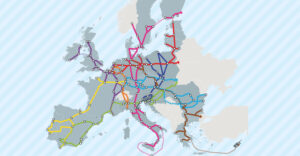
Funding of €200 billion is expected to be directed toward infrastructure projects across the EU by 2030 to meet the demands of military mobility—the rapid and seamless movement of troops, equipment, and supplies within and beyond the EU. These infrastructures, deeply linked with the Trans-European Transport Network (TEN-T), will serve military purposes while remaining dual-use, mainly benefitting civilian needs.
Military mobility—outlined in the EU’s White Paper on Defense—became a more pressing priority following the war in Ukraine. Already, €1.7 billion has been allocated to 95 projects in 21 EU countries. NATO has now joined in the planning, as 23 EU member states are also part of the Alliance. Representing the EU in discussions with NATO is Greek EU Commissioner Apostolos Tzitzikostas, who oversees transport and tourism portfolios.
A vital network
“The Trans-European Transport Network is not just essential for connecting people and businesses—it is crucial for defense, security, and Europe’s military readiness,” Tzitzikostas recently told Greek journalists in Brussels. He explained:
“The action plan, running through 2026, ensures our transport infrastructure can support the weight and scale of military movement, including fuel supply logistics.”
As part of this planning, key segments of military significance within the TEN-T network are being prioritized for upgrades. Together with NATO, four military mobility corridors have been defined, along which 500 dual-use infrastructure hotspots have been identified.
In Greece, such hotspots are reported to be located in Evros and Lemnos. However, for security reasons, the full list and exact locations of the four corridors remain undisclosed. The list of 500 points was compiled with the help of EU member states’ Defense and Transport ministries, following consultations with NATO.
What kinds of projects?
The projects planned in these 500 strategic points are dual-use infrastructure developments—either the creation of new structures or the upgrade of existing ones. Examples include strengthening road and railway bridges, expanding port facilities, and widening tunnels.
“We are still far from a well-connected, resilient dual-use transport network that meets both civilian and military needs,” said Tzitzikostas. “Future investments must be more targeted and significantly increased.”
He continued:
“Given the recent geopolitical shifts, we must intensify our efforts in prevention and defense. The White Paper on the Future of European Defense, along with the funding pillar ReArm Europe Plan/Readiness 2030, lays out our new approach to EU defense and investment. It stresses the importance of military mobility. These dual-use projects will benefit not just military logistics but all European citizens. We’re investing in roads, railways, and ports—and to realize these projects, we urgently need to boost funding for military mobility under the current and next Multiannual Financial Framework.”
Dual-purpose design
All transport infrastructure along the four military corridors is designed to serve both civilian and military needs simultaneously. For instance, as stated in the White Paper, railways must prioritize access to armed forces during times of crisis.
A detailed budget and full project plan are expected to be announced by summer or, at the latest, September. Funding will come from a mix of EU, national, and private sector sources, since these infrastructures will predominantly be used by civilians.
It’s worth noting that these military mobility projects are meant to complement the broader TEN-T program, already underway across the EU. By 2030, the core network (roads, railways, airports, ports) is expected to be completed, and by 2040, smaller towns will also be connected.
The estimated cost to complete both the core and extended TEN-T network by 2040 is around €850 billion. The impact on transport will be substantial. For example, the completion of the Lyon–Turin tunnel will cut travel time by two hours. The Baltic–Aegean corridor is also part of this program.
Ask me anything
Explore related questions