





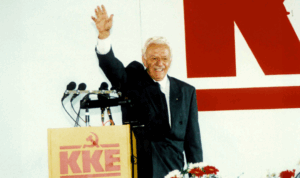
On April 23, 27 years have passed since the death of Konstantinos Karamanlis, a man who linked his name with the political scene of our country in the second half of the 20th century. He served as Prime Minister for 14 years (1955–1963 and 1974–1980) and as President of the Republic for 10 years (1980–1985 and 1990–1995). His first eight-year tenure as Prime Minister, despite its positive aspects, also had many dishonorable moments for him. The so-called “elections of violence and fraud” of 1961, the paramilitary state that reached the point of assassinating Grigoris Lambrakis on May 22, 1963, as well as the Zurich-London Agreements on the Cyprus issue, the “dowry” of Princess Sofia, and the increase in funding to the palace were some of these. His defeat by George Papandreou in the November 3, 1963 elections and the impending heavier defeat in the upcoming elections, as the Center Union, with 138 deputies, had formed a minority government with the support of EDA, which held 28 seats, led him to flee to Paris on December 9, 1963, after appointing Panagiotis Kanellopoulos as his successor in the ERE party. He remained in Paris until the night of July 23, 1974, when he departed for Athens on a plane provided by his personal friend, Valéry Giscard d’Estaing, the then President of France. On the early morning of July 24, 1974, Karamanlis was sworn in as Prime Minister of a National Unity Government, which had as its immediate priority the Cyprus issue and then had to focus on the restoration of democratic institutions in Greece.
The Communist Parties in Europe in the 1970s
Meanwhile, in Europe, apart from the presence of the USSR and the countries of the Eastern Bloc, the communist parties in the major Western European states were particularly strong. In France, the PCF, led by Georges Marchais, had a significant percentage, around 20%, among voters since 1970, due to the illness of Waldeck Rochet, and formally since 1972. In Italy, the PCI had been particularly strong since the early 1960s. In fact, in the 1976 elections, it gathered an impressive 34.6% under the leadership of Enrico Berlinguer. Finally, in Spain, the PCS, led by Santiago Carrillo, had been banned by Franco’s dictatorship. After Franco’s death (1975), Carrillo, who had been exiled in France since 1948 and had been the General Secretary of the PCS since 1960, secretly returned to Spain. Shortly thereafter, he was arrested but was soon released. Together with Marchais and Berlinguer, he started the Eurocommunist movement in 1977. That same year, the PCS was legalized. Communist parties existed in other Western European countries as well, but they were not particularly strong.
The KKE in Illegality
With the law of Themistoklis Sophoulis, which came into effect on December 27, 1947, the KKE and the EAM were driven into illegality, as this law mandated their dissolution and punishment, including the death penalty for anyone spreading their ideas. After the defeat of the Democratic Army of Greece (DSE) in the Civil War, at least 100,000 people left Greece for the USSR and other countries of the former Eastern Bloc. The headquarters of the KKE was moved to Bucharest. In 1951, KKE officials, together with members of other left-wing parties, founded the EDA (Unified Democratic Left), which was led by socialist Ioannis Pasalidis. EDA had significant appeal among voters. A key moment for it was undoubtedly the May 11, 1958 elections, when it secured 24.42%, finishing second behind the ERE party of Konstantinos Karamanlis, electing 79 MPs. It was the first time in Greece that a left-wing party became the official opposition. Meanwhile, developments in the illegal KKE were swift. In 1956, three years after Stalin’s death, under Soviet intervention, N. Zachariadis was removed from the position of General Secretary of the KKE, and in 1957, he was expelled from the party. After a brief transitional period with Apostolos Grozos as General Secretary, the post was taken over by Kostas Koligiannis, who served until 1972, when he was succeeded by Harilaos Florakis. A year later, in 1973, Nikos Zachariadis committed suicide in Surgut, Siberia, where he had been exiled since 1962. A new crisis broke out in the KKE with the Warsaw Pact invasion of Czechoslovakia in 1968. The party’s headquarters were moved to Budapest, and it split into two factions: one pro-Soviet and one pro-European, which took the name KKE Interior. During the dictatorship of the colonels, KKE members were imprisoned, tortured, and exiled.
How Konstantinos Karamanlis Became Prime Minister
As we mentioned earlier, Konstantinos Karamanlis was sworn in as Prime Minister on the morning of July 24, 1974, and formed a National Unity Government. For those who are not familiar with the details, the critical meeting to decide who would lead this government, under very difficult circumstances, took place on July 23, 1974, with the participation of both political and military figures. The main candidate for the position of Prime Minister was Panagiotis Kanellopoulos, who had been overthrown by the coup plotters on April 21, 1967. The Center Union, with its potential leader George Mavros, would also play a key role in the government.
Evangelos Averoff-Tsotsis, a close friend and collaborator of Konstantinos Karamanlis, proposed him for the prime ministership. However, none of the participants accepted this proposal. Karamanlis had been absent in Paris for 11 years, communications had been disrupted, and there were doubts about how well a strong personality like Karamanlis could fulfill the responsibilities of a National Unity Government. The decision to appoint Panagiotis Kanellopoulos as Prime Minister had already been made. The “President of the Republic,” Phaydon Gkizikis, was present at the meeting, but the only thing missing was the Archbishop, the blessed Seraphim, for the swearing-in ceremony. At that crucial moment, however, both Kanellopoulos and Mavros stated that they needed to consult further and left the meeting. Was it indecision? Fear of responsibility? Or perhaps knowledge of other matters that never came to light? Thus, Averoff, who had remained at the meeting, feigned illness and once again proposed Karamanlis.
However, Karamanlis seemed to have had no expectation of any invitation! With the French presidential plane provided to him by his friend Valéry Giscard d’Estaing, Karamanlis arrived at Elliniko at 2:05 a.m. on July 24, 1974, and by 4:00 a.m., he was sworn in as Prime Minister by Archbishop Seraphim. The National Unity Government he formed (better known from the same-named governments of the past, such as that of 1944 under George Papandreou) was composed of both old and new members of the ERE (which later became the New Democracy), members of the Center Union, and representatives of the New Forces—young resistance fighters who had distinguished themselves in the struggle against the junta.
One of the first actions taken by the new government was the closure of the Gyaros concentration camp, the release of political prisoners, the amnesty for political offenses, and the restoration of Greek citizenship to those whose citizenship had been revoked by the dictatorial regime. There were also purges of junta sympathizers from the army, efforts to prevent a new coup on August 11, 1974, and the “Attila 2” invasion, which were the major events up until September 1974. For the unsuccessful handling of “Attila 2,” a separate article has been written. What we would like to comment on today is the unacceptable indecisiveness of Kanellopoulos and Mavros at a time when the situation was critical, as aptly noted by Evangelis Chatzivasileiou.
It is in moments like these that leaders either prove themselves or reveal their weaknesses. It is important to note that Andreas Papandreou, leader of the Panhellenic Liberation Movement (PAK), did not participate in the National Unity Government, calling it, “a change of NATO’s guard.” He returned to Greece later, as did the communists who were operating illegally at the time.
The Legalization of the Communist Party (KKE)
After his long stay in Paris and the political changes that had taken place in the meantime, Konstantinos Karamanlis realized that the continued illegality of the KKE no longer made sense. Thus, with the decree-law 59/1974, signed by Karamanlis himself, the Deputy Prime Minister George Mavros, and the entire Cabinet, the formation of political parties was freely allowed, as well as the reactivation of those parties that had been dissolved in the past or whose activity had been suspended.
The decree-law 59/1974, dated September 23, 1974, is reproduced at the end of the article in its entirety. As you can see, it was also signed by the President of the Republic, Phaydon Gkizikis. This is not an error. Gkizikis, who became President of the Republic after Ioannidis appointed him on November 25, 1973, although he submitted his resignation to Karamanlis, remained in office at his insistence until December 18, 1974. He was then replaced by Michail Stasinopoulos, who temporarily took office (elected with 206 votes) until Konstantinos Tsatsos was elected to the post on June 20, 1975.
Referring to Decree-Law 59/1974, Professor Spyridon Vlachopoulos, a Law School professor at the National and Kapodistrian University of Athens (EKPA), states that the decree-law is one of the most significant moments in the post-junta period. This is because it legalized the Communist Party of Greece (KKE), including both of its factions, as well as all political parties in general.
This event becomes even more significant when we consider that it was a decree issued by the government of Konstantinos Karamanlis, representing the so-called “bourgeois” political parties of the country. At that time, the Left had no opportunity to act on its own, and this move marked a substantial shift in the political landscape of Greece. The decision to legalize the KKE and other political entities after years of repression was a crucial step in the restoration of democratic governance following the fall of the junta.
Continuing his analysis, Professor Spyridon Vlachopoulos argues that the legalization and reactivation of all political parties, as laid out in Decree-Law 59/1974, restored one of the fundamental conditions for the functioning of Greece’s parliamentary democracy, which is inconceivable without political parties. He further notes that this decision also marked the end of the “second national division,” as it officially legalized the political parties of the Left.
Moreover, Vlachopoulos emphasizes that Decree-Law 59/1974 also put an end to the long-standing practice of persecuting political opponents, a practice that had marred Greece’s political history since the “protective” law of Alexandros Papannastasiou and the “idionymo” law of Eleftherios Venizelos, through to the legislation during and after the Civil War. The decree, as Vlachopoulos highlights, serves as a reminder of how major reforms in Greece’s constitutional and political history should be carried out—calmly, with few words, and with respect for political opponents.
Article 1, Paragraph 2 of Decree-Law 59/1974
Vlachopoulos also references Paragraph 2 of Article 1 of Decree-Law 59/1974, which required that the leader or governing committee of each party submit a declaration to the Supreme Court Prosecutor before undertaking any activity. This declaration affirmed that the party’s principles were opposed to any action aimed at seizing power or overthrowing the democratic regime. Despite this requirement, the EKKE (Political Committee of Workers’ Struggle) participated in the elections of November 17, 1974, without submitting such a declaration. Similarly, in the 1994 European Parliament elections, three political parties, including “Uranio Toxo,” did not submit the required declaration. Initially, these parties were excluded from the elections, but after appealing, the Supreme Court accepted their appeals and allowed their candidates to stand.
The KKE’s View on Its Legalization
On the other hand, the KKE (Communist Party of Greece) believed that its legalization was not a result of the generosity of the bourgeoisie but rather because it had been a long-standing demand of the people. In his speech at the 10th Congress of the KKE, held under conditions of legality, Haris Florakis emphasized: “The legalization of the KKE was not only a victory for the working class but also a triumph for the democratic movement and for the democratic life of the country in general.” He added, “The second lesson from these years is that the KKE cannot be erased because the oligarchy of money and imperialism wants it so. Despite the severe persecution of its members, the KKE has continued to exist and act unbroken. This is not due to any coincidence or whim of history. Its existence is an historical necessity.”
The Return of Legal Communist Publications
From August 8, 1974, the newspaper Nea Ellada, which expressed the views of the KKE, began circulation for a few months. The first issue of the newly-legal Rizospastis (the official KKE newspaper) was published on September 25, 1974.
This marked a pivotal moment in Greece’s political history, symbolizing the end of an era of repression and the start of a new chapter in which democratic principles were restored and the political landscape of the country was redefined.
Epilogue
If our opinion matters, the decision of Mr. Karamanlis to legalize the KKE was entirely correct. It is likely that the late politician already had the European path of the country in mind, with its accession to the then EEC. Perhaps this also played a role in his decision. From that point on, the ultimate judge is the people. But why is it that, despite the difficult conditions often experienced by the Greek people, the KKE cannot become, at least, the second largest party? This is something that should concern its leadership. It cannot always be the fault of others… At some point, they themselves make mistakes too…
We conclude with what is written in the “History of the Greek Nation”, Vol. 17, Athens Publishing, regarding the legalization of the KKE: “The legalization of the KKE was a crucial step not only for the full restoration of political normalcy, but also for ensuring a climate of national unity. At the same time, it demonstrated the decision of Karamanlis personally, as well as the entire political world, to bring about a broad change without the constraints of the unfortunate legacy of the Civil War. Thus, the legalization of the KKE – in addition to being a measure that allowed the full functioning of the democratic system without exclusions – also became a deeply symbolic initiative for the will of the Greek political world to definitively turn the page on the political history of the country.”
Ask me anything
Explore related questions




