





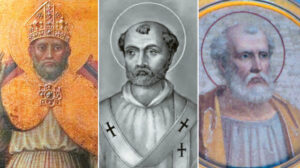
“Habemus… patriot,” once said the Greeks after the election of a Pope! After the funeral of Pope Francis, who, notably, spoke Greek, the Vatican is searching for the new Pope. Few remember the Greek presence in the papal throne. Greeks, especially before the Schism, represent one of the many facets of the long-standing history of the papal institution, carrying the… necessary mystery, since only three Popes of Greek descent have been historically confirmed. There are three others with possible but disputed Greek origins, and at least ten more believed to have some ties to Greece.
According to an earlier record by the Archdeacon of the Roman Catholic Archdiocese of Athens, Nikiforos Vidalis, among the 264 who have served from the time of the Apostle Peter to today, there are 12 Popes of Greek origin: Anacletus, Evaristus, Telesphorus, Hyginus, Liberius, Anterus, Sixtus II, Eusebius, Zozimus, Theodorus I, Agathon, and John VI. Additionally, John VI and Zacchaeus, both from Calabria, complete the list.
In the early centuries of Christianity, the Church of Rome was not isolated from the Greek-speaking East; rather, it was closely connected, and many of its early leaders were from Greece or Hellenized regions of the empire. Greek was widely used as the liturgical and theological language—many early church decisions and writings of the Church Fathers were composed in the language of Homer and Plato. In this context, the rise of Greeks to the papal throne was not a historical anomaly but a natural development. Although today the Papal Church is collectively associated with Italy and the Latin world, its early steps took place in a broader cultural environment where Greek language, education, and theology played a leading role. The Greeks who sat on the papal throne left their mark, shaping the Church as we know it today. But who are the three confirmed Greek Popes?
With Greek DNA on the Vatican throne — Were there 3, 6, or 16 Greek Popes?
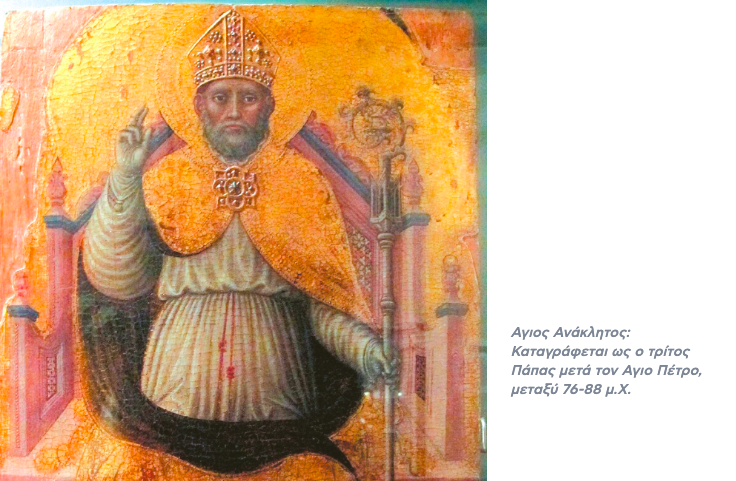
Saint Anacletus: Recorded as the third Pope after Saint Peter, serving between 76-88 AD.
Anacletus (or Cletus II)
The first of the three Popes explicitly of Greek origin is Saint Anacletus, whose papacy is dated between 76-88 AD. His story is both impressive and mysterious, as he is listed as the third Pope after Saint Peter. Some sources dispute whether he is the same as Cletus II, while others consider him a separate person. Despite uncertainties, tradition suggests he may have come from Athens or Corinth, supporting his Greek identity. Some historical accounts even describe him as the son of Athenian philosopher.
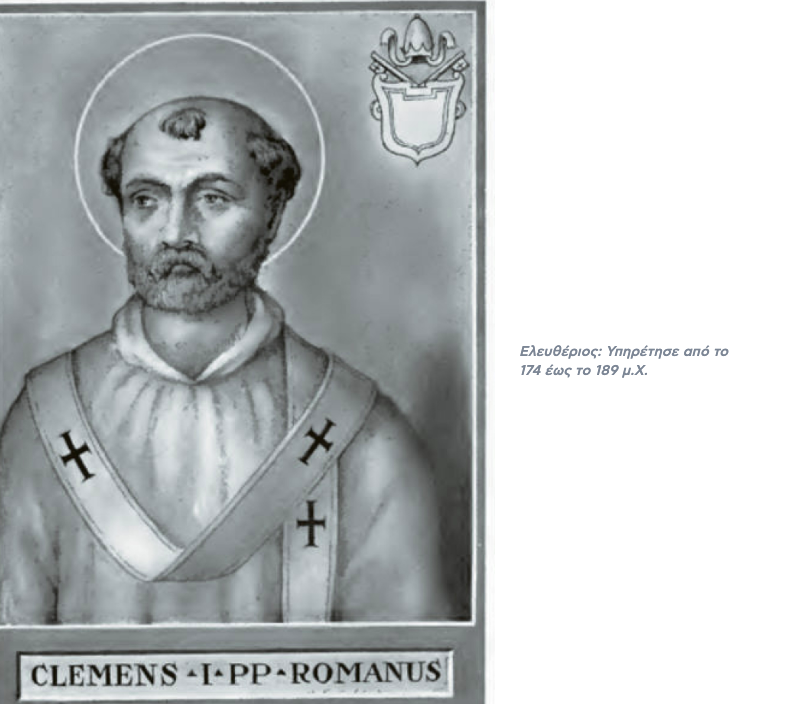
Eleutherius
The second Greek Pope, Eleutherius, served between 174-189 AD. Born in Epirus, an ancient Greek colony in modern-day Albania, he was among the early Popes who helped shape the Church’s official theological line. He was a staunch supporter of orthodoxy, condemning deviations, and strengthening Rome’s role as a theological center. Generally moderate, he showed tolerance toward non-Jewish Christians and contributed to the Church’s move toward universality.
With Greek DNA on the Vatican throne — Were there 3, 6, or 16 Greek Popes?
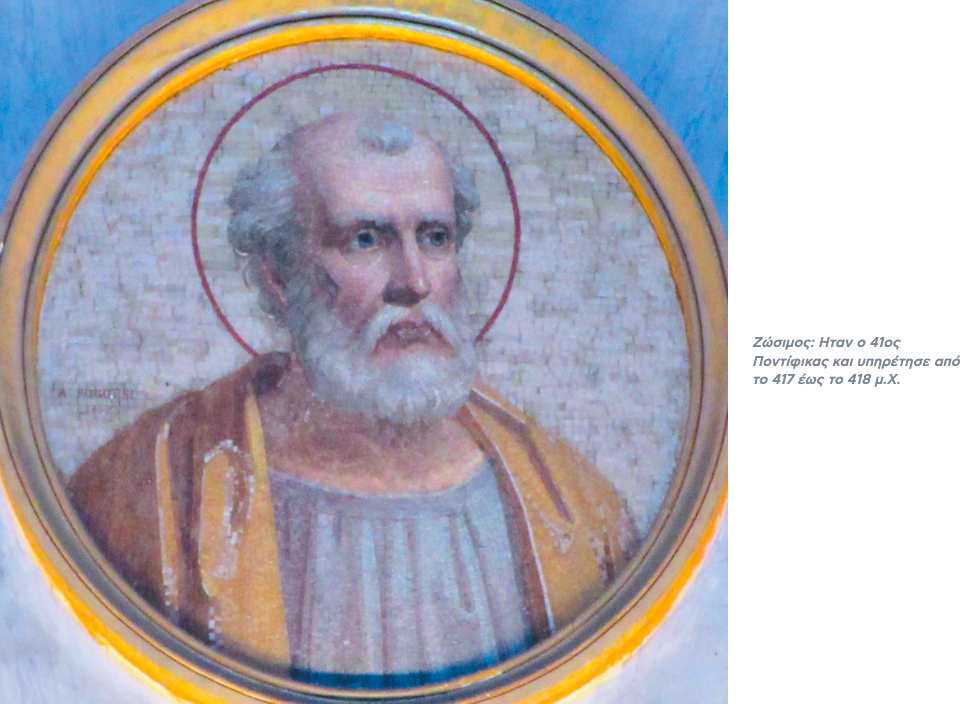
Zozimus: He was the 41st Pope, serving from 417 to 418 AD.
Zozimus
Pope Zozimus, also known as Zozimus the Cappadocian, was the 41st Pope and had a brief papacy from 417 to 418 AD. He was born in Calabria, Italy, but his origins are believed to be Greek, likely from Cappadocia. He played a significant role in theological debates of his time, especially against Pelagianism, a heresy challenging the doctrine of original sin.
The three with… perhaps
The influence of Greek thought and origin among the early centuries of the papal institution was broader than often believed. Beyond the three historically documented Greek Popes, there are others for whom there are indications or hypotheses of Greek descent, though historical evidence remains limited.
More plausible but less certain are the claims for Popes with potential Greek origins, such as:
- Theodore I (642–649): Son of a Greek bishop from Jerusalem. Although often considered a Roman Pope, his background from the East and education in a Greek-speaking environment support his Greek identity.
- John VΙ (701–705): Some sources suggest he was of Greek origin from Syria, a region with strong Helleno-Orthodox characteristics at the time. He was the 85th Pope and managed diplomatic affairs, even facing unrest in Rome.
- John VII (705–707): Born in Rome but descended from a Greek family from the Byzantine East. His education was heavily influenced by Greek theology and administration. Before becoming Pope, he dedicated an epitaph to his parents, which was preserved in the Church of Saint Anastasia until the 15th century.
His interest in art is also evidenced by the frescoes he painted in numerous churches. Sources mention he consecrated 18 bishops during his papacy and died just two years after ascending the throne.
Ask me anything
Explore related questions




