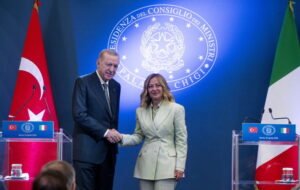
Turkish “touch” in the joint statement after Meloni – Erdogan meeting in Rome
The text portrays Turkey’s image in a positive light, legitimizing its ambitions for an active role in European Defense, and emphasizing its role in “stability in the Middle East and Eastern Mediterranean.” This joint declaration was issued after the 4th Turkey-Italy Intergovernmental Conference held Tuesday in Rome, chaired by Erdogan and Meloni.
It is evident from the document, as well as Erdogan’s statements to journalists during the return flight to Ankara, that Turkey has invested in defense cooperation with Italy (through Baykar-Leonardo collaboration and the purchase of Piaggio Aerospace) to position itself as the “siege engine” for unconditional entry into European defense and the large €150 + €650 billion rearmament package for Europe.
The lengthy text, dominated by the will of both countries to enhance economic and defense cooperation, completely omits references to human rights and the Rule of Law — fundamental obligations of those seeking rapprochement with the EU — and fully adopts Turkey’s positions regarding the delimitation of maritime zones in the Eastern Mediterranean.
The Italian side unconditionally expresses support for Turkey’s EU accession path, with no mention of the obligation to respect fundamental European principles or the need to resolve the Cyprus issue.
Specifically, it states:
“The parties agreed to coordinate their efforts to achieve concrete results in key areas such as accelerating Turkey-EU dialogue on visa liberalization, renewing cooperation on migration, and strengthening counter-terrorism efforts.
They also emphasized the urgent need to update the EU-Turkey Customs Union, which could potentially benefit both sides.”
Turkish “touch” in the joint statement after Meloni – Erdogan meeting in Rome
Of course, there is no reference to Turkey’s primary obligation regarding the Customs Union and the implementation of the Protocol towards the Republic of Cyprus.
Rome also fully supports strengthening the NATO-EU strategic partnership, which faces issues partly because Turkey does not recognize the Republic of Cyprus, and highlights “the importance of the possible full participation of non-EU allies in EU defense efforts to bolster this partnership.”
The relevant chapter points out the successful completion of joint projects between Turkish and Italian defense companies over recent years and the political will to promote this collaboration. In this context, they decided to “organize the 14th Defense Industry Cooperation Meeting in 2025 and hold seven high-level mutual visits and technical meetings to elevate bilateral defense relations as a model for allies.”
Notably, there is mention of the Eastern Mediterranean, where both countries underline the “importance of resolving maritime border disputes based on international law and agreements with solutions grounded in the principle of equality,” without any reference to the Law of the Sea, which is part of the EU acquis.
Furthermore, the joint declaration adopts Turkey’s proposal for an International Conference in the Eastern Mediterranean, stating that “the organization of a Multilateral Eastern Mediterranean Conference, provided the necessary conditions are met, will serve as an opportunity to create an inclusive cooperation mechanism in the region.”
Turkish “touch” in the joint statement after Meloni – Erdogan meeting in Rome
Turkey insists that Greece and other regional countries are attempting to “exclude” it from cooperation forums such as the Eastern Mediterranean Gas Forum (EMGF).
Despite references in the joint declaration to unresolved issues in the Middle East and the Mediterranean (Palestinian issue, Syria, Libya), there is no mention of the Cyprus problem or the threat of violence, which Italy, following EU policy, should have addressed.
It also surprises that the declaration mentions cooperation between Italy and Turkey to promote peace in third countries: “They also underscored the importance of collaboration to promote peace and stability in third countries and regions, based on respect for sovereignty, independence, and territorial integrity, fostering good neighborly relations, and enhancing economic development and regional connectivity.”
Additionally, Italy and Turkey agreed to cooperate on joint projects in oil and natural gas in third countries, which would benefit Turkey’s state oil company, TPAO.
Without compromising the relationship of a major European country like Italy with Turkey, the manner in which Rome and Meloni seek to become Turkey’s “voice” within the EU — legitimizing Ankara’s ambitions and visions — is problematic. It appears to bypass and ignore key principles of EU acquis and binding EU decisions.
Ask me anything
Explore related questions