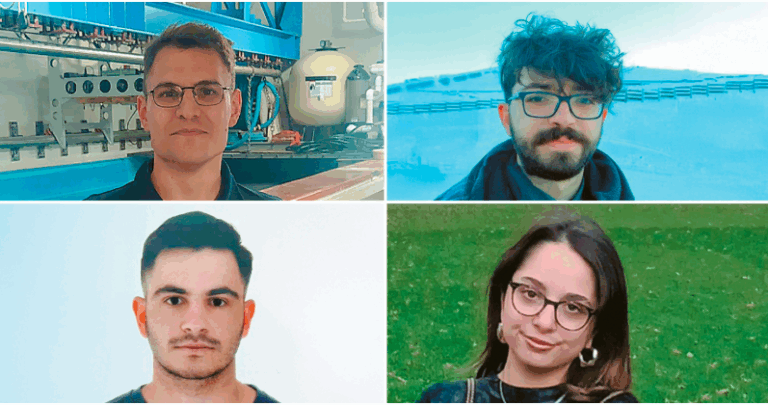
Four Greek undergraduates, each with different fields of study and career paths, recently had the chance to work in the research labs of MIT, Yale, and Harvard—all thanks to scholarships from the Greek Institute of Advanced Studies (HIAS).
When they returned home, they all agreed that Greek universities are just as capable in terms of knowledge and resources. However, they were all impressed by the organization, the facilities, and especially the opportunities that American universities offer for research participation.
For some, this experience pointed to their next steps in academia. For most, though, it reinforced their decision to seek professional opportunities either immediately or after some years in Greece.
Spyridoula Giannopoulou, a student at Panteion University, along with Marios Rizos and Yannis Papakalodoukasis from the National Technical University of Athens (NTUA), and Christodoulos Komiotis from the Medical School of Alexandroupolis, all earned the Nicholas and Robert Askounis Ashford scholarship, established by HIAS.
HIAS is a non-profit organization involving university professors from the Greek diaspora and their colleagues from Greek universities. Its goal is to create educational bridges and foster collaborations within the scientific community both in Greece and abroad.
A key part of this effort was the contribution of Eythimis Kaxira, a Physics professor at Harvard, and Daphne Manousaki, an Associate Professor in the Mathematics Department at the University of Crete.
Andreas Bountouvis, a professor at NTUA and former rector, emphasizes: “The students are thrilled with their lab experiences in the US. They’ve seen firsthand the importance of collaboration between Greece’s scientific talent and the Greek diaspora.”
He adds that despite the challenges, this cooperation has a lot of potential, especially when supported by a broader national vision. It can help counteract brain drain, provided it’s backed by a comprehensive plan. HIAS is working systematically toward this.
Yannis Papakalodoukasis: Master’s at MIT and a career at home
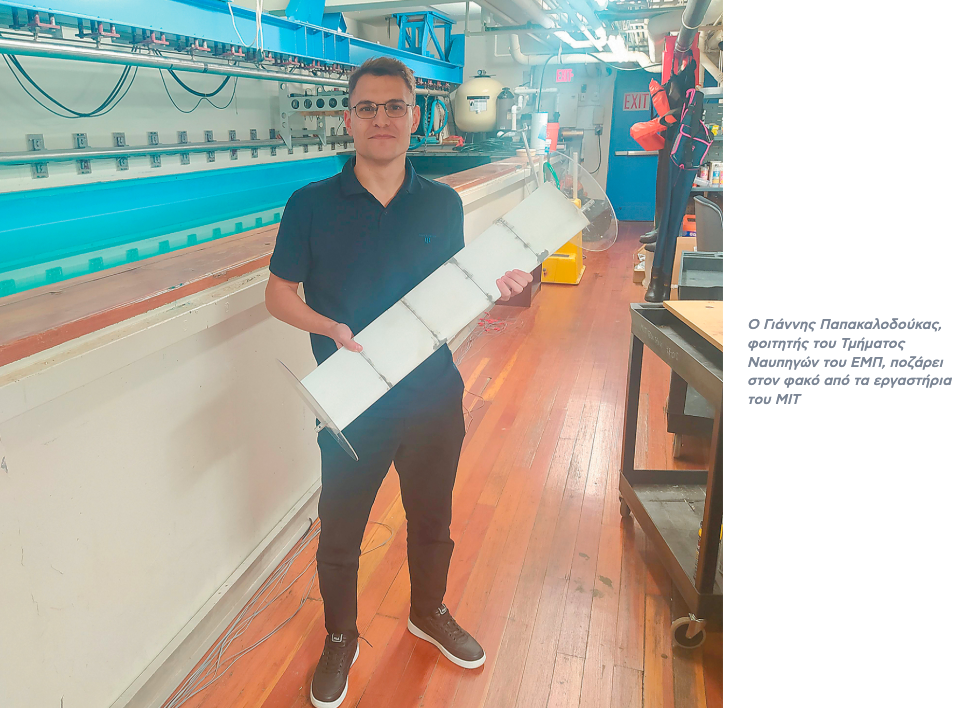
Yannis, who graduated from the NTUA Naval Architecture and Marine Engineering Department just a month ago, is already packing his bags for Boston. He was accepted into a master’s program at MIT, where he will spend the next five years.
His HIAS scholarship gave him the chance to participate in research at MIT’s lab, led by Professor Michalis Triantafyllou. He chose Naval Architecture because he hails from Symi, a place known for its maritime tradition.
Yannis is the second of four brothers, supported mainly by his father’s military income. During his studies, he stayed in student dorms, and his graduate studies will be funded by the paid research work he’s doing at MIT.
“The scholarship really boosted my confidence,” he says. “My education at NTUA was strong enough that I didn’t feel I was behind the US students academically or technically. But the facilities and the environment at MIT are on another level—they inspire research and participation.”
He sees his time in the US as temporary, planning to spend five years at MIT. He wants to gain experience there, perhaps for a few more years, then return to Greece either as a university professor or as part of an innovative research team in the shipping industry.
Yannis was always eager to seize every opportunity at NTUA. For example, he was part of Oceanos NTUA, which last year represented Greece in the Monaco Energy Boat Challenge 2024 and won first place and the Championship prize. They built a fully electric, trimaran-type boat, designing energy storage, propulsion, and control systems.
Spyridoula Giannopoulou: An academic career as a geopolitics expert abroad
Spyridoula is currently in her fourth year at Panteion University, studying International, European, and Regional Studies. She grew up in Ioannina and moved to Athens when she got into university.
She says that her three months working in the Technology and Policy Lab at MIT, under Professor Nicholas Asford, changed her both as a student and as a person. It shifted her perspective on many things, beyond just academics.
During her stay, she experienced the multicultural atmosphere of Massachusetts, especially during the US election campaign, which was a valuable lesson for someone planning to pursue a PhD in the US.
Coming from a middle-class Greek family—she says she never lacked anything but also never had extra—she describes life at MIT as organized and peaceful. She explains how different it was from her hometown: “In Athens, daily life is full of obstacles, which makes you more flexible and resourceful. In Boston, I found calm and order. The MIT building had a big lounge with sofas, whiteboards, screens, even a kitchen. It was a space designed for work and creativity, without graffiti or broken toilets.”
She never felt she was at a disadvantage compared to her American or European peers. Professors there are renowned worldwide and offer opportunities for ambitious students. But the scholarship made her realize her next goals: finishing her degree in three months, then doing a master’s and a PhD.
Looking ahead, she sees herself either in academia as a professor of International Relations or working at an international organization outside Greece. “There are no opportunities for geopolitics experts in Greece,” she notes. Her next stop is the Greek embassy in Sofia, where she will start an Erasmus Plus internship in October.
Marios Rizos: “High standards at NTUA, but Yale is another level…”
Marios, 23, received one of the four HIAS scholarships. He spent nearly three months at Yale in the lab of Professor Manolis Zabetakis, working with PhD student Katerina Mamalaki. His focus was on Theoretical Computer Science, specifically Learning Theory.
He says: “NTUA students definitely have a high level, and there’s a strong community of supportive students.” Coming from Metsovo, he moved to Athens from Ioannina, and he felt the transition was tough at first. But once he arrived at NTUA, he saw the opportunities there.
At Yale, the difference was clear. “Students can access huge resources—research funds, labs, infrastructure—that we simply don’t have in Greece,” he explains. “Research there is more advanced, and the facilities are inspiring.”
Marios plans to pursue an academic career focused on research. The Yale experience strengthened his decision to stay on this path, even after returning to Greece.
Christodoulos Komiotis: “Clinical Medicine Without Research? Not Possible”
Christodoulos, a fourth-year medical student from Alexandroupolis, is focused on clinical medicine, but after spending about two and a half months at Harvard’s Smirnakis Lab, he realized research is essential, even in medicine.
He earned the HIAS scholarship and worked at Brigham and Women’s Hospital under Professor Stelios Smyrnakis, a neurologist specializing in neuroscience. He was involved in a project on epilepsy.
“When I arrived, I didn’t know what I could do,” he recalls. “Everything was new, and I had no prior research experience. But I was impressed by the facilities from the start.”
He notes that at Democritus University, he had opportunities, but Harvard’s infrastructure and research environment are in a different league. “For me, clinical practice without research isn’t enough anymore. I want to combine both,” he says.
His goal is to go back, get more experience, and contribute to Greek medical research, especially in neuroscience.
Ask me anything
Explore related questions