





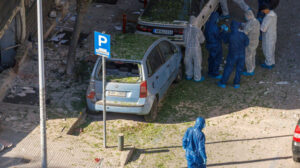
The route of the 38-year-old Georgian-born woman, who carried the bomb intending to place it but ended up being killed when it exploded in her hands on Saturday morning, was quickly traced by Northern Greece’s Organized Crime Unit. Investigators went door-to-door and located the apartment on Olympiou Diamanti Street, which she had rented and used as a bomb-making lab. Now, authorities are trying to interpret a number of puzzling actions that complicate any theory regarding the intended target of the bombing—an attack that resulted in the bomber’s death and significant damage in a central Thessaloniki neighborhood.
Timeline Before the Explosion
According to reports, in the final stage of her movements, the woman was seen walking along Agiou Dimitriou Street, approaching from Iasonidou Street. She was holding the backpack containing the bomb as she passed two fully operational ATMs. She descended some stairs, turned the corner onto Platonos Street, and left the bag on the sidewalk before walking away in the opposite direction—back up the stairs and toward Iasonidou Street.
Ten minutes later, she reappeared, walked directly back to the backpack—unnoticed by anyone—and as she approached it, the device exploded. The woman was fatally injured and later died at Ippokrateio Hospital. Some reports suggest she may have been seen briefly earlier before vanishing from view again.
Unanswered Questions and Theories
Her actions raise a host of questions that remain unanswered. Authorities believe answers will only emerge if they identify and apprehend one or more accomplices who can reveal the intended target. The leading police theory is that the ATMs were the intended target, possibly with the aim of triggering an explosion to steal cash. This is plausible, given the woman’s criminal background and links to a known bank robber with anarchist leanings, who has previously been implicated in a parcel bomb plot targeting a senior judge in Thessaloniki in December of last year. That man—now imprisoned—allegedly gave instructions for building and sending the parcel bomb.
However, CCTV footage complicates this theory. It shows the woman walking by the ATMs without paying them much attention, leaving the backpack on a nearby corner—clearly out of range to affect the ATMs in the event of an explosion.
Alternative Possibility: A Misstep in Timing
There’s also a more speculative theory. She may have left the bag temporarily, intending to place it at the target once the slow-burning fuse neared detonation. Her return ten minutes later could have been to move it into position—possibly toward the ATMs—for an immediate explosion. Tragically, the device detonated in her hands before she could complete the action.
Another Possible Target and Striking Similarities
Another police hypothesis is that the target wasn’t the ATMs specifically, but the bank itself. In this scenario, the placement of the bomb aimed to cause property damage and convey an ideological message—similar to previous attacks involving incendiary devices against banks. Investigators speculate the woman returned to check on a device that had not detonated as expected, possibly under orders from a third party directing her actions.
In both theories, what’s certain is that only the bomber died—an outcome that could easily have been worse. No warning was issued, as typically happens in ideologically motivated attacks, meaning innocent bystanders could have been injured or killed. This suggests the bombers were nihilistic in their approach, indifferent to collateral damage.
Connection to the Parcel Bomb Case
This tactic resembles the parcel bomb incident targeting a Thessaloniki Court of Appeals judge. The main suspect in that case is a 37-year-old prisoner who had threatened the judge for not merging his sentences—a legal impossibility. There was little effort to hide their involvement: threats were made from the prison phone, DNA was left on the tape used to wrap the bomb, and one suspect even filmed the bomb’s packaging on his phone.
Similarly, the woman involved in Saturday’s bombing did not attempt to conceal her identity. CCTV captured her clearly, and she left her rented apartment in broad daylight carrying the bomb-filled backpack. The person who rented the short-term apartment was quickly identified, and investigators are now analyzing DNA and fingerprints found both on-site and on the explosive materials and bomb-making tools found there.
Ask me anything
Explore related questions




