





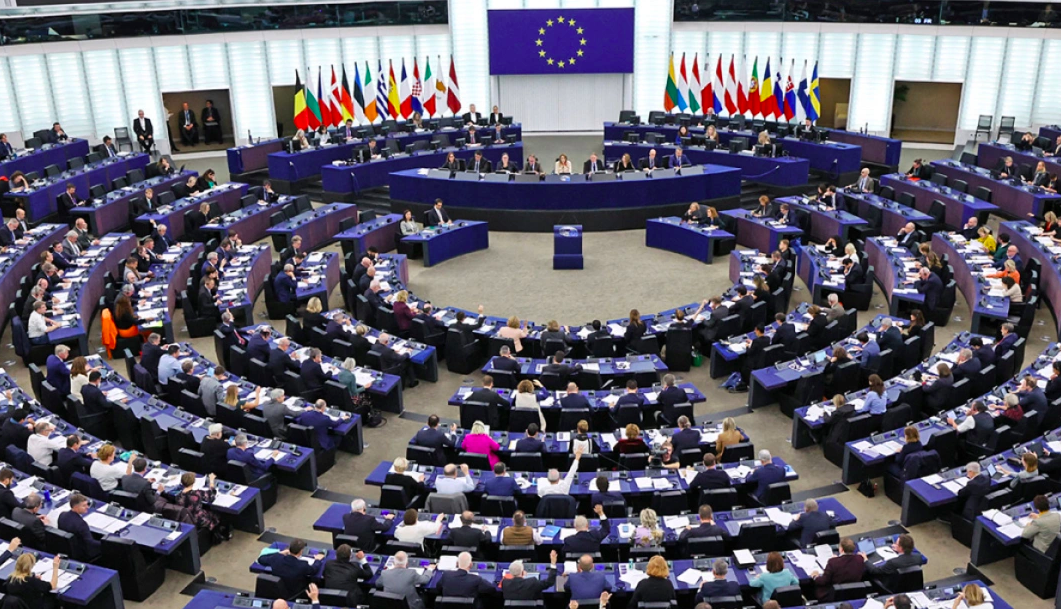
The European Parliament is demanding that Turkey’s path to EU membership remain “frozen.” The European Parliament points to a continuous decline in democratic standards in the neighboring country and condemns both the crackdown on protests over the arrest of Ekrem İmamoğlu and on May Day demonstrations, as well as Recep Tayyip Erdoğan’s visit to the occupied territories.
Turkey’s geopolitical and strategic importance cannot offset the government’s democratic backsliding – accession criteria are non-negotiable, the European Parliament states.
367 “Yes” Votes for “Frozen” Negotiations
Under current conditions, and despite the democratic and pro-European aspirations of a large part of Turkish society, Turkey’s EU accession process cannot be restarted, the European Parliament says in a report approved on Wednesday with 367 votes in favor, 74 against, and 188 abstentions.
The Turkish government has failed to address fundamental democratic shortcomings, the report notes, highlighting the growing shift within the EU towards “a different framework for the relationship, which may come at the expense of the accession process.”
The Parliament urges the Turkish government, as well as EU institutions and member states, to continue working, beyond the current frozen accession process, towards a closer, more dynamic, and strategic partnership, with a particular focus on climate action, energy security, cooperation on counter-terrorism, and regional stability.
EU Accession Criteria Are Non-Negotiable
MEPs express deep concern over the ongoing deterioration of democratic standards in Turkey and the relentless crackdown on critical voices. They condemn the harsh suppression of recent peaceful mass protests and the prosecution of hundreds of demonstrators through hasty mass trials without evidence of criminal behavior. MEPs also regret the targeting of political parties and opposition members and describe the actions against Istanbul Mayor Ekrem İmamoğlu as a politically motivated act aimed at preventing a legitimate competitor from running in the upcoming elections. They emphasize that with these actions, the Turkish authorities are pushing the country further towards a fully authoritarian model.
EU accession depends on fulfilling the Copenhagen criteria, which require stable institutions guaranteeing democracy, the rule of law, human rights, respect for and protection of minorities, good neighborly relations, respect for international law, and alignment with the EU’s common foreign and security policy. These criteria are absolute and cannot be subject to transactional strategic parameters and negotiations, and the recognition of all member states is an essential component of the accession process, the EP report states.
The Parliament continues to recognize and applaud the democratic and pro-European aspirations of the majority of Turkish society (especially among Turkey’s youth), which the EU will not abandon, emphasizing that these aspirations are a major reason to keep Turkey’s accession process alive.
Deeper Cooperation in Areas of Mutual Strategic Interest
MEPs acknowledge Turkey’s strategic and geopolitical importance, as well as its growing presence and influence in areas vital to international security, such as the Black Sea region, Ukraine, and the Middle East. Turkey is a strategic partner and NATO ally, as well as a country with which the EU maintains close relations in the areas of security, trade, economy, and migration, they add. Therefore, it is important to maintain constructive dialogue and deepen cooperation in areas of mutual strategic interest.
However, democratic backsliding and non-alignment with the EU’s common foreign and security policy are not conducive to progress, MEPs warn, also noting with concern that Turkey has requested to become a member of BRICS+, while considering the same for the Shanghai Cooperation Organisation (SCO) and showing increasing interest in an alternative framework for partnership with the EU, which is fundamentally incompatible with the accession process.
In this context, they refer to Turkey’s responsibilities in NATO and express concern about its tendency towards a “multilateral approach to promoting its interests without committing to full cooperation with any of these alliances.”
Regional Cooperation and Good Neighborly Relations
The Parliament reiterates the importance of Turkey’s cooperation in managing migration flows, calling on the Commission to ensure transparency in the allocation of funds and expressing concern about reports of serious human rights violations in EU-funded detention centers in Turkey. It also notes with concern the continuous increase in asylum applications in the Republic of Cyprus in recent years and recalls Turkey’s obligation to take all necessary relevant measures to combat irregular migration, particularly towards Greece and Cyprus, and to implement the relevant readmission agreement for Cyprus as well.
The text also reflects the Parliament’s regret over the casus belli regarding Greek territorial waters, as well as the fact that Turkey continues to violate the sovereignty of Greece and Cyprus, including through the promotion of the “Blue Homeland” doctrine. It calls on Turkey to respect the sovereign rights defined by EU and international law, including the United Nations Convention on the Law of the Sea, which is part of the EU acquis, while condemning the Turkish-Libyan memorandum.
Regarding the Cyprus issue, the Parliament calls for serious re-engagement and political will for peaceful negotiations under the auspices of the UN, while welcoming the resumption of informal talks on March 18-19, 2025, and the new package of confidence-building measures. It strongly reaffirms its view that the only solution to the Cyprus issue is a just, comprehensive, viable, and democratic settlement, within the agreed UN framework, based on a bi-communal, bi-zonal federation with a single international legal personality, single sovereignty, single citizenship, and political equality, as defined in the relevant Security Council resolutions and in accordance with international law and with the principles and values on which the Union is founded. MEPs also condemn a series of illegal and/or unilateral actions by Turkey, including in connection with the recent illegal visit of President Erdoğan to the occupied territories, the Green Line, Varosha, the rights of the Turkish Cypriot community and the enclaved Greek Cypriots, Greek Cypriot properties in the occupied territories, and the search for those missing from the invasion.
“Membership is About Democracy”
Rapporteur Nacho Sánchez Amor (Socialists, Spain) stated: “We constantly hear from the Turkish authorities about their supposed commitment to join the EU and how important it is for us to give new impetus to this process because of security and geopolitics, but they are wrong. Membership is about democracy, and the more they promote a fully authoritarian model (as recently seen with the arrest of Ekrem İmamoğlu), the further they move away from membership in the European Union.”
Ask me anything
Explore related questions




